Business Exit Plan: What Is It and How to Develop One
Business Exit Plan: What Is It and How to Develop One

Natalie Luneva
December 19, 2025



A well-thought-out business exit plan outlines how you intend to leave your business, whether through a sale, passing it down to family members, or closing it down. This strategic plan helps in reducing or liquidating your stake in the company.
A business exit plan is a roadmap to the future. It outlines how you intend to leave your business, whether through sale, transfer, or closure, ensuring a smooth transition and maximizing value.
In the United States, an estimated 73% of privately held companies plan to transition ownership within the next decade, representing a $14 trillion transfer opportunity, yet only a minority have formal strategies in place to guide their exit.
A business exit plan is a comprehensive document that details your strategy for exiting your business. Its core purpose is to ensure that your business is positioned for long-term success, even after your departure. This involves considering various factors, including your financial security and the continuity of your business operations.
Key elements of a business exit plan include: defining your exit objectives, determining the value of your business, and identifying potential successors or buyers.
Having a well-thought-out exit strategy ensures financial security and guarantees the continuity of your business, protecting your legacy and the livelihoods of your employees.
An effective exit plan helps you achieve financial security and maximize the value of your business. This involves understanding your business's worth, managing tax implications, and creating a plan that ensures you receive a fair return on your investment.
Ensuring business continuity is another aspect of an exit plan. Identify and develop future leaders or successors to ensure that your business continues to thrive even after you've exited.
A well-structured business exit plan ensures a smooth transition and protects your legacy. Proper exit planning can inform your business strategy and help improve the value and marketability of your company. With a clear plan in place, you can maximize the potential of your business and achieve your long-term goals.
One of the primary reasons for developing a business exit plan is to maximize the value of your business. This involves understanding your business's worth, identifying areas for improvement, and implementing strategies to increase its marketability. A well-planned exit strategy can help you:
When you focus on these key areas, you can significantly increase the value of your business, making it more attractive to potential buyers or successors.
A smooth transition when exiting your business involves planning for the handover of ownership, managing the change in leadership, and ensuring that the business continues to operate seamlessly. A well-planned exit strategy can help minimize disruptions and ensure continuity.
A smooth transition plan should include:
Your business is not just a financial asset; it's also a reflection of your legacy and the relationships you've built over the years. A business exit plan can help protect these aspects, as it ensures that your business continues to operate in a way that aligns with your values and goals.
When planning your exit, consider the impact on your employees. This includes:
Maintain customer continuity for the long-term success of your business. A well-planned exit strategy can help ensure that your customers remain loyal and continue to support the business under new ownership.
Key strategies for maintaining customer continuity include:
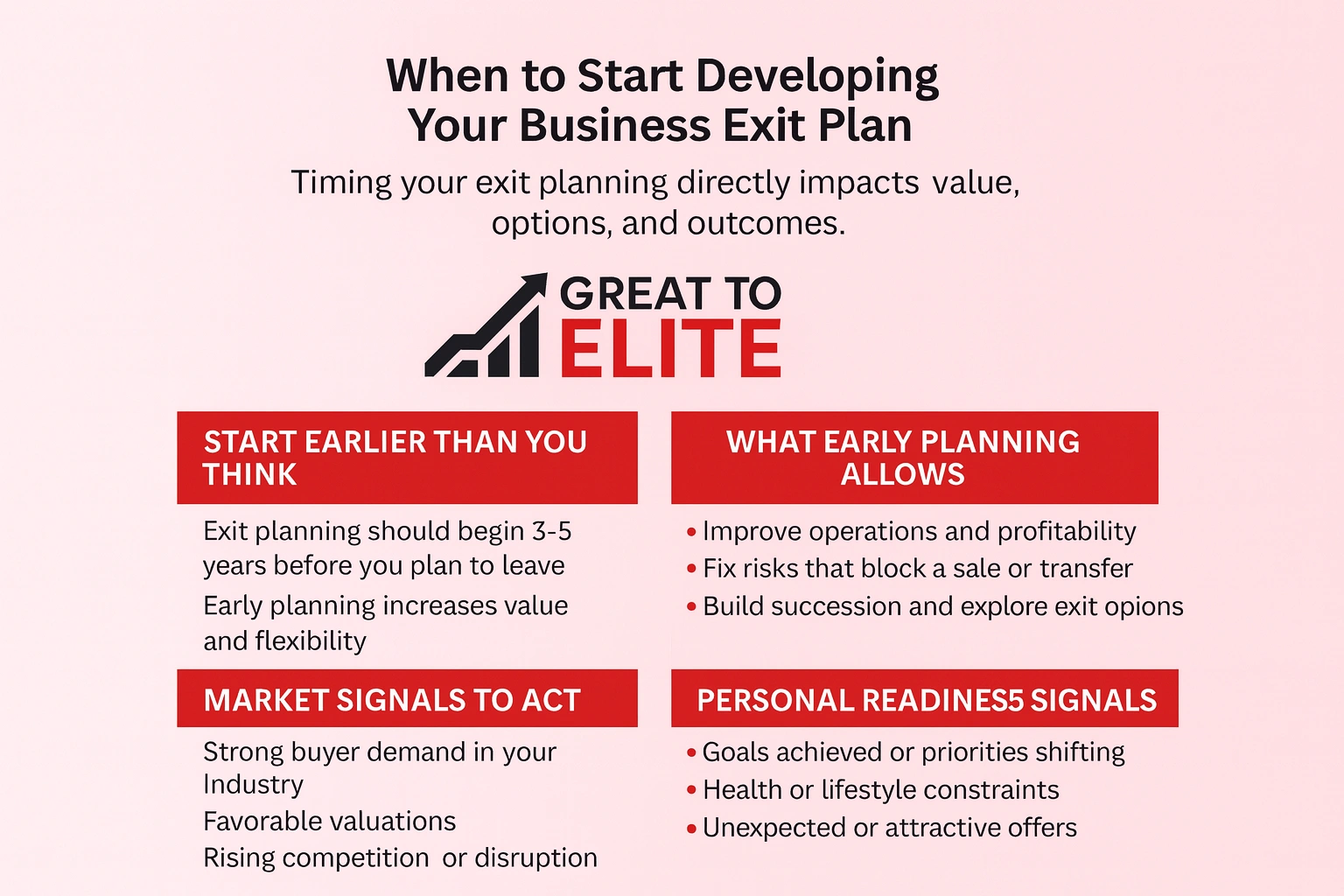
Knowing when to start your business exit plan can significantly impact its success. It's never too early to think about your exit strategy, as it can inform your business decisions and ultimately lead to a more successful outcome.
A well-timed exit plan can help you maximize your business value, ensure a smooth transition, and protect your legacy. Identify the right moment to start planning your exit.
The ideal timeline for exit planning varies depending on the type of business and the owner's goals. Generally, it's recommended to start planning your exit at least 3-5 years before you intend to leave the business. This allows sufficient time to:
Starting early gives you the flexibility to adjust your plan as needed and respond to changes in the market or your business.
Several indicators can signal that it's time to implement your exit strategy. These include:
Market conditions play a significant role in determining the right time to exit your business. Signs that it might be a good time to sell or transfer your business include:
In addition to market indicators, your personal readiness is important. Consider your exit when:
Assessing both market indicators and personal readiness factors will help you determine the optimal time to execute your exit plan.
Understanding the different types of business exit strategies can help you make informed decisions about your company's future. As a business owner, you have several options to consider, each with its unique advantages and challenges. The choice of exit strategy depends on your personal goals, financial situation, and the current market conditions.
Family succession involves transferring ownership of your business to family members, typically children or relatives. This strategy allows you to keep the business within the family and can be a smooth transition if planned properly. However, it requires careful consideration of the successor's capabilities and potential family conflicts.
A management buyout (MBO) occurs when the existing management team purchases the business from the current owner. This strategy is beneficial as the management team is already familiar with the business operations, reducing the risk of disruption. MBOs can be financed through various means, including loans and seller financing.
Strategic acquisition involves selling your business to a larger company or a competitor. This can be an attractive option as it often results in a higher sale price due to the strategic value of your business to the acquirer. Companies like Zulily have been involved in strategic acquisitions, demonstrating the potential for growth through such deals.
An Initial Public Offering (IPO) is the process of issuing stocks to the public for the first time, allowing your company to be publicly traded. An IPO can provide significant capital for growth and can be an exit strategy for early investors. However, it involves complex regulatory requirements and ongoing public company obligations.
Liquidation involves selling off all the assets of your business, typically to pay off creditors. While it's not the most glamorous exit strategy, it can be necessary if the business is no longer viable. Liquidation can be a straightforward process, but it often results in a lower return compared to other exit strategies.
Each business exit strategy has its pros and cons, and the most suitable option depends on your specific circumstances. When you understand these different strategies, you can better plan your exit and achieve your business goals.
An effective business exit plan is multifaceted, requiring careful consideration of exit objectives, business valuation, successor development, and tax implications. To ensure a successful exit, you must develop a comprehensive plan that addresses these critical components. This section will delve into the key elements that make up a robust business exit plan.
Defining your exit objectives is the foundation of a successful business exit plan. You need to clearly articulate your personal goals for the transaction, including your desired exit timeline, financial expectations, and any other critical factors that will influence your decision-making process. Establish a realistic timeline, as it allows you to prepare your business for sale, address any potential issues, and maximize its value.
A well-defined exit timeline should include milestones such as:
A critical component of your exit plan is a business valuation strategy. You need to understand the value of your business to negotiate a fair sale price or to determine the feasibility of other exit options. There are several business valuation methods, including asset-based valuation, income-based approaches, and market-based valuation.
A successor development plan ensures a smooth transition of your business. You need to identify and develop a suitable successor, whether it's a family member, existing management team, or external candidate. This plan should include training, mentoring, and gradually transferring responsibilities to the successor.
A well-executed succession planning strategy can significantly enhance the value of your business, as it demonstrates a clear line of succession and ensures continuity.
You need to consider the tax implications of your exit strategy and explore options for minimizing tax liabilities. This may involve consulting with tax professionals to identify opportunities for reducing capital gains tax, estate tax, or other tax obligations.
Some common tax minimization strategies include:
When you incorporate these key components into your business exit plan, you can ensure a successful and profitable exit from your business.
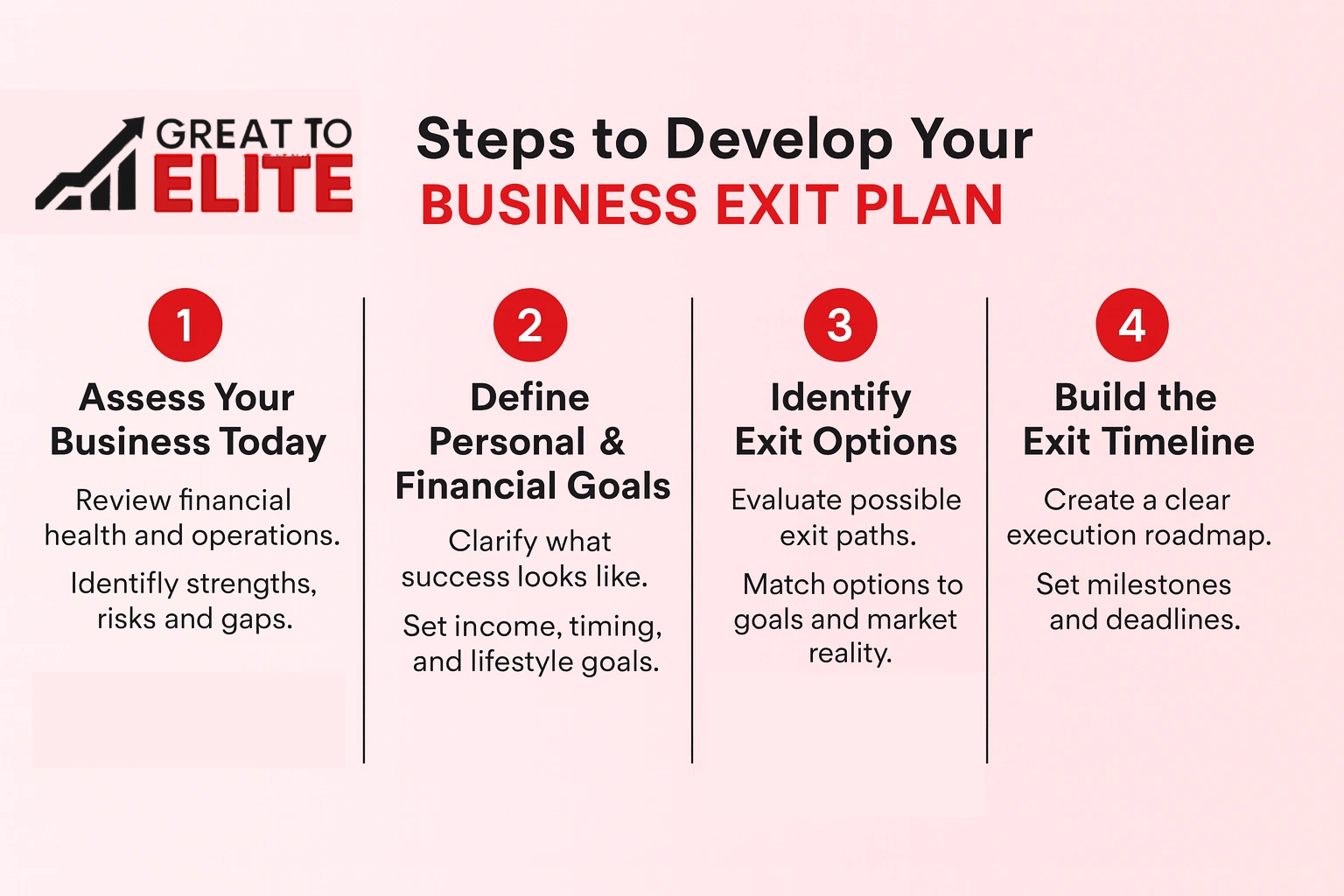
A successful business exit plan requires careful planning, starting with a thorough assessment of your current business position. This initial step lays the foundation for the entire exit strategy.
To develop an effective exit plan, you need to understand your business's current standing. This involves analyzing both financial health and operational efficiency.
Conduct a financial health analysis. This includes reviewing your business's financial statements, such as balance sheets, income statements, and cash flow statements. Key financial ratios and metrics like liquidity ratios, profitability margins, and debt-to-equity ratios will provide insights into your business's financial stability and performance.
An operational efficiency review examines your business's internal processes, systems, and infrastructure. This step helps identify areas of improvement and potential cost savings, making your business more attractive to potential buyers or successors.
Clearly defining your personal and financial goals is the next step in exit plan development. This involves determining what you want to achieve through the exit, whether it's maximizing financial return, ensuring business continuity, or fulfilling personal aspirations.
Identifying potential exit options is a pivotal part of your exit strategy. Common exit options include family succession, management buyout, strategic acquisition, initial public offering (IPO), and liquidation. Each option has its pros and cons, and the choice depends on your business's specific circumstances and your personal preferences.
Once you have identified your exit options, create a detailed implementation timeline. This timeline should outline the key milestones and deadlines for achieving your exit goals, ensuring that you stay on track and make necessary adjustments as you progress.
When planning your business exit, understand the different methods of business valuation to make informed decisions. Business valuation determines the worth of your business and influences your exit strategy. There are several approaches to valuing a business, each with its strengths and weaknesses.
Asset-based valuation involves calculating the total value of your business's assets, including tangible assets like equipment and property, and intangible assets such as patents and goodwill. This method is particularly useful for businesses with significant physical assets.
Key considerations for asset-based valuation include:
Income-based approaches value a business based on its expected future income. This can include methods like the discounted cash flow (DCF) analysis, which estimates the present value of future cash flows using a discount rate.
Key considerations for income-based approaches include:
Market-based valuation involves comparing your business to similar businesses that have been sold recently. This method relies on market data and transaction multiples to estimate the value of your business.
Key considerations for market-based valuation include:
The choice of valuation method depends on various factors, including the type of business, industry, and specific circumstances. Often, a combination of methods provides a more comprehensive picture of your business's value.
To determine the most appropriate valuation method for your business, consider:
Preparing your business for exit requires a strategic approach that enhances its financial and operational attractiveness. This involves several steps that not only improve the saleability of your business but also ensure that you achieve the best possible outcome.
Enhance your business's financial performance when preparing for an exit. This can be achieved through various strategies.
To boost profitability, consider implementing cost-reduction measures, optimizing pricing strategies, and improving operational efficiencies.
A strong balance sheet helps in attracting potential buyers. This involves managing your assets, liabilities, and equity effectively.
A competent management team provides for the long-term success of your business, especially after you've exited. Focus on developing key personnel and ensuring a smooth transition.
Documenting your business processes and systems not only enhances operational efficiency but also makes your business more attractive to potential buyers.
Consider creating detailed manuals and guides that outline your business operations, including:
Ensure that your business is legally compliant and has addressed any potential legal issues when preparing for an exit.
This includes:
A well-structured business exit plan must take into account various tax considerations to ensure you retain the maximum value of your business. Tax implications can significantly affect the financial outcome of your exit strategy, so plan effectively.
Capital gains tax is a significant consideration when exiting your business. The tax is levied on the profit made from the sale of your business assets. Efficient capital gains tax planning can help minimize this liability, ensuring you keep more of your hard-earned money.
To optimize capital gains tax planning, consider the following strategies:
If you're planning to pass your business to heirs, you should know the estate tax implications. Estate taxes can significantly reduce the value of your business before it's transferred. Effective estate planning can help mitigate these taxes, preserving your business legacy.
Strategies for minimizing estate taxes include:
Choosing the right exit structure can have a substantial impact on your tax liability. Two tax-efficient structures to consider are installment sales and qualified small business stock.
An installment sale allows you to receive payments over time, potentially reducing the immediate tax burden. This can be particularly beneficial for managing capital gains tax.
If your business qualifies as a small business under IRS guidelines, you may be eligible for tax benefits on the sale of qualified small business stock. These benefits can include exclusion of capital gains tax, significantly reducing your tax liability.
To qualify, your business must meet specific requirements, such as being a C corporation and having gross assets below a certain threshold. Consult with a tax professional to determine eligibility and navigate the complexities of qualified small business stock.
A well-structured business exit plan must take into account various legal factors to protect your interests and maximize value. As you prepare to exit your business, understanding the legal implications of your decisions helps in a successful transition.
Your business exit plan must consider existing contractual obligations and potential restrictions. This includes reviewing contracts with suppliers, partners, and employees to understand any obligations or restrictions that may impact your exit strategy.
Key contractual obligations to consider:
Protecting your intellectual property (IP) involves ensuring that your IP is properly documented, valued, and transferred as part of the exit process.
Steps to protect your IP:
Liability considerations are another aspect of business exit planning. You need to understand and mitigate potential liabilities to ensure a clean exit.
Representations and warranties provide assurances about the condition and performance of the business. Understand the scope and implications of these representations.
Indemnification provisions outline the responsibilities of the parties involved in case of future claims or liabilities. Negotiating these provisions carefully protects your interests post-exit.
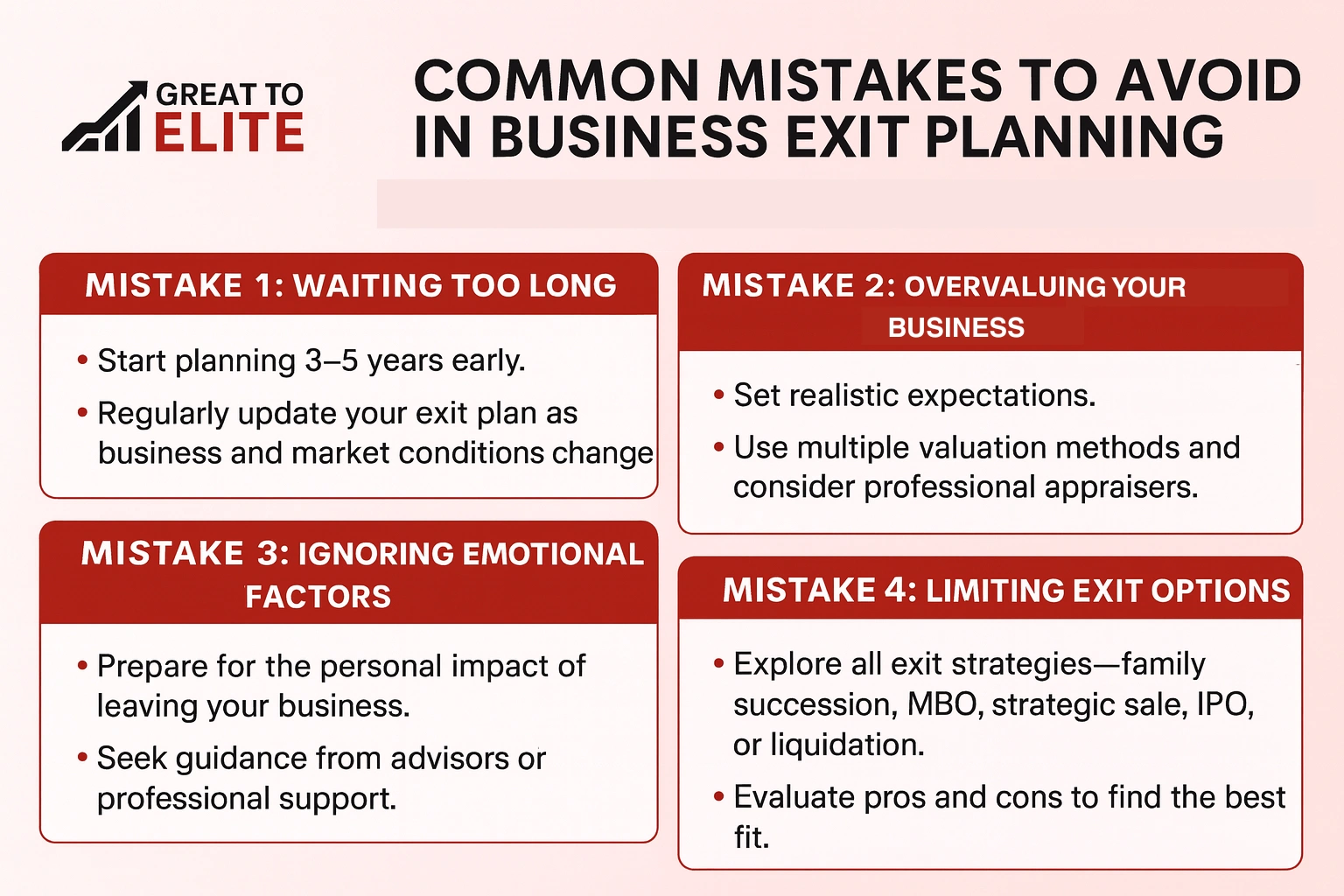
Business exit planning is a complex process, and being aware of the most common mistakes can help you navigate it more effectively. A well-planned exit strategy requires careful consideration of several factors to ensure a smooth transition and maximize the value of your business.
To achieve your exit goals, avoid critical errors that can impact the outcome. Here are some common mistakes to watch out for:
One of the most significant mistakes business owners make is waiting too long to start planning their exit. Early planning allows you to maximize your business value and make necessary adjustments to achieve your goals.
Overvaluing your business can lead to unrealistic expectations and deter potential buyers. Accurate business valuation attracts serious buyers and helps negotiate a fair price.
Business exit planning is not just about financial considerations; it also involves emotional aspects. Preparing yourself emotionally for the transition can make a significant difference in your exit experience.
Business owners often limit themselves to a single exit strategy. Exploring multiple exit options can help you find the best fit for your goals and circumstances.
When you are aware of these common mistakes and take proactive steps to avoid them, you can ensure a more successful business exit. A well-planned exit strategy maximizes your business value and helps you achieve your personal and financial goals.
Great to Elite is revolutionizing the way business owners approach exit planning. We provide comprehensive exit planning services and help business owners achieve their goals. Our team of experts works closely with you to understand your needs.
Our services include developing a strategic exit plan, business valuation assistance, tax optimization strategies, succession planning support, and buyer identification and negotiation. Here are some key benefits of working with Great to Elite:
Partner with Great to Elite to ensure a smooth transition and maximize the value of your business. If you're ready to start planning your exit, consider reaching out to Great to Elite for expert guidance. You can book a call today to discuss how they can help you achieve your exit goals.
As you navigate the complexities of business ownership, a well-crafted business exit plan maximizes the value of your business and ensures a smooth transition. When you understand the different types of exit strategies and key components of an effective exit plan, you can make informed decisions about your future.
A business exit plan is about securing your legacy and ensuring business continuity. With the right guidance, you can achieve your exit goals and enjoy a successful transition. Great to Elite is here to help you navigate the process and create a personalized exit plan tailored to your needs.
Take control of your business exit plan to ensure a prosperous future for yourself and your organization. Start planning today to secure the best possible outcome.