What Is a Succession Plan in Business

What Is a Succession Plan in Business

Natalie Luneva
December 13, 2025
What Is a Succession Plan in Business
BG Shape
Perspective Grid Shape
Table of Contents:

A succession plan in business is a structured strategy that identifies and develops employees to take over key roles when current leaders retire, leave, or are unexpectedly unavailable. It involves documenting responsibilities, mapping critical relationships, and building the skills successors need to step in confidently. 

Effective succession planning strategies ensure business continuity, preserve institutional knowledge, minimize disruption, maintain client and stakeholder trust, and protect the overall value of the company.

Key Takeaways

  • Clear roles and knowledge transfer reduce disruption when leaders change.
  • Practical steps help you stabilize leadership and protect company value.
  • This guidance applies across sizes and stages, and you should start now.
  • The next sections cover value impact, step-by-step processes, and risk mitigation.

What Is a Succession Plan in Business?

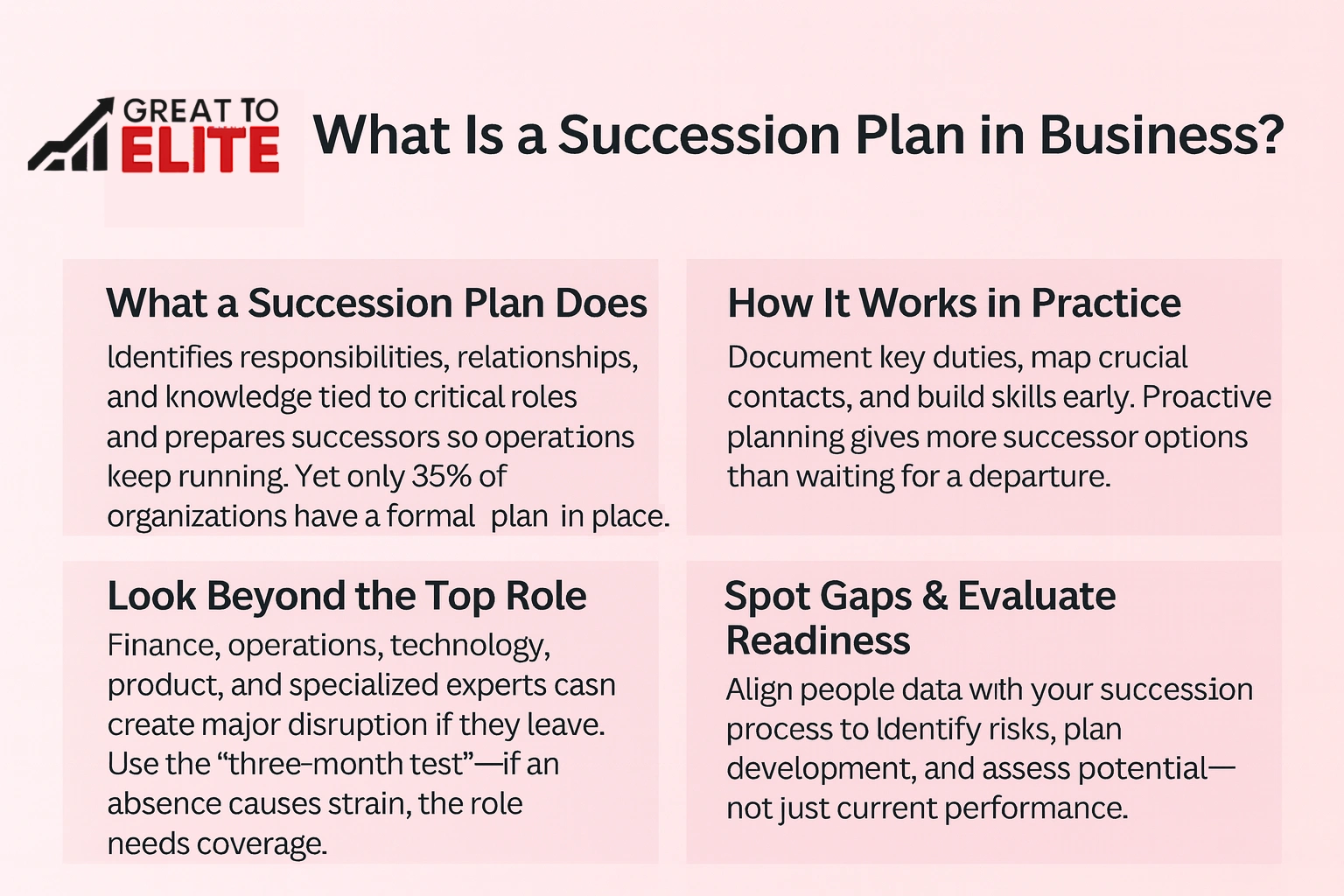
A succession plan identifies the contributions, responsibilities, and relationships tied to critical roles and prepares others to assume them so operations keep running, yet only about 35% of organizations have a formal succession plan in place.

You treat this as an ongoing discipline: document responsibilities, map key contacts, and build skills so successors step in with confidence. Start early; proactive work gives you more options than waiting for an expected departure.

Critical Roles Beyond the CEO

Look past the top office. Heads of finance, operations, technology, product, and highly specialized positions can disrupt service delivery or revenue if they leave.

  • Use the three-month test: if absence causes major strain, that role needs coverage.
  • Protect institutional knowledge and supplier or client ties; these are assets to transfer.

Align people data with the succession planning process to spot gaps, plan development, and evaluate readiness. Remember: current performance does not guarantee future leadership potential.
what is a succession plan in business

Why Succession Planning Matters for Continuity and Value

Unexpected departures can expose gaps that slow operations and erode trust. When a key person leaves, stakeholders often ask who will keep work moving and protect account relationships. You can prevent that uncertainty.

Protecting Institutional Knowledge and Key Relationships

Good succession planning preserves institutional knowledge, as it documents processes, client histories, and vendor terms. This keeps vital information accessible when someone leaves.

You make sure enterprise value stays intact when you reduce disruption and prevent costly delays in decision-making. Designated successors who already know major accounts help maintain revenue and client trust.

  • Clarify decision ownership so approvals and signatures transfer smoothly.
  • Map temporary responsibility shifts to keep the team productive.
  • Invest in people development to align skills with future strategy.
Risk
Action
Benefit
Knowledge loss
Document processes
Faster onboarding
Client churn
Introduce successors early
Preserved revenue
Governance gaps
Set clear approvals
Reduced delays

The Succession Planning Process: From Assessment to Action

A focused process helps you spot gaps, prepare talent, and reduce downtime during role changes.

Assess Current State and Identify Key Roles

Start with an audit that maps leadership, critical roles, decision rights, and key contacts. Capture customer and supplier ties that must transfer smoothly.

Define Future State and Close Skill Gaps

Clarify how roles will evolve and the skills future leaders need. Use objective criteria to identify potential successors; strong performance today does not guarantee readiness tomorrow.

Develop and Execute the Transition Plan

Create a 12–18 month roadmap with phased handoffs, mentor assignments, and measurable milestones. Schedule shadowing, targeted training, and staged responsibility transfer.

Contingency Planning for Unexpected Departures

Document interim coverage, successor criteria, and external recruitment triggers. Specify incumbent advisory roles and how approvals shift across the team.

  • Audit current roles and relationships
  • Define future capabilities and gaps
  • Sequence knowledge transfer and training
  • Prepare contingency steps and governance tools
Process Stage
Key Actions
Timeframe
Outcome
Assess
Map roles, decision rights, key contacts
1–2 months
Clear roster of critical exposures
Design
Define future duties, skills, successor criteria
1 month
Targeted development plan
Execute
Phased handoffs, mentoring, milestones
12–18 months
Ready internal candidates
Contingency
Interim coverage, selection process, external search steps
Immediate activation
Minimal disruption

Best Practices and Common Mistakes to Avoid

Prepare early so leadership shifts do not disrupt day-to-day service delivery. Start several years before any expected change so you can develop candidates and phase duties without pressure.

Integrate succession planning with strategic reviews. Check plans at least once per year and adjust for market shifts, ownership needs, and talent moves.

Start Early and Integrate with Strategy

Map future role requirements and align development with company goals. Use coaching, mentoring, and stretch assignments as concrete steps that build readiness.

Avoid Rushing and Bias When Choosing Successors

Do not name a single heir apparent too soon. Assess candidates against role-specific criteria, leadership potential, and cultural fit rather than current task performance alone.
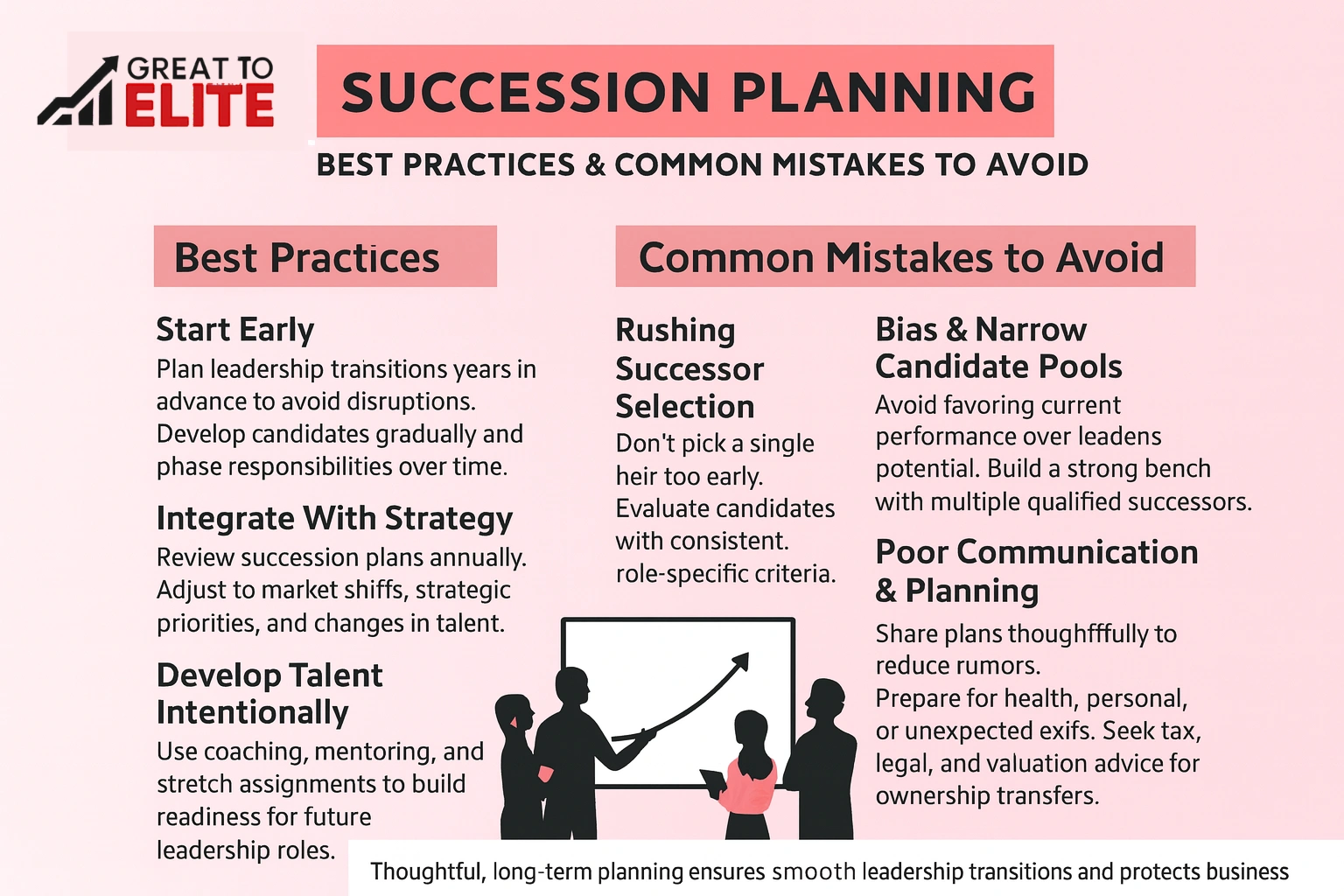
  • Keep multiple internal candidates and a strong bench of talent.
  • Communicate clearly with employees and stakeholders to reduce rumors.
  • Plan for different circumstances, including health or personal exits.
  • Seek outside tax, legal, and valuation advice for ownership transfers.
best practices and common mistakes to avoid in succession planning

Ownership Transfers, Risk Mitigation, and Internal Talent Development

A structured approach to transfer, insurance, and development keeps your company resilient. Address both ownership and operational risks so transitions do not derail growth.

Internal Pipelines vs. External Hires

Internal pipelines save time and protect culture. Develop employees through rotations, mentoring, targeted training, and on-the-job stretch assignments.

External hires add skills that your organization may currently lack. Evaluate candidates objectively and decide if outside experience is needed to meet future goals.

Key Person Insurance and Governance Considerations

Key person insurance can cover short-term costs after the loss of an essential person and help stabilize operations. Use it alongside clear governance rules to reduce immediate financial strain.

Ownership transfer choices include internal buyouts, third-party sales, or family transfers. Legal tools such as buy-sell agreements, GRATs, and ILITs help manage tax and liquidity effects. Seek legal and financial counsel to align personal and company goals.

  • Weigh culture, speed, and skills when choosing internal versus external routes.
  • Define objective successor criteria and assess candidates fairly.
  • Clarify decision rights, board roles, and reporting lines before activation.
  • Codify responsibilities, role charters, and skills requirements for smooth transfers.
Risk
Mitigation
Benefit
Key person loss
Key person insurance; interim coverage
Operational stability; time to recruit
Ownership liquidity
Buy-sell agreement; trusts (GRAT, ILIT)
Tax planning; orderly transfer
Skills gap
Talent development; external hire if needed
Maintains capability and culture

How Great to Elite Helps You Build a Future-Ready Succession Plan

Transitions reveal whether roles, skills, and knowledge live outside any single desk. Great to Elite guides you to map critical positions and capture the outcomes each role must deliver.

You get a clear road map that aligns people work with strategy, so leaders step in smoothly and stakeholders keep confidence.
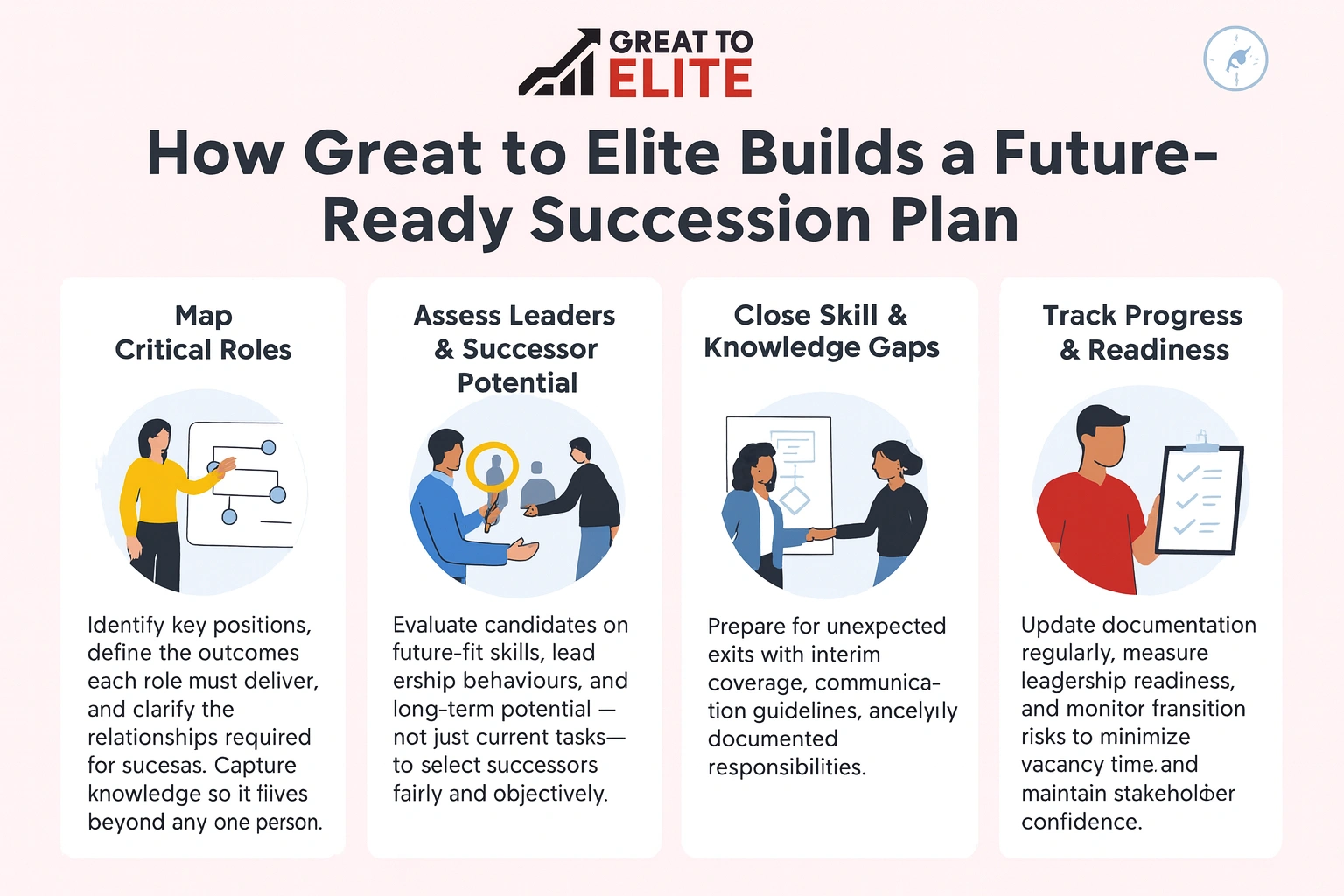
  • You map roles, outcomes, and required relationships so duties are documented and transferable.
  • You assess leaders and candidates beyond current tasks to identify potential successors fairly.
  • You close gaps with targeted development, mentoring, and phased handoffs to transfer knowledge.
  • You build contingency playbooks for unexpected exits, including interim coverage and communications.
  • You track progress, update documentation, and measure readiness to reduce vacancy time.
how great to elite helps you build a future ready succession plan

Great to Elite serves companies and designs tested roadmaps that protect revenue and culture. Work with us to create succession planning that fits your team and company goals. Book a call to get started.

Conclusion

A clear roadmap keeps your organization steady when key people depart.

Use the roadmap to document roles, positions, and responsibilities so the right people step into each role with minimal downtime. Pair leadership development with focused knowledge capture and open communication so employees and customers feel secure during transitions.

Review and refresh your plan on a set cadence. Balance internal pipelines with outside hires so your company can fill positions quickly with capable leaders. Align stakeholders, start your assessment, and formalize next steps so your team stays ready for whatever comes next.

FAQs

How Often Should a Succession Plan Be Updated?

A succession plan should be reviewed at least once a year or whenever there are major changes in leadership, business strategy, or market conditions to ensure it remains relevant and actionable.

What Tools or Software Can Help Track Succession Planning Progress?

HR software, talent management platforms, and project management tools can track successor readiness, training milestones, and role documentation. Examples include Workday, BambooHR, or specialized succession planning software.

How Do You Measure the Success of a Succession Plan?

Success can be measured by reduced downtime during leadership transitions, smooth knowledge transfer, employee readiness, minimal client disruption, and alignment of promoted leaders with strategic goals.

What Are the Costs Associated with Implementing a Succession Plan?

Costs include employee training, mentoring programs, software or tools, consulting fees, and possible recruitment expenses. Long-term benefits like continuity and preserved revenue usually outweigh initial investments.

Should Succession Plans Include Emergency Exit Scenarios for Multiple Roles?

Yes. Planning for sudden departures across multiple roles reduces disruption and ensures coverage of critical functions, maintaining operations and client trust during emergencies.

How Do You Handle Succession Planning in Family-Owned Businesses?

Family businesses should balance family and non-family leadership development, formalize criteria for successor selection, document roles, and consider legal and tax implications for ownership transfers.