Succession Planning Framework
Succession Planning Framework

Natalie Luneva
December 13, 2025



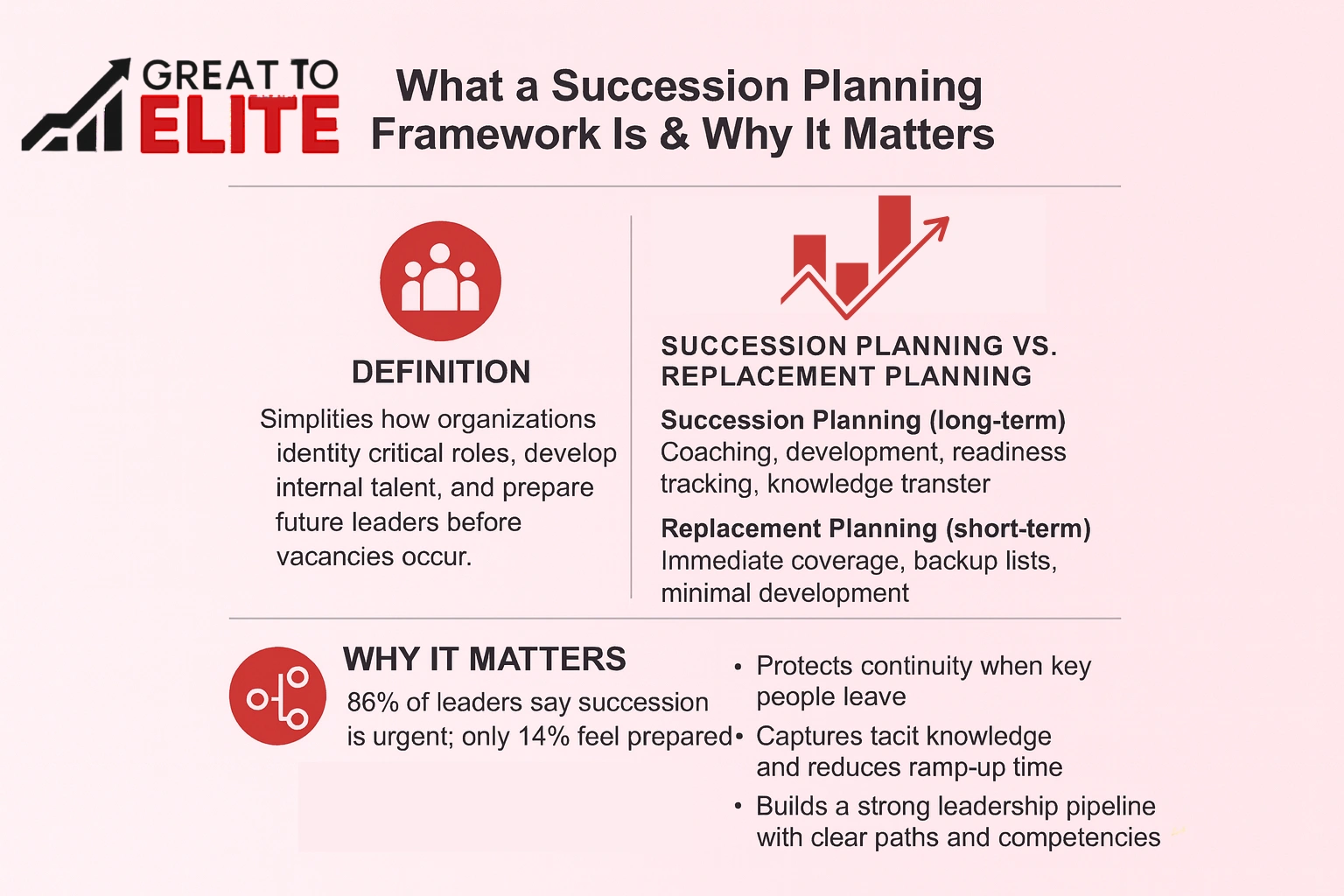
A succession planning framework is the structured system an organization uses to identify critical roles, assess internal talent, and prepare future leaders before vacancies occur. The succession plan in business defines how you evaluate readiness, choose successors, and build the skills required for smooth transitions.
When this framework is clear and consistently applied, you protect business continuity, reduce time-to-fill for key positions, and keep institutional knowledge from walking out the door.
A clear approach helps you identify high-potential employees and give them the training and experience needed for critical positions. In a survey by Deloitte, 86% of leaders said succession planning is an “urgent” or “important” priority, yet only 14% believed their organisations are doing it well.
Succession planning is long-term and development-centered. It pairs future leaders with current ones, uses coaching, and tracks readiness over time.
Replacement planning is short-term. It lists backups for immediate coverage but offers little growth or mentorship.
A focused plan anchors business continuity. When key people leave, your organization keeps operating and morale stays intact.
Pairing candidates with role holders captures tacit knowledge and process details before transitions occur. That protects institutional experience and reduces ramp-up time.
Clear career paths improve engagement and retention. Track readiness levels and bench strength so your efforts translate into real resilience for the business.
Today many U.S. service firms face gaps that leave vital roles unprotected during leadership change. This reality raises costs and slows performance when turnover occurs in leadership and specialist positions.
Limited bench strength is a top issue. Shallow pipelines mean one departure can cascade into several vacancies and missed deadlines.
Many companies also struggle to identify which positions are truly critical. That makes it hard to quantify turnover risk and prioritize development dollars.
Regular talent reviews and workforce analysis expose skills gaps and training needs. Use those findings to design targeted upskilling and reskilling tied to business goals.
Map key positions against likely turnover scenarios so you can focus on the highest-risk roles first. Establish a review cadence for bench strength to match changing market and business needs.
Build broader, more diverse pipelines to increase resilience and bring more perspectives into decision-making. These steps move you from good intentions to everyday execution and lower the cost of transitions.
Move from high-level design to real action and connect your leadership intent with defined steps and owners. A model defines the conceptual map for how you identify and develop future leaders. The framework, by contrast, sets the governance, culture preconditions, and role definitions that let the model work.
You translate the succession planning strategy into practice through a clear planning process. That process lays out tools, decision points, and templates for talent reviews, development plans, and readiness checks. Feedback loops link development activity to candidate identification so readiness is based on evidence.
Keep the system living: update the model, governance, and process on a set cadence. Give leaders a simple scorecard each cycle so risks, next steps, and development needs are clear. This alignment bridges strategy and execution and drives effective succession for your organization.
When leaders visibly back talent development, your business keeps moving even as people change. Make leadership growth a visible, measurable part of how your organization operates.
Secure executive sponsorship so leadership development is a shared priority, not just an HR task. Senior leaders should mentor, recognize managers who grow talent, and model the behaviors you want to see.
Embed development into manager expectations. Make mentoring, coaching, and talent advocacy part of performance goals. Reward managers who build high-potential employees.
Focus on a small set of critical positions that would cause major disruption if left vacant. Use clear job architecture, decision rights, and success criteria to make role identification objective.
Make it normal for leaders to share lessons and codify processes. Set concrete goals so the organization views succession and development as an ongoing commitment.
A clear, repeatable process turns leadership risk into manageable development work. Start with simple, visible steps that connect talent development to real role readiness.
Map career paths so employees see how skills translate to the next role.
Use rotations, mentoring, and targeted training to build the core experience required for critical jobs.
Hold recurring talent reviews that weigh performance, learning agility, and aspiration. Use short tools and manager feedback to spot high-potential candidates.
Accelerate readiness with project ownership, cross-functional assignments, coaching, and 360-degree feedback. These actions build judgement and exposure.
Set a review cadence to monitor progress, remove blockers, and align resources so leaders coach candidates and reduce time-to-fill.
Define clear readiness criteria so hiring and promotion decisions rely on evidence, not opinion. Translate strategy into concise role profiles that list responsibilities, decision rights, and KPIs. Keep each profile focused so candidates know what the role demands.
For every target role, separate must-have competencies from nice-to-have skills. Include both technical abilities and leadership behaviors.
Categorize candidates into Ready Now, Ready Soon, and Ready Later to set clear timelines and development intensity. Link each category to specific experience and competency gaps.
Share criteria with employees so expectations are transparent. When multiple potential successors exist, use documented competencies and multi-source performance data to decide and to guide development.
A well-chosen set of tools turns scattered data into clear actions for leader readiness. Use software to centralize talent reviews, learning content, and performance records so your team spends less time on admin and more time on development.
Talent management software helps you map performance and potential. A simple 9-box grid visualizes where employees sit today and what support they need to grow into leadership roles.
This view makes it easier to prioritize development investments and document readiness levels in your plan.
Learning management capabilities centralize training, store knowledge-transfer materials, and track completions. You can capture experience from rotations and projects so learning is evidence-based.
Align performance management with development plans so goals, feedback, and coaching reinforce the competencies future leaders need.
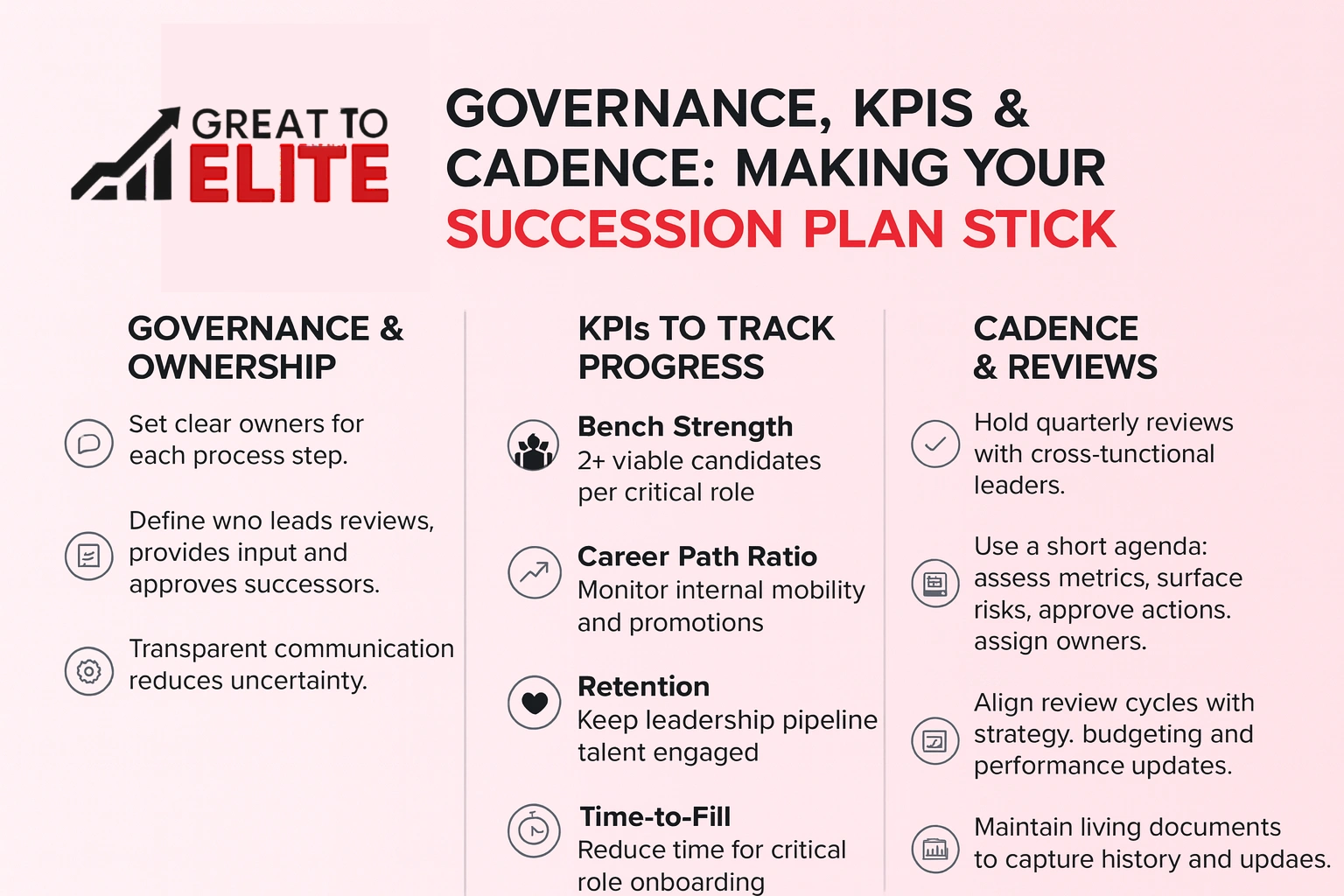
A simple governance rhythm makes talent moves predictable and reduces disruption. Set clear owners, a review cadence, and a short agenda so your process runs on time and drives results.
Track a small set of KPIs that show real progress: bench strength, career path ratio, retention in leadership pipelines, and time-to-fill for critical roles. Use these to measure performance and adjust development activity.
Define bench strength targets per critical role so you have multiple viable candidates across time horizons. Monitor career path ratio (promotions ÷ total role changes) to see if internal mobility is improving.
Watch retention in your pipeline and time-to-fill for priority positions. If time metrics slip, increase stretch assignments or coaching to speed readiness and improve performance.
Hold quarterly reviews with cross-functional leaders. Use a short agenda: assess metrics, surface risks, approve actions, and assign owners with deadlines.
Formalize who leads the process, who provides inputs, and who signs off. Communicate the aim and steps to employees so decisions feel fair and reduce uncertainty.
A fair, transparent approach to talent selection helps companies retain trust and surface strong candidates from all backgrounds.
Embed diversity, define inclusive criteria and widen sourcing so qualified candidates from underrepresented groups are visible and supported.
Use consistent evaluation and clear communication with employees to reduce ambiguity and build confidence in decisions. Track nominations, feedback, and development access to spot bias patterns.
Don’t rely on a single favorite. Build two to four potential successors for each critical role to reduce single-point failure risk.
Connect effective succession planning to business outcomes, continuity, customer confidence, and growth, to keep leaders invested and protect employees and organizations when change happens.
Companies often need tools that link day-to-day client work with clear leadership growth paths. Great to Elite designs a practical approach so your talent and development work maps directly to client delivery and business goals.
We help you:
Ready to build confidence in your leadership pipeline? Book a call with Great to Elite to assess your current plan, prioritize critical roles, and launch a right-sized program for your team.
A clear end point ties your talent work to business outcomes and keeps teams ready for change. This succession planning framework links strategy, culture, and role clarity to a practical, repeatable process you can run each quarter.
You can define competencies and readiness, align development to close gaps, and use evidence to make confident decisions. Track bench strength, career path ratio, retention, and time-to-fill so the plan stays active and measurable.
Embed inclusive practices, build multiple successors per role, and choose tools that fit your context. These steps protect client delivery and strengthen your leadership pipeline for the future.
When you’re ready to move from design to results, revisit the Great to Elite section above and book a call to launch or refine your plan for the future.