Succession Planning Strategies
Succession Planning Strategies

Natalie Luneva
December 13, 2025



Succession planning is the process of preparing future leaders before you need them. It identifies your critical roles, develops people who can fill them, and keeps operations steady when someone leaves or retires.
Succession planning strategies help you turn that preparation into a clear, workable system. They guide how you choose successors, build their skills, and reduce risks from leadership gaps so your business stays resilient through any transition.
Succession planning is the process of preparing future leaders before you actually need them. It identifies the critical roles that keep your business running, develops people who can step into those roles, and ensures continuity when someone retires, resigns, or faces an unexpected absence. Instead of scrambling when change hits, you build a structured way to keep operations stable, retain hard-earned knowledge, and protect client relationships. Yet only about 35% of organizations have a formal succession plan in place, showing how exposed most companies are when key talent leaves.
Succession planning strategies help you move from a basic plan to a deliberate, future-proof approach. They show you how to choose the right successors, create development paths that actually build capability, and reduce the risks that come with leadership gaps. With the right strategy, your business becomes far more resilient, able to grow, transition smoothly, and maintain confidence with employees, customers, and stakeholders even during major shifts.
Succession planning is a structured process that identifies and develops internal candidates for key positions so your organization keeps running when leaders leave. It begins by naming critical positions, defining required competencies, and assessing who can grow into those roles.
Your goals should include continuity, reduced risk, preserved institutional knowledge, faster productivity in new roles, and higher engagement. Use role profiles, performance standards, and transparent selection criteria to build trust and fairness.
Demographic shifts and tight labor pools make external hiring harder and slower. That raises the value of internal development and visible growth paths that improve retention and experience for younger workers.
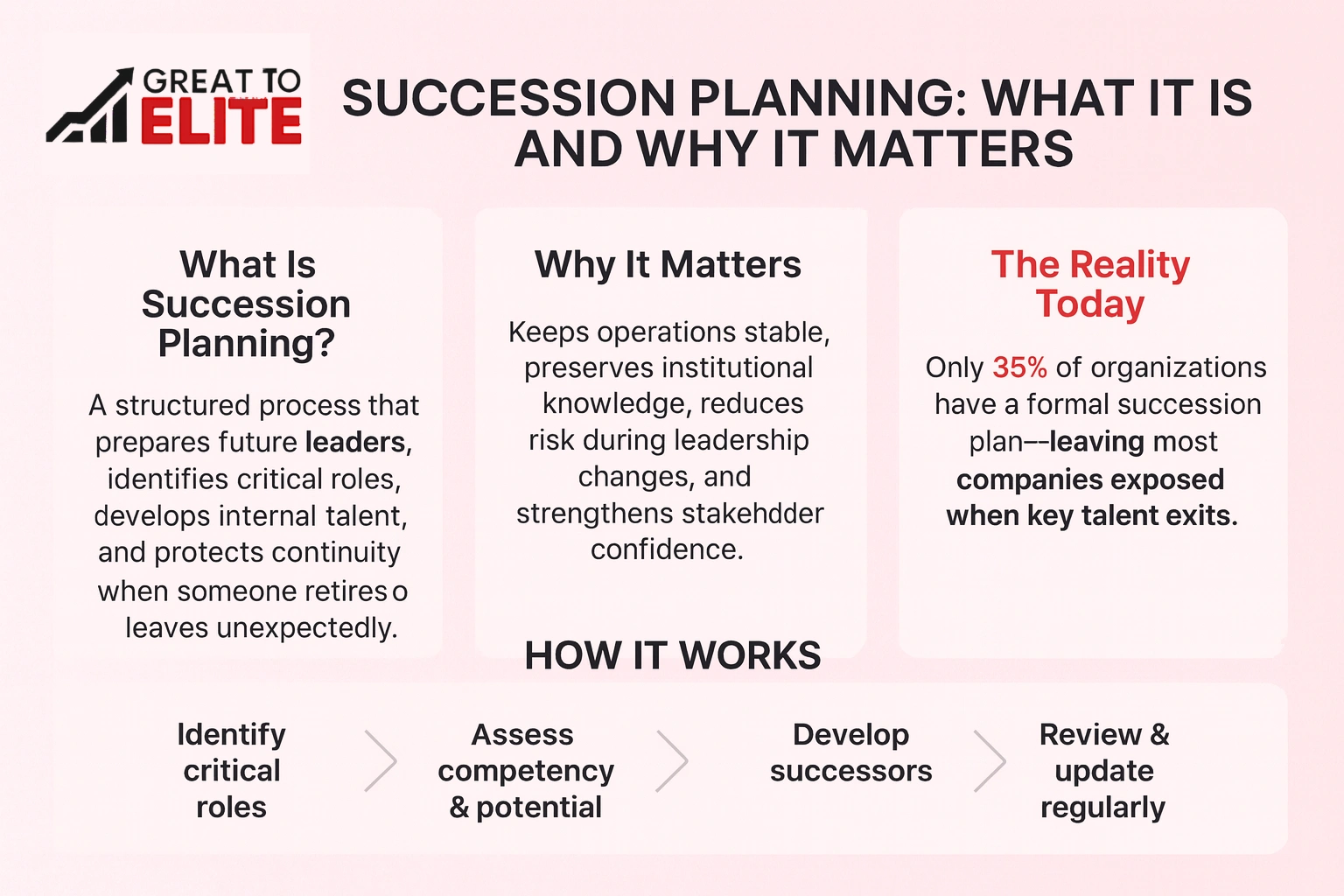
Preparing for executive change reduces financial exposure and keeps stakeholders confident in your company. Research shows mishandled executive transitions can erase significant market value across large indexes. A formal plan with clear criteria and leader involvement protects continuity and reputation.
Quantify risk reduction: when you prepare for transitions, you defend market confidence and operational continuity. Documented oversight and a regular review cadence cut ambiguity and speed decisions during a transition.
Capture knowledge: formal handoffs, written playbooks, and mentor pairings store critical know-how. Targeted development aligned to role competencies shortens ramp time and cuts training costs.
Increase engagement: transparent pathways and feedback loops show employees how to grow. That clarity improves intent to stay and supports performance across the organization.
Build a living process that updates your talent roadmaps as strategy shifts. Start early and keep work rolling so gaps never become crises. Tie reviews to business changes, product launches, and reorganizations.
You will schedule regular talent reviews and calibration sessions to reassess readiness. Hold annual career conversations so managers surface aspirations and match development to need.
Define a clear process to document role changes, candidate status, and progress. Formalize triggers, mergers, new products, or reorgs, that force immediate updates and scenario testing.
Keep leaders accountable for healthy pipelines. Reinforce confidentiality and fairness while sharing enough detail to build trust across the organization.
Identify the few roles whose absence would halt critical operations or strategic momentum. List pivotal posts first so you avoid spreading effort too thin. Validate each entry with current role holders and key stakeholders.
For each of the key positions, create a competency profile that blends technical, leadership, and behavioral skills. Tie those competencies to measurable performance outcomes so you can track readiness.
Benchmark expectations against the current market and near-term trends. Update competency models when technology, regulation, or customer needs shift so your successors train for tomorrow, not yesterday.
Run a focused skills gap analysis across successor pools to reveal where targeted training will move the needle fastest. Prioritize investment where gaps pose the highest risk to continuity or growth.
Use this approach to make succession planning concrete: focus effort on the roles that matter, measure what counts, and direct investment to close the most damaging gaps.
Build a steady pipeline of high-potential people so your organization can shift leaders without losing momentum.
Use the 9-box to map performance against potential and capture aspiration. That visual helps you see who belongs in your talent pipeline and what support they need.
Hold biannual talent reviews to refresh ratings, confirm goals, and protect equity. Use consistent criteria, written notes, and cross-team calibration so assessments stay fair and actionable.
Create clear development plans that blend training, coaching, and on-the-job work tied to competency gaps. Include low-risk simulations so potential successors practice key responsibilities before high-stakes moves.
Design stretch assignments and cross-functional projects to build judgment, influence, and execution at scale. Engage leaders as sponsors who open doors and give candid feedback. Define exit criteria that show when an individual is “ready now” or “ready soon.”
Scale mentoring and coaching so tacit knowledge flows where it's needed most. You institutionalize pairing high-potential employees with experienced leaders to speed real-world development beyond formal training.
You train mentors to set clear goals, give actionable feedback, and support different learning styles. That preparation improves the quality of guidance and the consistency of experience for individuals across the organization.
Use shadowing, reverse mentoring, and short rotations to move context-specific know-how across functions. Capture decision frameworks and critical processes in living playbooks so responsibilities survive staff changes.
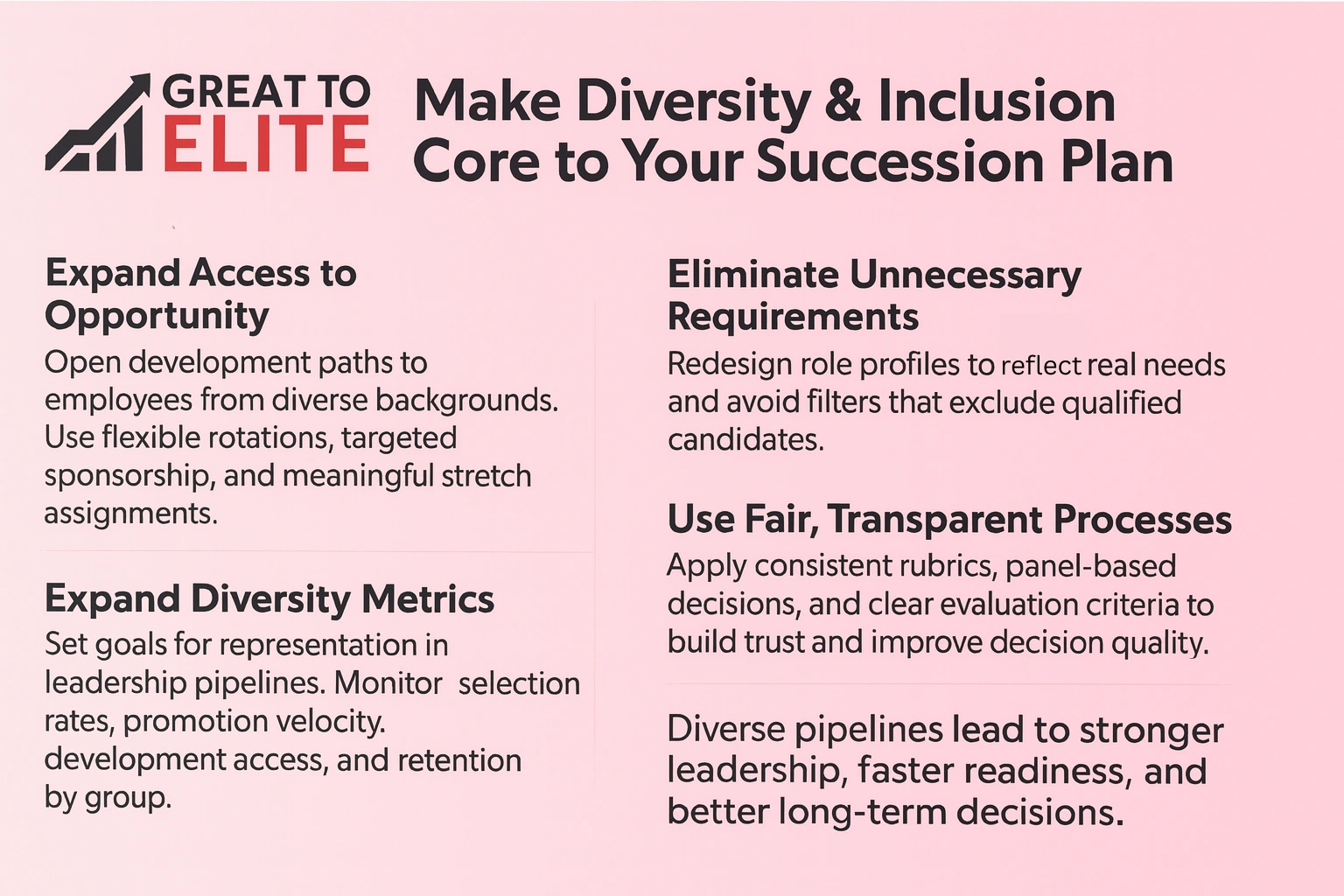
Centering diversity in your talent work improves decision quality and strengthens leadership pipelines. Inclusive processes broaden who gets visible development and who can meet future needs.
Widen access to development so employees from varied backgrounds can show readiness for high-impact roles. Offer flexible rotations, targeted sponsorship, and compensated stretch assignments.
Remove unnecessary requirements that exclude qualified candidates and redesign role profiles to reflect true needs.
Set measurable goals for representation in your talent pipeline and review progress each talent cycle. Track selection rates, promotion velocity, development access, and retention by group.
Use consistent rubrics, panel-based decisions, and clear timelines to reduce bias and build trust. Publish role requirements and explain how candidates are evaluated.
When you embed these practices, your organization gains stronger, more representative leadership and clearer paths for potential successors. Use data, transparency, and accountability to make inclusive development a routine part of planning.
Technology turns fragmented talent data into clear, actionable intelligence for faster transitions. Modern platforms centralize role profiles, readiness data, development activities, and charts so you can update plans in real time.
Define functional and integration requirements before you buy. Consolidate competencies, performance indicators, development plans, and candidate readiness into one system of record.
Establish data governance, access controls, and user training so confidential information stays protected while leaders can act quickly.
Deploy readiness dashboards that show gaps by role, risk level, and time to fill. Automate reminders for reviews, goal updates, and plan refresh cycles so nothing falls through the cracks.
Create and test emergency playbooks that name interim leaders, list responsibilities, and outline communications. Stress-test your plans against market shocks and budget for ongoing support and vendor reviews.
Great to Elite turns talent intent into measurable outcomes that keep your business running. You get a clear talent architecture, mapped critical roles, and development pathways that make internal moves predictable and fast.
You will clarify which critical roles matter most and define the competencies that signal readiness. This alignment makes your investment in people deliberate and tied to business goals.
Great to Elite co-designs blended development, training, coaching, simulations, and stretch assignments, so leaders reach “ready now” or “ready soon” status. You measure progress with scorecards and ramp-time targets.
We help you stand up readiness dashboards, run quarterly pipeline reviews, and tie outcomes to performance and internal fill rate. That lets you reallocate resources where gaps pose the highest business risk.
For service firms, you get practical tools that fit billable models and client delivery rhythms. We focus on speed, repeatability, and protecting institutional knowledge so client outcomes stay consistent.

Ready to operationalize your plan? Book a call to review how Great to Elite can tailor development, dashboards, and quarterly reviews to your organization.
Commit to a repeatable process that turns talent intent into measurable readiness. Define key positions and critical roles, map competencies, and keep rolling updates so your plan tracks market and strategy shifts.
Build a diverse talent pipeline and use targeted development, mentoring, and real work to speed readiness. Rely on data, performance, readiness, and pipeline health, to focus investment, test emergency steps, and document interim responsibilities.
Hold quarterly reviews, assign leader accountability, and keep employee experience front and center with clear expectations and feedback. When you make these practices routine, transitions are steady, low-risk, and aligned to business success.