What Is Enterprise Value

What Is Enterprise Value

Natalie Luneva
December 12, 2025
What Is Enterprise Value
BG Shape
Perspective Grid Shape
Table of Contents:

Enterprise value measures a company’s total worth by adding market capitalization and total debt, then subtracting cash and cash equivalents.

You use figures from the balance sheet and market prices to get this metric. It shows the full cost to buy a business, since a buyer would assume debt and receive any cash on hand.

Compared with market capitalization alone, this approach gives a broader view of market value. Investors often lean on EV to build ratios like EV/EBITDA or EV/Sales for clearer valuation across peers. For example, the global median EV/EBITDA multiple for M&A transactions in 2025 is 9.3x.

In rare cases, total value can be negative when cash exceeds market cap plus debt. That signals excess cash or unusual capital structure and should prompt closer analysis.

Key Takeaways

  • EV = market capitalization + debt − cash, reflecting the company’s total value.
  • Use this metric to estimate the true cost to acquire a business, including obligations.
  • EV offers a more complete valuation lens than equity alone.
  • Investors compare EV to EBITDA to assess operating performance across firms.
  • Negative EV can occur and often points to excess cash or balance sheet quirks.

What Is Enterprise Value

To see true acquisition cost, adjust the share-based price by the firm's borrowings and liquidity.

This measure goes beyond market capitalization by adding total debt and subtracting cash from the equity market price. That process uses the current share price and shares outstanding for the market figure, then pulls debt and cash from the balance sheet.

What Enterprise Value Measures Versus Market Capitalization

Market capitalization reflects price times shares outstanding and focuses only on equity. It leaves out debt and cash held by the company.

By contrast, enterprise value includes debt and subtracts cash, giving a fuller view of obligations and liquidity that affect acquisition cost.

Why EV Is Often Used To Gauge A Company’s Total Value

You use this metric to standardize analysis across firms with different capital structures. It pairs well with EBITDA to compare operating performance regardless of financing or tax differences.

When two firms share similar market capitalization, differing debt or cash positions can make their implied valuations diverge materially.
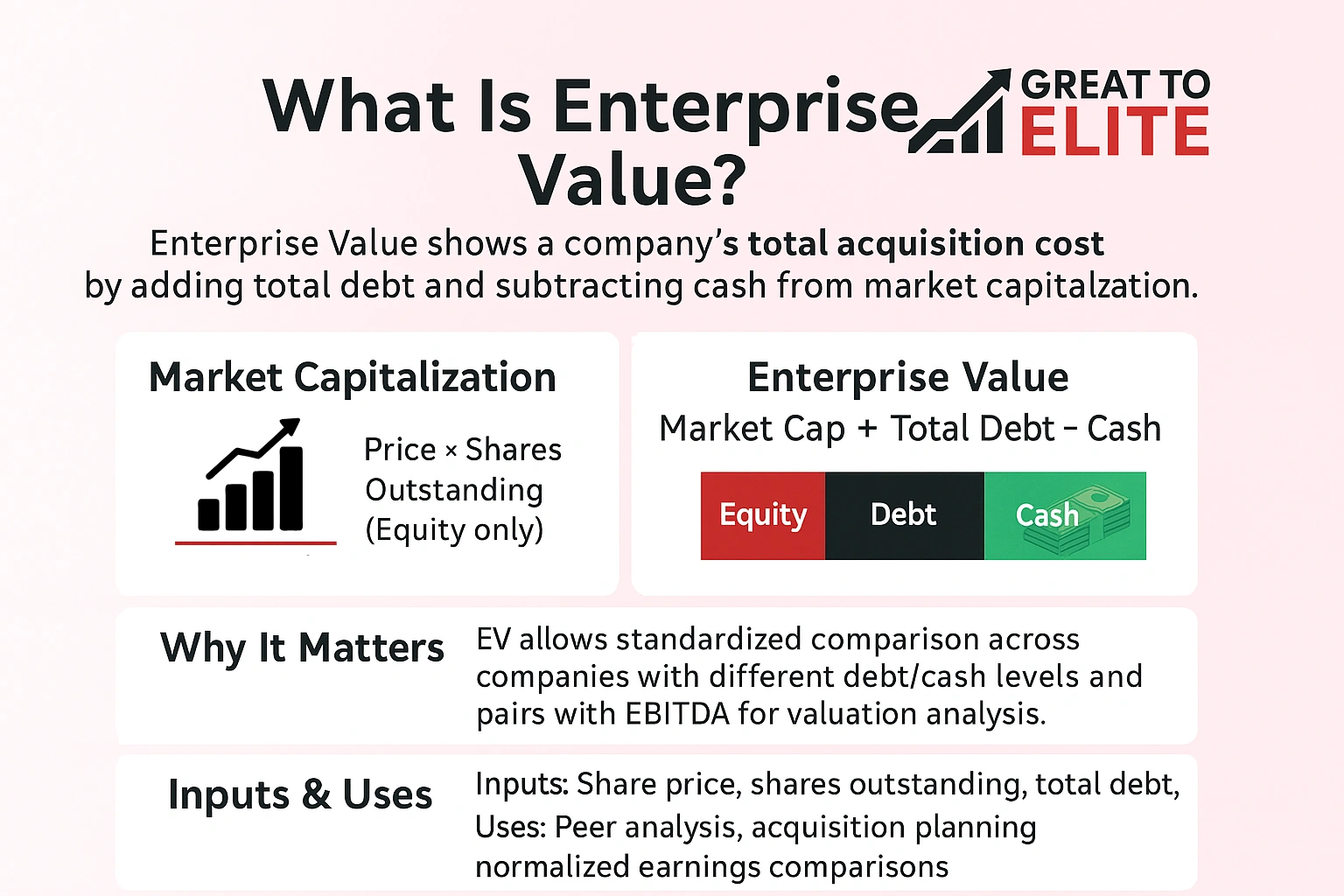
  • Inputs: share price, shares outstanding, total debt, cash.
  • Use: peer analysis, acquisition planning, normalized earnings comparisons.
what is enterprise value

Enterprise Value Components And Formula

Begin with the distinct capital claims and liquid holdings that change how a buyer would price a company.

Market Capitalization And Shares Outstanding

Compute market capitalization by multiplying share price by shares outstanding. This gives the equity portion used in the enterprise value formula.

Total Debt: Short-Term And Long-Term Debt

Add short-term borrowings and long-term debt to capture obligations a buyer must assume. Treat total debt as a clear claim on company assets.

Cash And Cash Equivalents, Including Marketable Securities

Subtract cash and cash equivalents. Include money market funds, CDs, Treasury bills and marketable securities since they reduce net obligations.

Preferred Equity And Minority Interest Considerations

When present, add preferred equity and minority interest to reflect non-common claims. This aligns the numerator with all capital providers.

The Enterprise Value Formula Explained

The simple formula ties these pieces together: EV = Market Capitalization + Total Debt − Cash and Cash Equivalents. Use this calculation to form reliable ratios like EV/EBITDA and compare peers.

  • Verify inputs on the balance sheet and notes for accuracy.
  • Treat net debt (total debt minus cash equivalents) as the bridge from equity value to enterprise value.
Component
Includes
Role
Market cap
Share price × shares outstanding
Equity claim
Total debt
Short-term + long-term debt
Buyer obligations
Cash equivalents
Money funds, T-bills, securities
Reduces acquisition cost

How To Calculate Enterprise Value Step By Step

Begin with live market quotes and the firm's latest financial statements. This ensures your calculation uses current share price and balance sheet figures for accurate analysis.

Gathering Balance Sheet And Market Data

Pull the most recent share price and shares outstanding to form market capitalization. Then locate total debt and cash equivalents on the balance sheet.

Calculate Market Cap, Add Total Debt, Subtract Cash

Compute market capitalization by multiplying share price by shares outstanding. Add short- and long-term total debt to that figure. Subtract cash and cash equivalents to net out liquidity.

Worked Example: From Share Price To Total Value

Start with market capitalization from price × shares outstanding. Add total debt taken from notes. Subtract cash equivalents to reach final enterprise value.

  • Double-check filings to confirm inputs.
  • Watch for negative results if cash exceeds combined debt and market cap.
  • Use the final number in ratios like EV/EBITDA for comparison.
Step
Input
Action
Outcome
Market Cap
Share price, shares outstanding
Multiply price × shares
Equity capitalization
Add Debt
Short-term + long-term total debt
Add to market cap
Reflects buyer obligations
Subtract Cash
Cash equivalents, marketable securities
Subtract from subtotal
Net acquisition figure
Validate
Official filings, notes
Reconcile arithmetic
Ready for ratio analysis (e.g., EV/EBITDA)

Using Enterprise Value In Valuation Ratios

Anchor valuation to the company’s operating cash drivers, then layer in debt and liquidity. That approach ties total value to the business’s core performance and helps you compare firms with different capital mixes.

EV/EBITDA: Enterprise Multiple For Operating Performance

EV/EBITDA links the purchase claim to operating earnings. You use this ratio to strip out financing and non-cash charges so companies with different leverage become comparable.

EV/Sales: When Revenue Multiples Make Sense

EV/Sales pairs total claims with top-line revenue. It proves useful when earnings are negative or uneven, since revenue provides a stable basis for relative valuation.

Interpreting Multiples Across Similar Companies

  • Compare within an industry because margins and capital intensity vary.
  • Adjust for higher debt, which raises enterprise value and can widen a ratio versus peers.
  • Check earnings quality, working capital trends, and capitalization to avoid misleading signals.
  • Use multiples as a screening tool, then run deeper analysis with equity and stock context.
Multiple
Best Use
Watch For
EV/EBITDA
Operating earnings comparison
Leverage and accounting differences
EV/Sales
When earnings are volatile
Thin margins and cyclical revenue
Interpretation
Industry peers
Market cycles

Enterprise Value Versus Market Cap And P/E

Look at the market’s equity estimate and contrast it with a total-claims approach that adds obligations and subtracts liquidity.

Where Market Capitalization Falls Short

Market capitalization shows the market price for equity, measured by share times shares outstanding. It leaves out debt and cash, so a company with heavy borrowings or excess cash can appear misleadingly cheap or expensive.

That omission matters for acquisition planning and cross-company comparison. You must factor in assets and capital structure to avoid a shallow read of market value.

How EV Complements The P/E Ratio

Enterprise measures include debt and subtract cash, so EV-based ratios bring capital providers other than equity into your analysis. P/E ties price to earnings per share and reflects equity return expectations alone.

Match the numerator and denominator: use enterprise with EBITDA or EBIT, and use equity value with net income. That keeps comparisons consistent and reduces misinterpretation across cycles.

  • Market moves affect market capitalization and P/E quickly, while the broader measure tempers swings and reflects balance sheet changes.
  • Use both lenses to triangulate a fuller picture of how the market values the same company from different angles.
Measure
Includes
Best Paired Metric
Market Capitalization
Equity only (share × shares)
P/E
Enterprise
Market cap + debt − cash
EV / EBITDA
Why It Matters
Reflects stock sentiment
Aligns with operational cash drivers

Interpreting EV Across Industries And Capital Structures

When you move between industries, asset intensity often dictates how debt and cash shape overall valuation.

Capital-Intensive Versus Asset-Light Companies

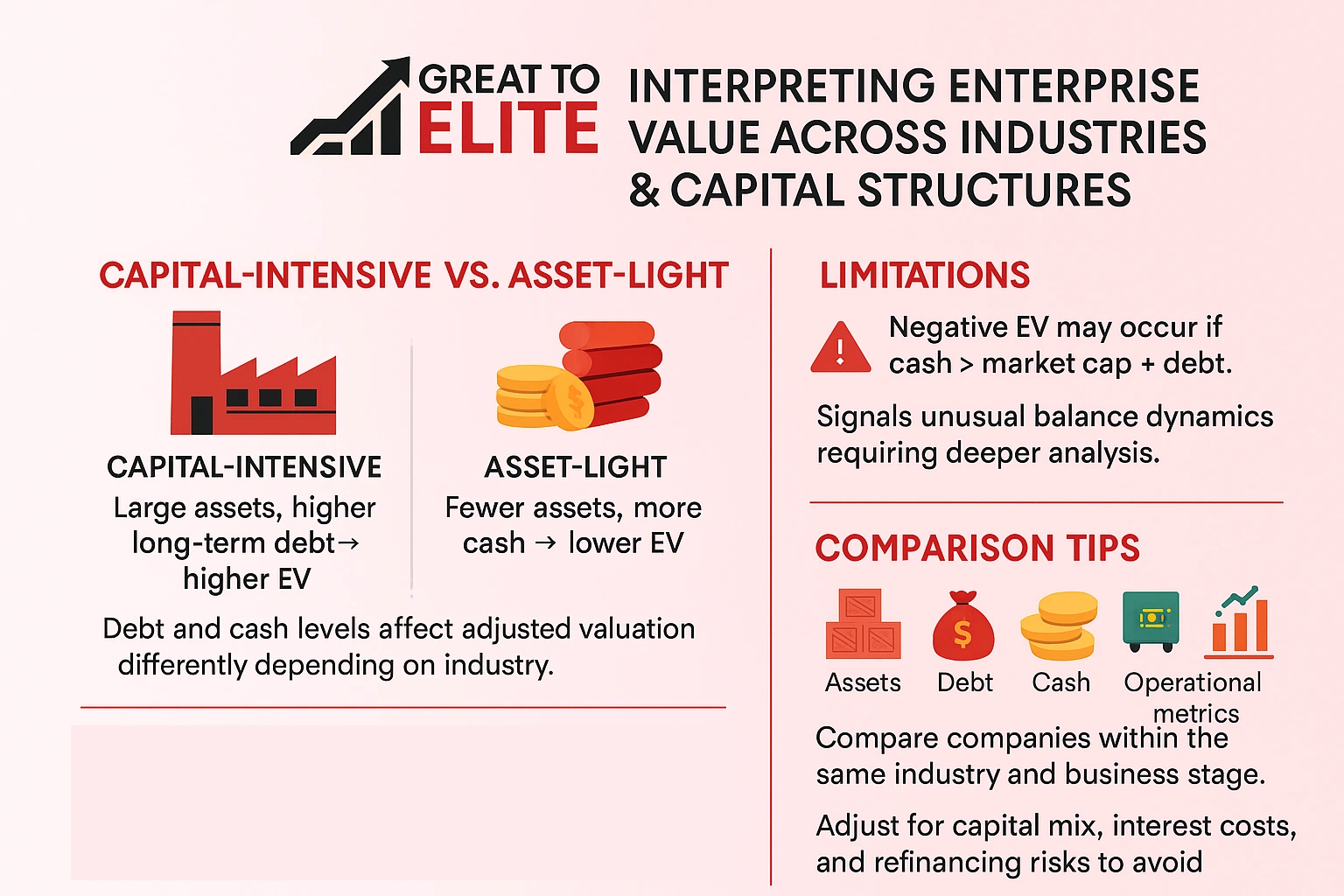
Capital-intensive sectors carry large assets and often finance them with long-term debt. That raises adjusted measures and can make cross-industry comparison misleading.

By contrast, asset-light companies hold less equipment, keep more cash, and show lower adjusted totals relative to peers with heavy capitalization.

Limitations, Negative EV, And When Comparisons Mislead

Negative enterprise value may appear when cash and equivalents outweigh market capitalization plus debt. That flags unusual balance dynamics and calls for deeper analysis.

Always compare companies within the same industry and at similar business stages. Different capital mixes, interest costs, and refinancing risks skew ratios across sectors.
  • Check assets and long-term debt to see whether higher totals reflect investment or leverage risk.
  • Match equivalents definitions so cash comparisons are apples-to-apples across firms.
  • Use EV with margins and growth so your analysis captures operational reality, not just capital structure.
interpreting enterprise value across industries

Practical Ways You Can Use Enterprise Value Today

Build repeatable screens that normalize debt and cash so you compare companies fairly. This gives you a cleaner lens for stock selection and deal checks.

Screening And Comparing Companies In Your Watchlist

Rank companies by EV/EBITDA or EV/Sales to spot outliers quickly. Those ratios help investors filter the market when earnings differ or margins vary.

Keep a running shortlist where you calculate enterprise value for each candidate. Update price and shares to refresh rankings after major moves.

Assessing Mergers, Acquisitions, And Deal Economics

Start M&A math with enterprise value because it reflects the total cost, adding debt and subtracting cash. That view shows what an acquirer truly pays and whether projected synergies justify the bid.

Factor assets, working capital, and capitalization in your analysis to test sustainable returns. Use enterprise as a bridge between strategy and numbers when you pressure-test deal economics.

  • Normalize for debt and cash to avoid equity-only traps when comparing stock opportunities.
  • Create repeatable calculate enterprise workflows to standardize diligence across companies.
  • Document balance and liquidity assumptions so your comparisons remain transparent.
Use
Purpose
Action
Screening
Find cheap or rich companies
Rank by EV/EBITDA or EV/Sales
Deal Prep
Estimate acquisition cost
Start with EV, include debt and cash
Monitoring
Keep watchlist current
Update price and shares regularly

How Great to Elite Helps Businesses Leverage Enterprise Value

A focused program that maps cash generation to client delivery often moves the needle on a firm's acquisition metrics. For service leaders, aligning pricing, processes, and capital choices can change both perceived and realized worth.

What You Gain Working With Great to Elite

Great to Elite translates big-picture valuation concepts into clear, practical steps for your business.
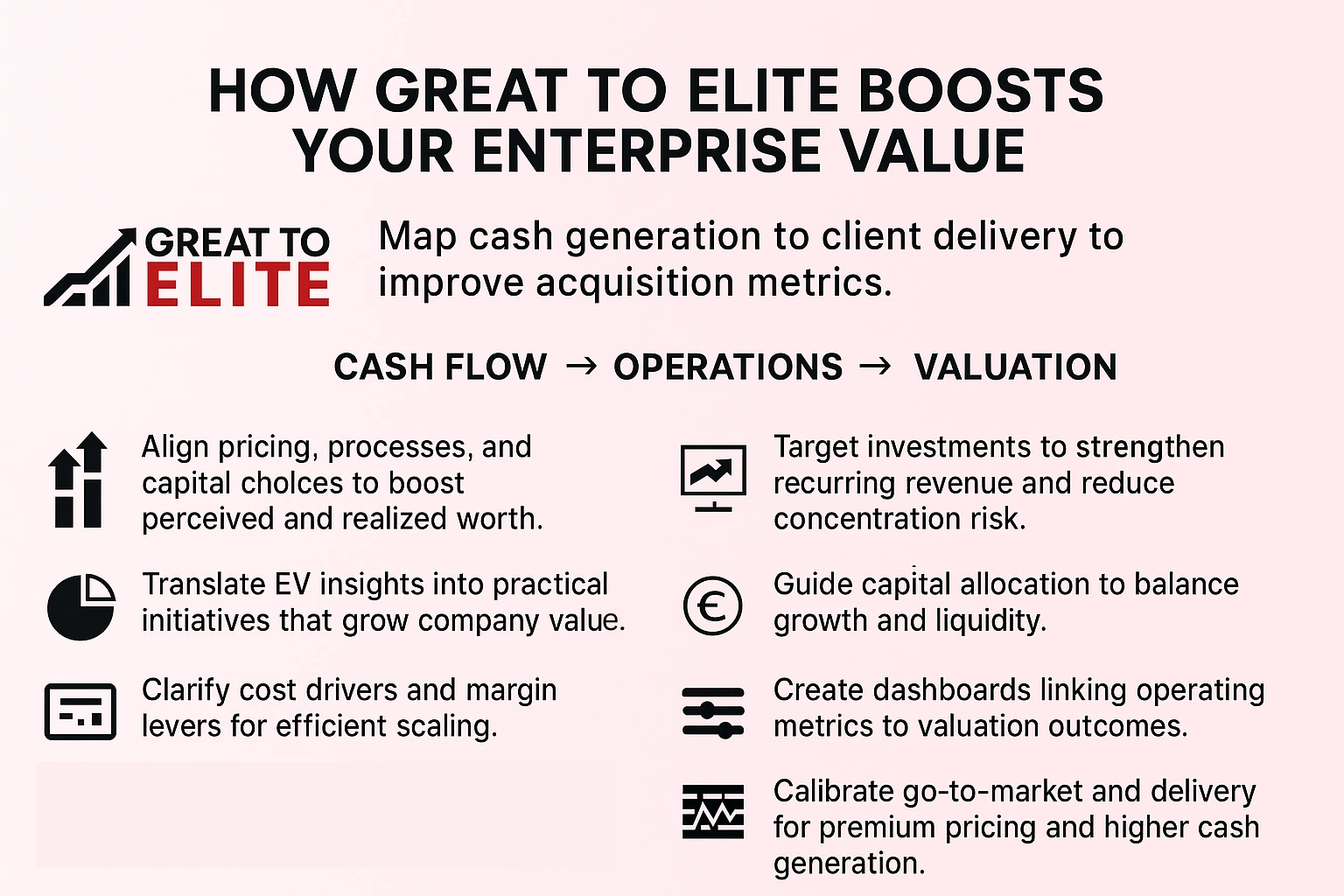
  • Convert enterprise insights into initiatives that grow your company’s worth and resilience.
  • Structured approach that aligns positioning, pricing, processes, and capital choices to boost equity value and market value over time.
  • Analysis clarifies cost drivers and margin levers so your company can scale efficiently and enhance perceived value company-wide.
  • Explore targeted investments that strengthen recurring revenue and reduce concentration risk, improving how the market assesses your business.
  • Receive guidance on capital allocation to balance growth and liquidity, keeping your enterprise value trajectory aligned with strategy.
  • Turn EV concepts into dashboards that track operating metrics tied to valuation outcomes and make progress measurable.
  • Calibrate go-to-market and delivery to support premium pricing, expand cash generation, and increase attractiveness to investors.
how great to elite boosts your enterprise value

Book A Call To Unlock Your Company’s Value

Start with a short audit. Book a call with Great to Elite to review valuation drivers, prioritize quick wins, and design a plan to unlock measurable gains.

Conclusion

Use enterprise value to combine market capitalization, debt, and cash so your view of a company reflects total value, not just equity. Start every calculation with live price and shares, add debt, and subtract cash and marketable securities from the balance sheet.

Apply EV/EBITDA and EV/Sales to relate operating earnings and sales to valuation, while checking earnings quality and assets. Keep comparisons within industry peers, update inputs often, and pair ratios with qualitative insight.

With this method you can screen stock ideas, assess deals, and explain outcomes to investors using a clear, repeatable framework. Great to Elite can help turn these steps into action.

FAQs

What is the difference between enterprise value and firm value?

Enterprise value focuses on the total value of a company’s operational and financial obligations, including debt and cash, while firm value can sometimes refer to the total value of assets, including non-operating ones. EV is more practical for acquisition and market comparison purposes.

How does preferred stock affect enterprise value?

Preferred stock represents a claim on assets that is senior to common equity. When calculating EV, preferred equity is added to reflect these non-common claims, ensuring the total value accounts for all stakeholders.

Can negative enterprise value indicate a buying opportunity?

Yes, a negative EV occurs when cash exceeds the combined market capitalization and debt. While it may signal excess liquidity, it can also reflect unusual or risky capital structures, so it requires deeper analysis before considering it a bargain.

How often should enterprise value be recalculated?

Enterprise value should be recalculated whenever there are significant changes in market price, outstanding shares, debt levels, or cash holdings. Quarterly financial statements and daily market updates can guide timely adjustments.

Does enterprise value consider intangible assets like goodwill?

EV does not directly account for intangible assets; it focuses on market capitalization, debt, and cash. However, high goodwill can affect a buyer’s perception of value and may influence negotiation pricing beyond EV.

Can enterprise value be used for private companies?

Yes, but market capitalization is estimated using comparable public company multiples or recent financing rounds. Debt and cash adjustments still apply, though access to detailed financials may be limited.