Small Business Succession Planning: A Complete Guide

Small Business Succession Planning: A Complete Guide

Natalie Luneva
December 25, 2025
Small Business Succession Planning: A Complete Guide
BG Shape
Perspective Grid Shape
Table of Contents:

Small business succession planning is the process of deciding in advance who will own your company, who will run it day to day, and how decisions are made when you step away due to retirement, disability, death, or a temporary absence. It is a separate, operational plan that works alongside estate documents but goes further and defines leadership authority, ownership transfer rules, and timing so the business continues without disruption.

For most small business owners, the company is their largest asset and the primary source of income for employees and families who depend on it. Without a clear succession plan, even a short absence can stall operations, freeze bank accounts, unsettle staff, and push clients toward competitors, yet 61% of family businesses in North America do not have a written, formal succession plan in place. Estate plans determine who inherits equity; succession plans determine who can sign contracts, approve spending, manage teams, and keep revenue flowing.

Key Takeaways

  • The plan separates ownership from day-to-day operations to avoid confusion.
  • Common triggers include retirement, death, disability, or temporary absence.
  • Buy-sell agreements and funding options make ownership transfers predictable.
  • Documenting roles, SOPs, and org charts keeps work moving during change.
  • Treat planning as an ongoing strategy that you update as your company grows.

What Small Business Succession Planning Really Covers

A practical roadmap lays out leadership, decision rights, and documents needed to keep your company steady.

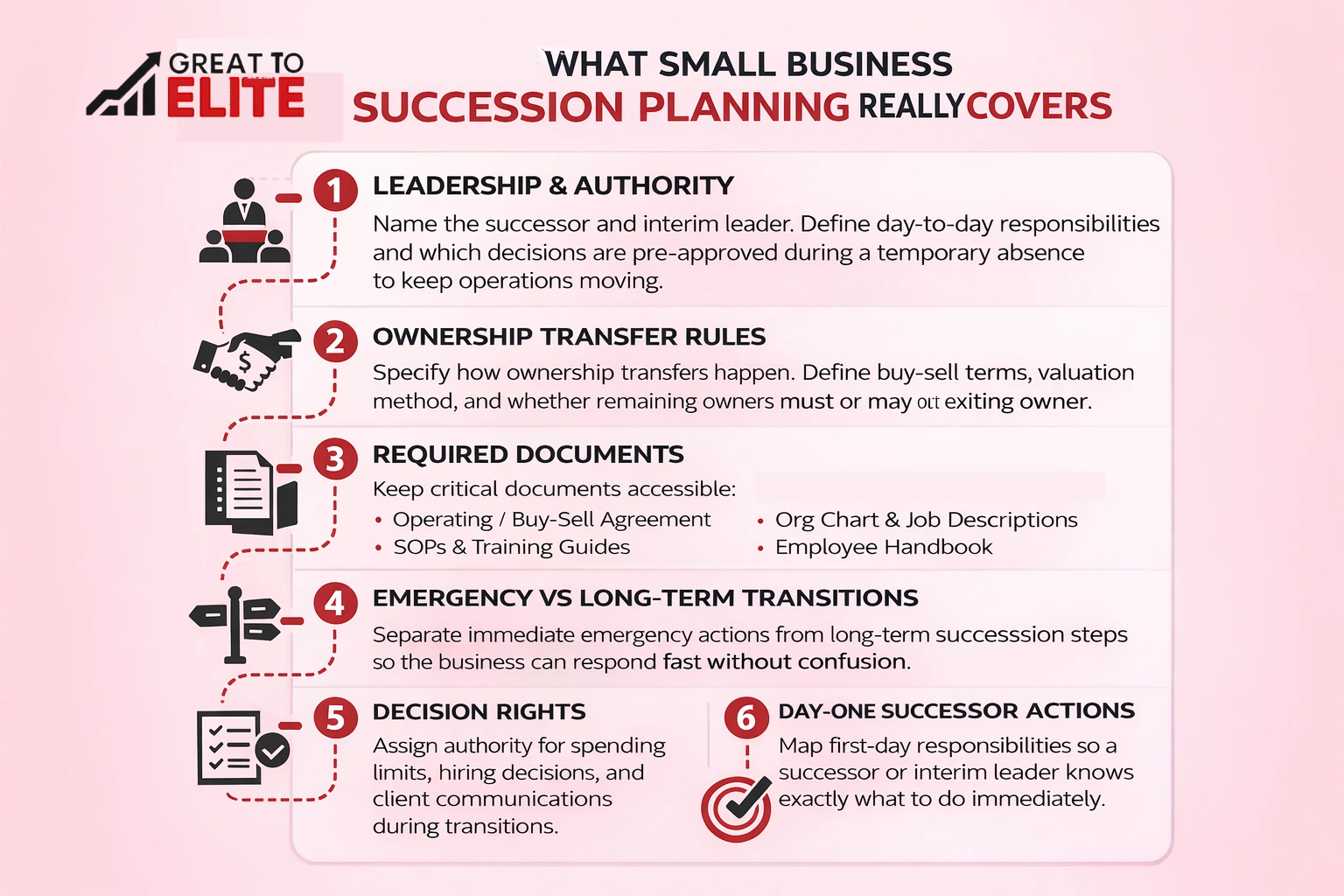
Name who will take over leadership and specify day-to-day duties. Define which management decisions are pre-authorized during a temporary absence. That prevents confusion and keeps operations moving.

Make ownership transfer rules explicit. State whether remaining owners can or must buy an exiting owner’s interest and reference an operating or buy-sell agreement to make that enforceable.

  1. List required documents: operating or buy-sell agreement, org chart, job descriptions, employee handbook, SOPs, and training guides.
  2. Distinguish emergency actions from long-term transition steps so both scenarios are covered.
  3. Assign decision rights: spending limits, hiring authority, and client communications for interim leaders.
  4. Map day-one responsibilities for successors so anyone stepping in knows what to do immediately.

Keep these plans and documents aligned and in one accessible place so your company can act fast under pressure.
what small business succession planning really covers

Why Planning Now Protects Your Business, People, And Legacy

Acting now preserves value for your heirs and keeps operations steady when the unexpected happens.

Assess immediate risks: death, disability, or a temporary absence. Define triggers so your plan activates automatically and work continues without guesswork.

Risk Mitigation: Death, Disability, Or Temporary Absence

When a trigger occurs, pre-set steps reduce confusion. Name an interim leader, set spending limits, and secure client communications to limit revenue loss.

Continuity Of Operations Versus Ownership Transfer

Ownership transfer is not the same as who runs day-to-day work. Your plan should separate equity moves from operational roles so qualified leaders keep the company running.

Economic Reality: Most Owners’ Wealth Is Tied Up In The Company

Many owners hold most of their net worth in the company. Without a clear plan, heirs and stakeholders can face steep losses, delays, or forced sales at a discount.

Common Pitfalls: No Buyer, Family Conflict, And Tax Surprises

About one-third of firms have a plan and nearly 70% fail to sell at retirement. Early work reduces buyer discounts, lowers tax surprises, and calms family disputes.

  1. Name a successor and alternate decision makers.
  2. Document operations so employees can carry on day-to-day tasks.
  3. Build tax-aware funding, insurance, loans, or staged buyouts, to protect value.
Risk
Immediate Action
Who Owns It
Goal
Death or total disability
Trigger buyout or trust transfer; appoint interim CEO
Owners, legal counsel
Preserve value for heirs and clients
Temporary absence
Activate interim authority; notify customers
CEO, operations lead
Maintain cash flow and service levels
No buyer at retirement
Start exit readiness 3–5 years out; improve sellability
Owner, CFO
Increase sale probability and price
Unplanned tax costs
Model tax scenarios; adjust entity and timing
Owner, tax advisor
Reduce erosion of proceeds

Your Buyer’s Guide Roadmap To Small Business Succession Planning

Fix a firm timeline that turns an abstract idea into actionable milestones. Set a clear exit goal three to five years out so you can sequence valuation work, grooming, and financial cleanup.

Define Your Exit Timeline: Three To Five Years Out

Work backward from your target date. Add checkpoints for valuation, debt cleanup, and buyer outreach.

Identify Successor Options And Criteria

Create a skills-based profile for candidates, family, partner, employee, or third party, and rate them objectively on leadership, financial acumen, and client relationships.

Organize Financials: Clean Books, P&L, And Audits

Clean the balance sheet, produce a reliable P&L, and consider an independent CPA review to boost buyer confidence.

Document Operations: SOPs, Org Charts, And Training

Capture day-to-day processes, roles, and training guides so a new manager can follow a proven process from day one.

Plan Funding And Tax Strategy Early

Match funding methods, insurance, loans, or seller financing, with tax advice to avoid surprises at close.

Announce Smartly: Sequence Communications To Your Team

Tell key team members early to preserve morale, then inform the wider staff after closing or at a controlled point to protect retention.

  • Create a prioritized list of tasks, owners, and due dates tied to your timeline.
  • Use a simple updating process so documents remain current in one secure place.
Step
Owner
Goal
Timeline & milestones
Owner
Three–five year exit roadmap
Financial cleanup
CFO / Accountant
Reliable P&L and clean balance sheet
Operations documentation
Operations manager
Replicable SOPs and training guides

Choosing A Transition Path: Family, Employees, Partner, Or Sale

Choosing the right exit route shapes how value, control, and continuity travel after you step back. Compare the main types to match your goals for timing, cash needs, and culture.

Passing To A Family Member Or Heir

Passing ownership via will or trust keeps things in the family and can preserve legacy. Evaluate readiness: leadership skills, financial ability, and willingness to run the company.

Plan fair treatment for relatives who do not work in the company to avoid conflict and claims that erode value.

Sale During Life To A Third Party

Selling during your life typically maximizes price but adds confidentiality and due-diligence work. You can negotiate earnouts, warranties, and timing to protect value.

Third-party deals often move faster if financials are clean and key clients are secure.

Co-Owner Paths: Operating Agreements And Buyouts

Predefined operating or buy-sell terms remove guesswork. Use triggers, valuation formulas, and funding rules so owners know how a transfer will be priced and paid.

Funding clarity, insurance, loans, or staged payments, reduces interruption and preserves relationships among owners.

Employee-Centered Transitions And Leadership Placement

Employee transfers combine leadership promotion with broader ownership options like ESOPs or seller financing. This protects culture and continuity.

Design leadership placement, training, and retention incentives so clients and staff see steady management from day one.
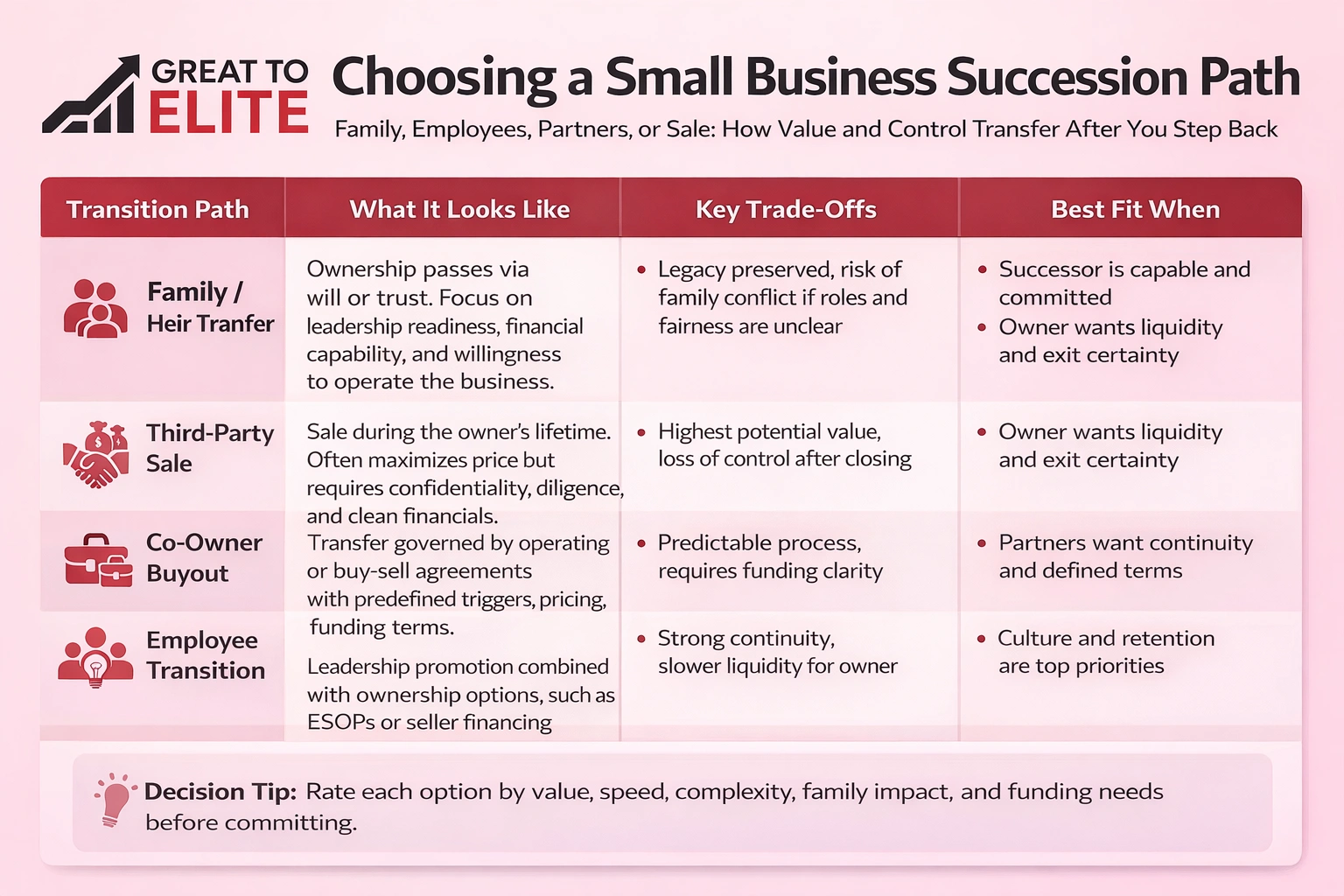
  • Decision matrix tip: Rate each type by value, speed, complexity, and family impact to make a defensible choice.
  • Weigh ownership control, leadership readiness, funding needs, and timing trade-offs before you commit.
how to choose a small business succession path

Valuing Your Business And Funding The Succession

Pinning down both price and payment sources makes business ownership succession moves practical and predictable.

Valuation methods to choose from

Pick the method that matches your company’s size, growth outlook, and data quality. Common approaches are:

  • Asset-based: assets minus liabilities for firms with heavy tangible assets.
  • CCF / capitalization of cash flow and SDE: useful for owner-heavy earnings and stable cash flows.
  • DCF: projects and discounts future cash flows for growth companies with reliable forecasts.
  • Market-based: uses comparable transactions when good comparables exist.

Improving sellability

Buyers reward predictable profit, a clean balance sheet, and a diversified customer base.

Work to remove one-time expenses, tighten collections, and document recurring revenue. That raises perceived value and speeds selling business negotiations.

Funding and pricing mechanics

Common funding tools include life insurance, bank loans, internal reserves, or seller financing. Match the mix to cash needs and tax goals.

Decide if transfers use a fixed price or a formula tied to fair market value. Put update rules into the succession plan so owners avoid disputes later.

Method
When to use
Primary benefit
Asset-based
Asset-heavy firms
Simple and defensible
CCF / SDE
Stable owner earnings
Reflects cash available to an owner
DCF / Market
Growth or comparable deals
Captures future value and market signals

Tax-aware timing matters. Model tax outcomes, choose entity structure, and time payouts to keep more value in your pocket. That makes the transition more attractive to a successor and to lenders.

Legal And Operational Documents You Need In Place

Gather the legal and operational files now so transfers run smoothly when a trigger occurs.

Compile core legal agreements that make ownership and price mechanics enforceable. Include wills and trusts for ownership interests, an operating agreement for decision authority, and a buy-sell agreement that states valuation methods and funding rules.

Core agreements

These documents define who owns what, when a transfer happens, and how payments are made. Make sure each paper names the owner, pricing formula, funding source, and trigger events.

Playbooks for continuity

Operational playbooks let a new leader keep operations steady from day one. Create SOPs, org charts, an employee handbook, and training guides that spell out daily tasks.

  • Compile and label: wills, trusts, operating and buy-sell agreements so title and price are clear.
  • Document how work gets done: SOPs, org charts, and handbooks for continuity.
  • Write roles and responsibilities: clear duties speed onboarding and reduce disputes.
  • Maintain a living list: where documents live, update schedules, and who owns each update.
  • Align legal and operations: match triggers, pricing rules, and decision rights across all plans.
  • Review annually: a short checklist keeps facts, people, and numbers current.
Document
Primary purpose
Owner
Storage
Wills & Trusts
Transfer ownership interests
Owner & attorney
Attorney vault + secure cloud
Operating Agreement
Decision rules and governance
Owners / legal
Company records + cloud
Buy-Sell Agreement
Valuation, funding, triggers
Owners / CFO
Secure file share & attorney
Operational Playbooks
Daily processes and training
Operations manager
Accessible cloud drive

Executing The Transition With Confidence

A smooth handoff hinges on defined roles, clear timing, and repeatable steps that everyone follows.

Leadership Handover And Interim Management

Orchestrate a formal leadership handover with documented duties, immediate priorities, and interim coverage. Appoint an interim leader who has spending limits and client contact rules.

Train that person on critical tasks and give access to advisors. Set governance and reporting rhythms so the new leader reports progress weekly at first.

Employee Communications And Retention

Tell key staff early to protect morale and retention. Then announce widely at a controlled time, often after closing, to limit rumors and churn.

Use clear messages: who will lead, what changes to expect, and how roles will evolve. Offer retention incentives for essential roles.

Emotional Readiness And Post-Exit Life Planning

Prepare for life after the deal. Talk with former owners, ask detailed questions of advisors, and create a post-exit plan that excites you.

Schedule milestones for leadership, systems, customers, and financial handoffs. A disciplined checklist reduces regret and keeps the future secure.

  • Formalize the handover with dates and owners.
  • Document reporting and governance for the first 90 days.
  • Train successors and connect them to mentors.
how to hand over leadership in a small busienss succession

How Great to Elite Helps You Build And Execute A Succession Plan

Great to Elite helps you turn a vague exit idea into a concrete roadmap with deadlines and owners. We work with business owners to make the plan practical and executable.

  • Strategic Roadmapping: You clarify your timeline, define a successor profile, and set staged milestones that keep the process moving on schedule.
  • Financial Readiness: You align valuation goals, clean financials, and design a funding approach that fits your company and buyer.
  • Operational Continuity: You codify SOPs, org charts, and training so operations remain stable before, during, and after the transition.
  • Deal Support: You assemble documents, coordinate advisors, and streamline diligence so the transaction closes smoothly.
  • People and Change Management: You plan communications, incentives, and retention strategies for key employees to protect value.

If you are a small business owner ready to start or refine your plan, book a call with Great to Elite. Get a tailored strategy, a clear timeline, and hands-on execution support from a trusted team.

Conclusion

A clear exit roadmap turns vague intentions into steps you can follow years before retirement.

Start now: name leaders, document daily roles, and validate financials so you protect value when you transfer ownership.

Align funding and tax choices early to avoid surprises and make selling business or a sale more attractive to buyers.

Use measurable milestones and review this plan each year over the next five years to stay on track.

Act with urgency. A structured process preserves customers, keeps employees steady, and helps owners reach their retirement goals with more value in hand.

FAQs

How Is Succession Planning Different for Very Small Businesses or Solo Owners?

Succession planning still matters even if you have only a few employees or operate solo. In these cases, the focus shifts from layered leadership to continuity of clients, access to accounts, and ownership transfer. A plan ensures someone can step in to collect receivables, fulfill contracts, or wind down the business in an orderly way instead of leaving value stranded.

What Happens If I Have No Clear Successor Today?

Not having a successor does not mean you should delay planning. A good succession plan defines interim leadership, stabilizes operations, and prepares the business for multiple exit paths, including a future sale. This flexibility protects value while you explore internal development or external buyers over time.

Can a Succession Plan Help If I Am Not Planning to Retire Soon?

Yes. Succession planning is as much about risk management as retirement. It protects the business during unexpected absences, health events, or emergencies and reduces operational chaos. Owners who plan early also retain more control over timing, valuation, and leadership choices later.

How Often Should a Small Business Succession Plan Be Updated?

A succession plan should be reviewed annually or after major changes such as new partners, rapid growth, debt restructuring, or leadership turnover. Keeping documents current ensures triggers, valuation assumptions, and decision rights still match reality when the plan is activated.

Do I Need a Succession Plan If I Already Have a Will or Trust?

Yes. Estate documents control ownership, not daily operations. Without a succession plan, employees, vendors, and clients may not know who has authority to act. A succession plan bridges the gap between legal ownership and operational continuity so the business keeps running.

How Long Does It Typically Take to Put a Succession Plan in Place?

Most small business owners can create a practical succession plan within three to six months. The timeline depends on financial readiness, documentation gaps, and whether valuation or legal restructuring is required. Starting earlier reduces pressure and allows for better decision-making.

Is Succession Planning Only About Selling the Business?

No. Selling is just one possible outcome. Succession planning also covers temporary leadership gaps, internal promotions, family transfers, and co-owner buyouts. The goal is continuity and value protection, regardless of whether ownership ultimately changes hands.