Business Ownership Succession: Strategies for a Successful Leadership Transition
Business Ownership Succession: Strategies for a Successful Leadership Transition

Natalie Luneva
December 21, 2025




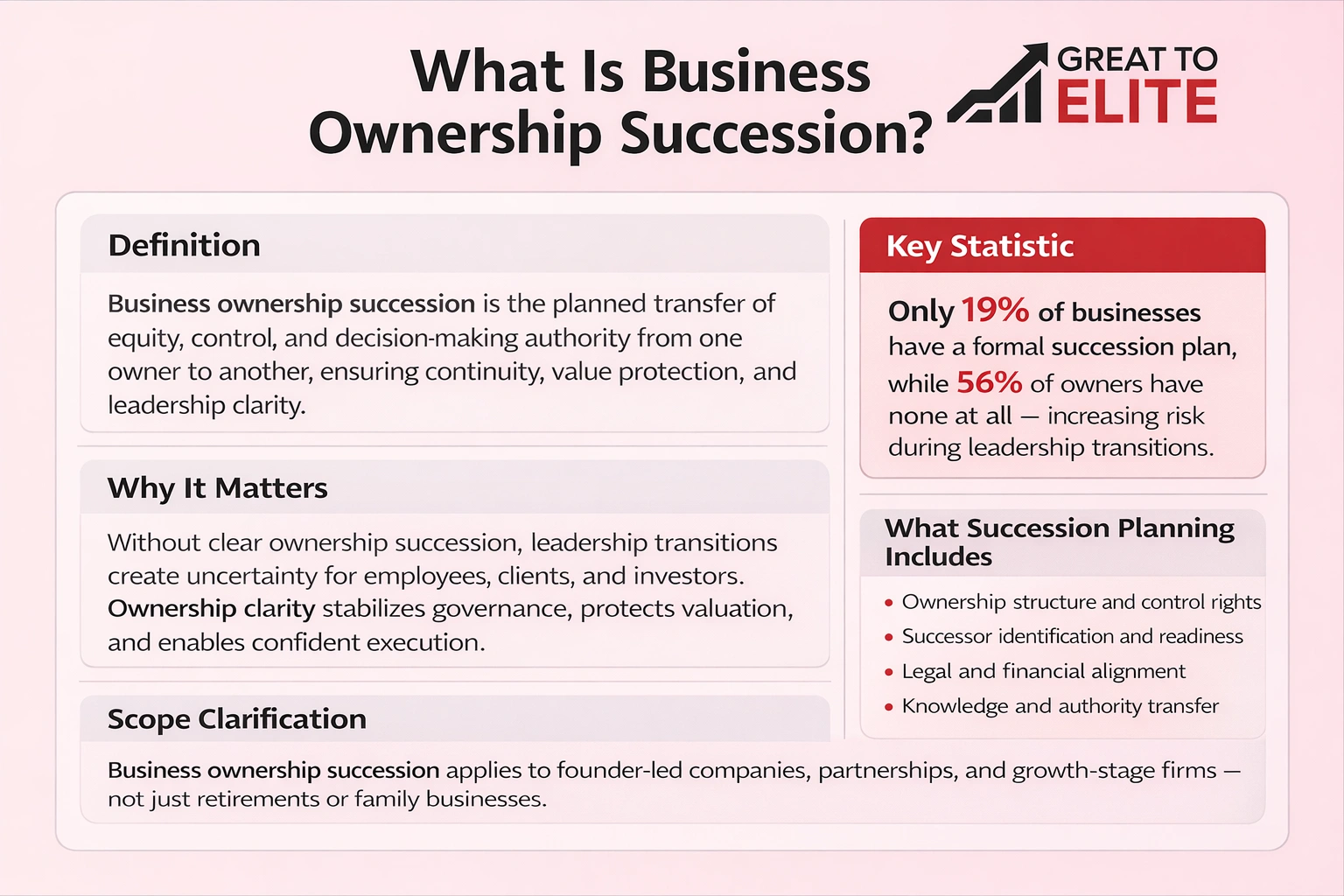
Business ownership succession is the structured transfer of ownership, control, and decision-making authority from one owner to another. It determines who holds equity, who has voting power, and how value is preserved when leadership changes. Unlike informal handoffs or last-minute exits, ownership succession is a deliberate process that aligns legal, financial, and operational realities with the future direction of the business.
Business ownership succession is the deliberate transfer of equity, control, and decision-making authority from one owner to another. It defines who owns the business, who controls key decisions, and how value is protected during a leadership change. As of 2025, only about 19% of businesses have a formal succession plan in place, and 56% of all business owners haven’t established one at all, despite succession’s role in continuity and stability. Rather than a reactive or informal handoff, ownership succession is a planned process that aligns legal structure, financial outcomes, and operational control with the company’s long-term direction.
A successful leadership transition depends on this foundation. Without clear ownership succession, even capable leaders operate under uncertainty, creating risk for employees, clients, and investors. Ownership clarity stabilizes governance, protects valuation, and allows new leadership to execute without friction or hidden constraints.
This process is not limited to retirement or family businesses. Ownership succession applies to founder-led companies, partnerships, and growth-stage firms planning for continuity, liquidity, or partial exits. When done well, it reduces dependency on a single individual, strengthens institutional resilience, and turns transition into a strategic advantage rather than a disruption.
Succession planning is not just about deciding who will take over the business; it's about creating a comprehensive plan to prepare the next generation of leaders. A well-structured succession plan includes identifying key positions, developing successor profiles, and implementing leadership development programs.
Many businesses lack adequate succession planning, with nearly 50% having done no planning whatsoever. This oversight can lead to significant disruptions in business operations and impact the company's ability to achieve its objectives.
Succession planning ensures business continuity. It allows companies to respond to leadership changes in a structured and proactive manner, minimizing the risk of disruption to operations.
Statistics underscore the importance of succession planning for business survival. Companies that have a robust succession plan in place are more likely to weather leadership transitions successfully. For instance, businesses with effective succession planning are:
When business owners ensure that the next generation of leaders is equipped to continue the company's mission and vision, they can safeguard their legacy and maintain the value of their business.
Effective succession planning involves not just the transfer of ownership but also the transfer of knowledge, expertise, and company culture. This comprehensive approach ensures that the business continues to thrive under new leadership.
The timing of succession planning can significantly impact the future of a business. Early planning is important for a smooth transition and the long-term success of the organization.
Effective succession planning requires a well-thought-out timeline. This involves identifying the right moment to initiate the transition process, ensuring that all stakeholders are prepared, and that the successor is adequately groomed for the role.
A successful transition timeline should consider the complexity of the business, the readiness of potential successors, and external factors such as market conditions.
Delaying or neglecting succession planning can have severe consequences for a business. Two significant areas of impact are financial implications and operational disruptions.
Without a clear succession plan, businesses may face significant financial challenges, including the potential for decreased valuation, increased tax liabilities, and the costs associated with rushed decision-making.
The absence of a succession plan can lead to operational disruptions, affecting the day-to-day activities of the business. This can result in decreased productivity, loss of customer confidence, and potential damage to the business's reputation.
Assessing your business's current state is a foundational step in succession planning. This process involves understanding the overall health and value of your business, as well as identifying the critical elements that drive its success.
A comprehensive business valuation will show the worth of your business. This valuation includes assessing both tangible and intangible assets to get a complete picture of your business's financial and operational standing.
Tangible assets include physical properties such as equipment, real estate, and inventory. Intangible assets, on the other hand, comprise intellectual property, brand reputation, customer relationships, and proprietary technology.
Identify key positions and knowledge centers within your organization. Key positions are those roles that are critical to the day-to-day operations and strategic direction of your business. Knowledge centers refer to individuals or teams that possess unique knowledge or skills.
When you understand your business's current state, including its valuation and key operational elements, you can develop a more effective succession plan that ensures continuity and minimizes disruption.
Business owners can choose from various models, each with its unique characteristics, advantages, and challenges.
Family business succession planning involves transferring ownership and leadership to family members. This model is often chosen for its ability to keep the business within the family and maintain its legacy.
To ensure a smooth transition, prepare next-generation leaders within the family. This involves providing them with the necessary training, mentorship, and experience to take over the business successfully.
Key aspects of family succession include:
A management buyout (MBO) occurs when the existing management team purchases the business from the current owner. This model is advantageous as it allows for continuity of leadership and preserves the company's culture.
Benefits of MBOs include:
Selling the business to an external party is another viable succession model. This can involve selling to another company, private equity firm, or individual investor.
Considerations for external sales include:
ESOPs are a popular succession model where employees become owners of the company through a trust. This model provides tax benefits and can be an effective way to transfer ownership.
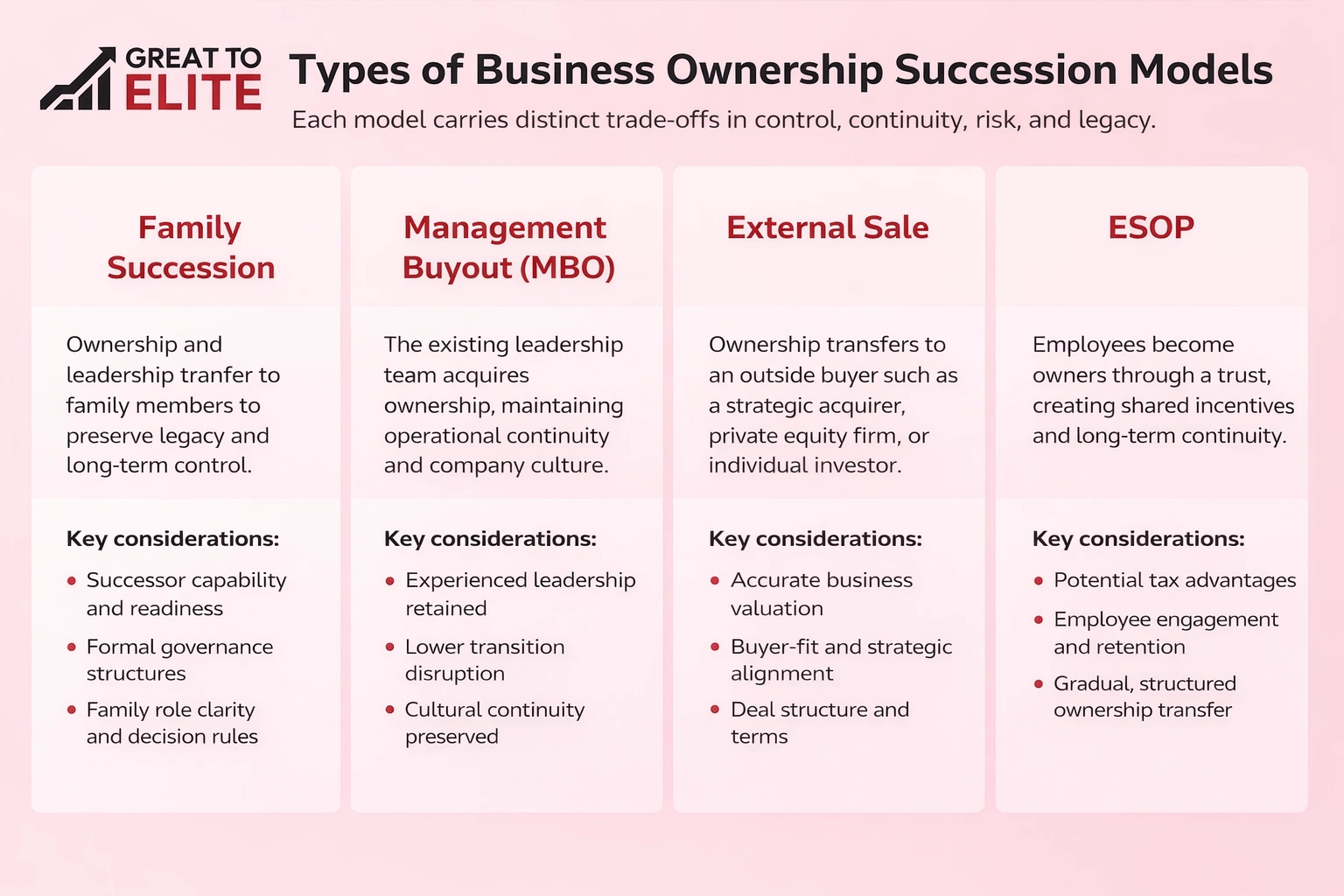
Each succession model has its unique advantages and challenges. Business owners should carefully evaluate these options to determine the best fit for their company, considering factors such as financial goals, leadership continuity, and employee motivation.
Build a robust succession planning team to handle the complexities of leadership transitions. A well-structured team ensures that all aspects of the succession process are considered, from financial and legal implications to operational continuity.
A succession planning team should comprise various professional advisors who bring different areas of expertise. These include:
Financial consultants can help in valuing the business and identifying potential funding sources. Legal advisors ensure that all legal documents are in order, and the transition complies with relevant laws and regulations. Business consultants assist in developing a strategic plan for the future, ensuring the business remains competitive.
Define the roles and responsibilities of the succession planning team. Each member should have clear tasks and be accountable for specific aspects of the succession plan.
The team leader should oversee the entire process, ensuring that all elements are completed on time. Financial advisors will focus on the financial aspects, while legal professionals will handle the legal documentation and compliance. Business consultants will work on strategic planning and market analysis.
A well-planned succession strategy begins with identifying and developing potential successors. This step ensures that your business is prepared for a smooth leadership transition.
The first step in identifying successor candidates is to create detailed profiles and selection criteria. This involves defining the key skills, experience, and qualities required for the role. Establish clear criteria to objectively evaluate potential successors and ensure the best fit for your business.
To create effective successor profiles, consider the following factors:
Once you have identified potential successor candidates, provide them with the necessary training and development opportunities. Leadership development programs can help potential successors build the skills and expertise required for the role.
These programs may include:
When you pair potential successors with experienced leaders, you can facilitate the transfer of knowledge and expertise.
Structured knowledge documentation is an aspect of the knowledge transfer. This involves capturing and documenting business knowledge and processes, making it easier to transfer to potential successors.
To implement structured knowledge documentation, consider the following steps:
The financial aspects of business ownership succession are complex and require careful planning to ensure a smooth transition.
Business owners must decide how to finance the transfer of ownership, which can be through various means.
Internal financing involves using the company's own funds or profits to finance the succession. External financing, on the other hand, involves seeking funds from outside sources, such as loans or investors.
Each option has its pros and cons, and the choice depends on the company's financial health and goals.
Different succession strategies have varying tax consequences.
Effective tax planning can help minimize tax liabilities, ensuring that the succession process is more cost-effective.
Structuring the financial transaction involves deciding on the terms of the sale or transfer, including the price, payment terms, and any conditions.
A well-structured financial transaction affects both the seller and the buyer.
Carefully consider these financial aspects to ensure a smooth and successful succession.
The success of a business ownership transition heavily relies on its legal underpinnings. A comprehensive legal framework ensures that the transfer of ownership is executed smoothly, minimizing potential disputes and legal challenges.
These documents provide clarity on the terms of the transition, protect the interests of all parties involved, and help in navigating complex legal requirements.
A buy-sell agreement is a document that outlines how a business owner's share will be transferred in the event of retirement, death, or other triggering events. It ensures continuity and establishes a clear process for the transfer of ownership.
An operating agreement governs the operation of the business and the relationships between owners. Amendments to this agreement may be necessary to reflect changes in ownership structure during a transition.
Business owners must ensure that their succession plan complies with relevant laws and regulations. This includes securities laws, tax laws, and employment laws, among others.
A successful business transition relies heavily on the ability to manage stakeholder relationships effectively. This involves not only maintaining but also strengthening relationships with various stakeholders, including employees, clients, and vendors.
Effective communication with employees helps in reducing uncertainty and anxiety among the workforce.
Key strategies include:
Clients and vendors are crucial stakeholders whose relationships need to be maintained and nurtured during a transition.
Strategies for maintaining these relationships include:
Proactive engagement involves anticipating the needs of stakeholders and taking initiatives to address them.
Examples include:
Risk management plays a pivotal role in ensuring the continuity of a business during ownership transitions. It involves a comprehensive approach to identifying, assessing, and mitigating risks that could impact the succession process.
These may include:
Contingency planning addresses unexpected events that may arise during the succession process. This involves:
Emergency succession protocols ensure business continuity in the face of unexpected events, such as the sudden departure or incapacitation of the current owner. These protocols should include:
With robust risk management strategies, businesses can mitigate potential risks and ensure a smoother transition during the succession process.
The implementation of a business ownership succession plan is a complex process that requires careful planning, precise execution, and ongoing monitoring. It's the phase where strategies are put into action, and the groundwork laid in previous stages is utilized to ensure a smooth transition.
This involves:
This way, businesses can ensure that all necessary steps are taken in a timely and orderly manner, minimizing disruptions and ensuring continuity.
Adopting a phased implementation approach can help manage the transition process more effectively. This might involve several stages:
Continuously monitor the progress of the succession plan implementation and make adjustments as necessary. This involves:
This proactive approach enables businesses to respond to challenges promptly, ensuring the succession plan remains on track.

A well-planned succession is just the beginning; businesses must also navigate post-transition considerations to achieve long-term success. Focus on the period that follows as well. This phase maintains stability, drives growth, and secures the future of the organization.
Assess the success of the transition and its impact on the business. This involves examining various aspects of the organization to determine if the transition has achieved its intended objectives.
Key performance indicators (KPIs), such as revenue growth, customer satisfaction, and employee engagement, show the effectiveness of the transition.
Support the new leadership to ensure a successful transition. This involves providing the necessary resources and guidance to help the new leaders navigate their roles effectively.
Maintaining ongoing advisory relationships can provide valuable support to the new leadership. This can include continuing to work with professional advisors, such as lawyers, accountants, and business consultants, to address any challenges that arise during the post-transition period.
Business owners often overlook critical aspects of succession planning, leading to unnecessary complications. A well-planned succession strategy ensures the continuity and success of a business. However, several common mistakes can hinder this process.
Emotional barriers can significantly impede the succession planning process. One of the primary emotional challenges is the difficulty in letting go of control and legacy.
Founder's Syndrome is a phenomenon where the founder or current leader struggles to relinquish control, often due to a deep emotional attachment to the business. This can hinder the transition process and create uncertainty among stakeholders.
Besides emotional barriers, technical pitfalls can also derail succession planning. These include inadequate preparation and poor execution.
Insufficient documentation and training for the successor can lead to operational disruptions and knowledge loss. Ensure that the incoming leader is well-equipped to manage the business.
When you understand and address these common succession planning mistakes, you can handle the transition more effectively, ensuring continuity and long-term success.
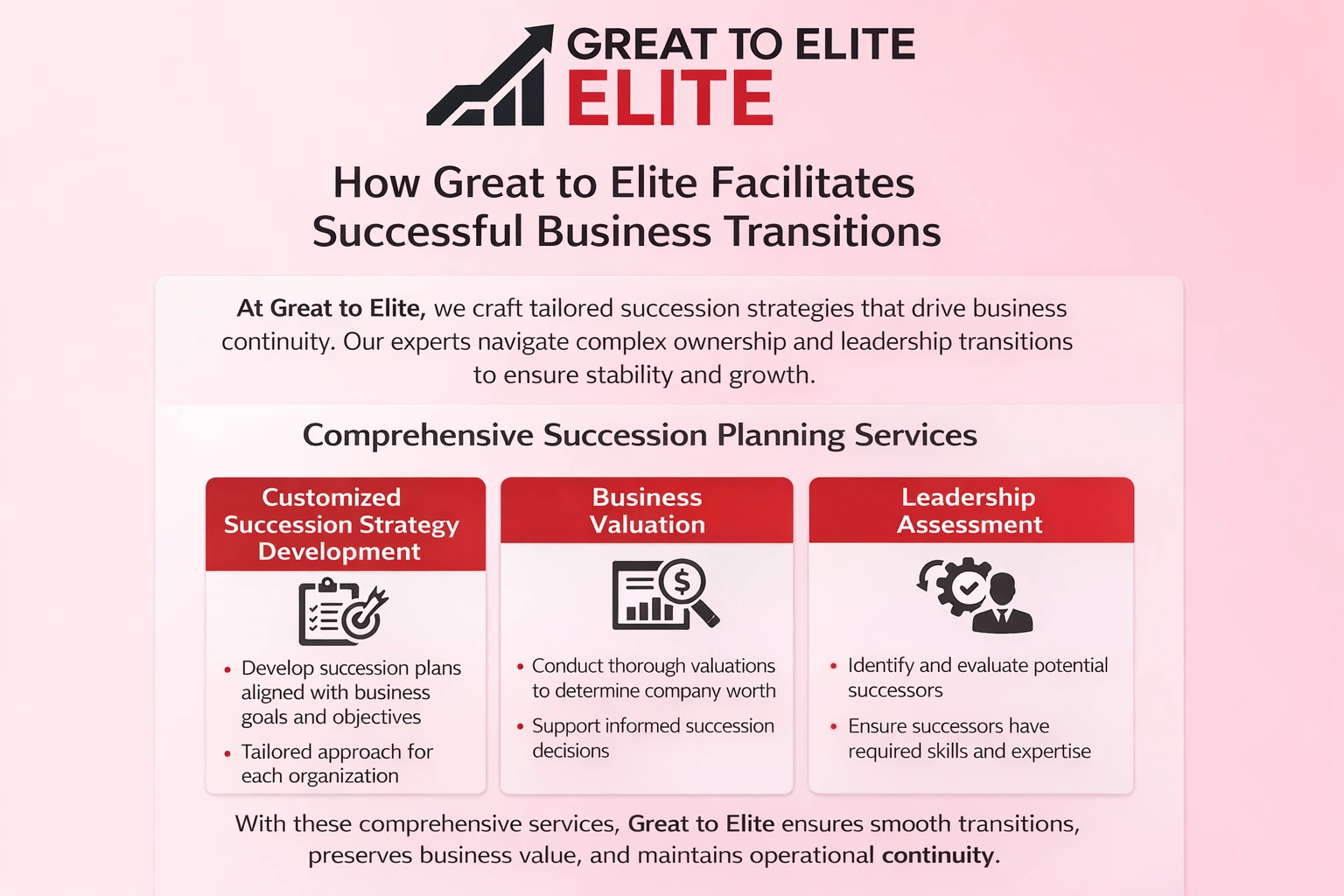
At Great to Elite, we specialize in crafting tailored succession strategies that drive business continuity. Our team of experts understands the complexities of business transitions and is dedicated to helping organizations navigate these changes successfully.
Great to Elite offers a range of succession planning services designed to meet the unique needs of each business. Our services include:
With these comprehensive services, Great to Elite helps businesses ensure a smooth transition and maintain continuity.
Embarking on a succession planning journey can seem daunting, but with Great to Elite, you're not alone. Our experienced professionals guide you through every step, from initial consultation to the final transition.
To take the next step in your succession journey, consider the following:
With these steps, you can ensure a successful business transition and secure the future of your organization.
Effective succession planning ensures that your company's legacy endures beyond your tenure. When you understand the intricacies of business ownership succession, you can handle the transition process with confidence.
Great to Elite specializes in guiding businesses through the complex process of succession planning. Their comprehensive services include:
When you partner with Great to Elite, you can ensure a seamless transition that preserves your business's value and reputation. To explore how Great to Elite can support your business ownership succession, book a call to discuss your succession planning needs.