Seller financing is a common route for small company purchases in the United States. In this option, the seller acts like a bank and holds a promissory note while you make monthly payments. That arrangement can lower immediate cash needs and help you manage transition costs.
According to the International Business Brokers Association (IBBA), in many deals, seller financing typically accounts for 10-20 % of the overall transaction value.
Key Takeaways
Seller-held notes let you pay the seller monthly instead of using a bank loan.
Common negotiation points include price, down payment, and interest rate.
This option often appears in small transactions and can conserve operating cash.
Prepare credit, resume, and liquidity to align with realistic terms.
Cash-flow coverage and legal documents protect both parties during repayment.
Owner Financing At A Glance
A frequent practice in smaller deals is the seller extending credit to complete the sale. In many U.S. transactions this seller financing lets you secure the purchase without full bank lending, which is why some buyers see it as one of the few ways to buy a company with no money or with very little cash upfront. It can speed closing and save working capital for operations and transition costs.
You’ll typically see a down payment and a note that covers the balance. Down payments often range from 10%–25% or higher. Seller-held portions commonly cover about 10%–30% of the price, though markets vary.
Terms usually run 3–7 years.
Interest and rates sit in mid-single to low-double digits depending on risk and cash flow.
Agreements are secured by assets and formalized with a promissory note and security agreement.
The main advantage is flexibility: you and the seller can tailor payments around cash flow and risk. Payments must fit the enterprise’s cash flow so both buyers and sellers protect their positions.
Feature
Typical Range
Why It Matters
Common Term
Down payment
10%–25%+
Reduces seller exposure and shows buyer commitment
Paid at closing
Seller-held portion
10%–30%
Bridges funding gaps when bank credit is limited
Secured by assets
Term length
3–7 years
Balances monthly payment size and total interest
Amortized or balloon
Interest rates
Mid-single to low-double digits
Reflects risk and cash-flow stability
Fixed or variable
What Is Owner Financing In Business Acquisitions?
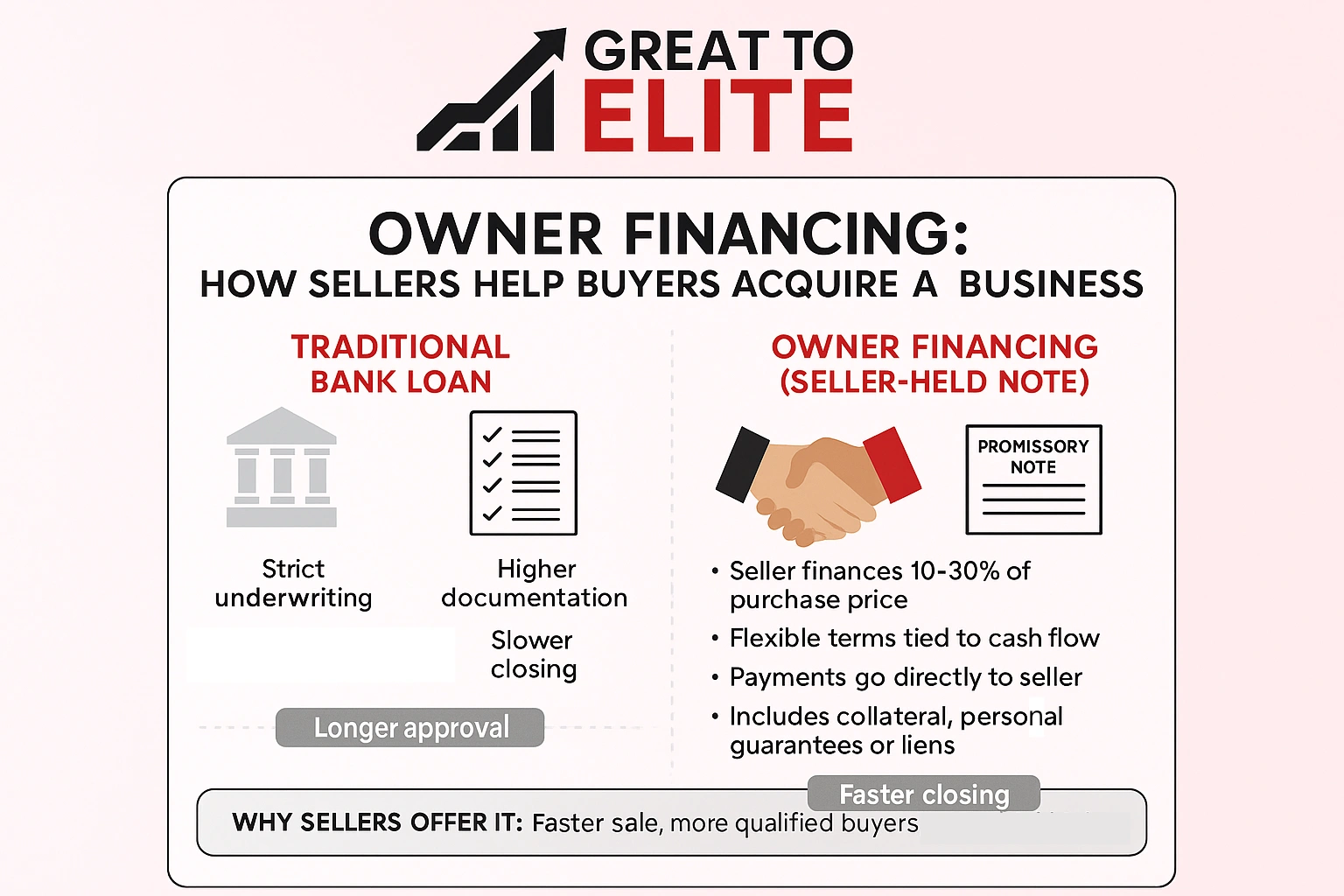
A seller-held note means monthly payments go straight to the former owner rather than a traditional lender. In this setup, the seller covers part of the purchase and you repay principal plus interest under agreed terms.
How seller financing works compared to a bank loan
Underwriting is negotiated between you and the seller. Documentation focuses on cash flow and risk, so timelines can be shorter and paperwork lighter than a bank loan.
Typical share of the purchase price financed by the seller
Many small deals include a meaningful seller portion. In mid-market transactions the seller often finances about 10%–30% of the purchase price. That share depends on size and perceived risk.
Why sellers offer a seller note
Sellers expand the pool of qualified buyers and can close faster.
They may command a higher price in exchange for carrying part of the deal.
Protection comes from liens on assets, personal guarantees, and performance clauses.
How To Buy A Business With Owner Financing
Map each step from first inquiry through final closing so you keep the deal on track. A clear roadmap reduces surprises and sets expectations for both parties.
Map the process from interest to closing
Begin with outreach and an NDA, then review documents the seller provides. Next, present an offer anchored on price and follow with terms negotiation.
Prepare your buyer package: credit, resume, and capital
Assemble a concise packet that shows your credit profile, relevant experience, and available capital. Sellers often vet these before agreeing to extend financing.
Sequence negotiations: price first, terms second
Agree on valuation first. Once the price is set, structure down payment, interest, amortization, and any balloon. This keeps negotiations focused and efficient.
Set a realistic timeline for diligence and funding
Define milestones for financial review, tax returns, cash flow checks, and legal work. Build contingency steps for findings that affect price or terms.
Document key negotiation points in writing.
Request access to systems and staff introductions for post-closing transition.
Keep momentum, meet agreed deadlines and communicate changes.
Stage
Action
Typical Time
Why it matters
Initial interest
Sign NDA; exchange docs
1–2 weeks
Protects confidentiality and starts review
Offer & negotiation
Price offer, then terms
1–4 weeks
Valuation first clarifies affordability
Due diligence
Financials, tax returns, credit checks
2–6 weeks
Verifies cash flow and uncovers risks
Documentation & closing
Purchase agreement, promissory note, signatures
1–3 weeks
Finalizes obligations and starts payments
Key Terms You’ll Negotiate With The Seller
Negotiations center on a handful of terms that shape monthly obligations and long‑term risk. Be explicit early so the seller and you share the same expectations.
Purchase Price and Down Payment
Set the purchase price using cash‑flow analysis and market comps. Then pick a down payment that proves commitment and reduces seller exposure. Typical down payments run 10%–25% or higher.
Loan Amount, Term, and Repayment Schedule
After the down payment, confirm the loan amount and a term that keeps monthly payments manageable. Common terms are 3–7 years. Agree on amortization and any balloon payoff dates.
Interest Rate, Fees, and Balloon Payments
Negotiate an interest rate tied to risk and cash flow. Clarify origination, late fees, and whether a balloon will require refinance or lump‑sum payment.
Collateral, UCC Filings, and Personal Guarantees
Secure the note with business assets and record a UCC filing to perfect the lien. Discuss whether you must provide a personal guarantee depending on credit and deal size.
Special Clauses: Performance Benchmarks and Forfeiture
Include benchmarks, reporting rights, and clear remedies for default. Specify access to interim statements and exact steps that follow missed payments to minimize disputes.
Clear payment schedule: monthly due date and allocation of interest vs principal.
Collateral clarity: which assets secure the note and filing details.
Default remedies: cure periods, forfeiture triggers, and repossession rights.
Term
Typical Range
Why it matters
Down payment
10%–25%+
Signals commitment; lowers seller risk
Term length
3–7 years
Balances monthly payment and total interest
Collateral & guarantees
Asset lien; possible personal guarantee
Protects seller and affects your exposure
Balloon & fees
Balloon common; fees negotiable
Impacts refinance need and cash planning
Buyer And Seller Due Diligence Essentials
Careful review of numbers and credit uncovers risks that affect price and terms. This is the core of due diligence when buying a company, where you verify statements, tax returns, and schedules to confirm true revenue and normalized cash flow. Keep notes on anomalies and trends.
Financial statements, cash flow, and tax returns
Request balance sheets and profit & loss reports for at least three years. Compare those to filed tax returns and bank statements.
Test cash flow sensitivity for seasonality and customer concentration. That helps set realistic payment capacity.
Business credit reports and working capital needs
Check vendor histories, liens, and judgments on the business credit file. Analyze receivables, payables, and inventory cycles to confirm run-rate working capital.
Buyer vetting: credit, experience, and references
Provide your credit report, relevant resume, and references so sellers can assess operational fit and repayment ability.
Risk flags and documentation
Watch for inconsistent revenues, weak bookkeeping, or missing records. Address issues through price adjustments, tighter terms, or additional collateral.
Due Diligence Item
What You Check
Why It Matters
Next Step
Financial statements
3 years P&L, balance sheet
Verifies revenue and margins
Normalize earnings; adjust offer
Tax returns
Federal returns, payroll filings
Confirms reported income
Resolve discrepancies with seller
Credit reports
Business and buyer credit
Shows payment history, liens
Require cure or stronger collateral
Assets & UCCs
Ownership, liens, registrations
Protects collateral package
Clear or subordinate encumbrances
Contracts And Legal Documents You’ll Need
Well-drafted contracts reduce ambiguity and protect both parties during transfer and repayment. You need a clear set of papers that ties the negotiated terms to enforceable steps at closing and afterward.
Purchase agreement: assets, price, and closing terms
The purchase agreement must state whether the sale is an asset or stock transfer. It should list included assets, the agreed price, prorations, assumed liabilities, and precise closing conditions.
Promissory note: interest, payments, and remedies
Use a promissory note to set the interest rate, payment schedule, late fees, cure periods, acceleration rights, and default triggers. The promissory document makes repayment terms enforceable and clear for both seller and buyer.
Security agreement and UCC lien filings
A security agreement grants the seller a security interest in named assets and is perfected by UCC filings. Confirm filing and notice requirements so third parties see the lien.
Match representations, warranties, indemnities, and survival periods to negotiated risk allocation.
Document any post-closing transition support, scope, duration, and compensation.
Document
Primary Role
Why it matters
Purchase agreement
Defines transfer terms
Prevents disputes at closing
Promissory note
Creates repayment obligation
Clarifies payments and remedies
Security agreement & UCC
Secures seller interest
Protects creditor rights in the business
Structuring Payments And Interest For Affordability
Aim for a payment plan that matches revenue timing and leaves room for normal expense swings. Test monthly obligations against a realistic, normalized cash flow projection. That simple check reveals whether the deal will strain operations or allow breathing room.
Amortization Basics And Cash Flow Coverage
Amortization spreads principal and interest across the agreed years. Early payments are interest‑heavy; principal falls slower at first. Use an amortization schedule so each monthly amount covers interest and reduces the balance steadily.
Setting A Market-Realistic Interest Rate
Set the rate based on risk factors: down payment size, experience, and cash stability. Market rates often sit in a mid-single to low-double digit band. Pick a rate that reflects deal risk, not just headline benchmarks.
Designing A Repayment Period That Works In Practice
Keep annual debt service well below normalized cash flow, ideally under one-third when cash varies.
Longer periods lower monthly sums more than small rate cuts.
Consider a balloon only if you have refinance options or reserve funds.
Element
Typical Range
Impact on Affordability
Common Choice
Term (years)
3–7
Short term raises monthly load; long term lowers it
5 years
Interest rate
Mid-single to low-double digits
Higher rate increases total cost; affects monthly interest
6%–9%
Annual coverage
<~33% of cash flow
Buffer for payroll and reserves
25%–30%
Collateral, Protections, And Default Scenarios
Agreeing on security and remedies gives both parties predictable options if trouble arises. Clear protections reduce disputes and help preserve value when payments slip or cash flow tightens.
Securing the note with business assets
Use a security agreement and UCC filing so the seller has a perfected lien on tangible assets. This makes the note enforceable and clarifies which assets secure the obligation.
When personal guarantees and benchmarks apply
Sellers may ask for a personal guarantee if credit or reserves are thin. You should negotiate measurable benchmarks, such as minimum working capital or inventory levels, and define reporting steps.
Repossession rights, lease considerations, and note servicing
Default triggers typically include missed payments past a grace period, covenant breaches, or material adverse changes. Spell out cure rights and the order of remedies so you have time to correct issues.
Address lease positioning: whether the seller stays on the lease or can retake control upon default.
Consider neutral third-party servicing for invoicing and collections to keep records clean.
Define treatment of transferred licenses and assets if repossession occurs.
Protection
Typical Mechanism
Why it matters
Common Outcome
Secured collateral
Security agreement + UCC
Gives legal priority over other creditors
Enforceable lien on assets
Personal guarantee
Guaranty signature
Reduces seller risk if business cash flow fails
Additional recourse for collection
Benchmarks
Working capital covenants
Protects ongoing operation value
Triggers cure or remedy steps
Servicing & remedies
Third-party servicer; notice periods
Simplifies collections and avoids surprises
Transparent records; orderly enforcement
Pros, Cons, And When Owner Financing Makes Sense
This financing route often shifts the decision from strict credit thresholds to practical cash‑flow realities. Seller financing can speed a sale and help you keep working capital for operations. It also changes negotiation priorities from bank criteria to performance and terms between parties.
You can close faster and shape payments around real revenue cycles. That flexibility preserves cash for legal fees, repairs, inventory, and payroll. Many buyers use this option when speed matters more than maximizing upfront equity.
You should expect some trade-offs. Sellers often charge a premium in price or a higher interest rate for taking risk. You may also accept reporting requirements and transition oversight while payments run.
Decision triggers for buyers and sellers
Consider this path when traditional lending is slow or unavailable but the business shows steady cash that covers payments. Sellers use it to widen buyer interest and close the deal faster. Weigh total cost against the value of speed, control, and liquidity.
Buyer advantage: speed and preserved cash.
Seller advantage: broader pool and possible higher price.
Key buyer test: can normalized cash cover debt service and reserves?
Combine Owner Financing With Other Capital Sources
Stacking different capital sources often makes the deal work when one funding stream falls short. Use owner financing as one part of a broader plan, then layer other funds so closing and post-close needs are covered.
Using Bank Or SBA Loans Alongside A Seller Note
Many buyers pair traditional bank loans with a seller-held note. A bank loan usually sits senior, so structure, subordination, and required down payment matter.
Tip: clarify priority of claims and whether the seller will accept a subordinate position before finalizing terms.
Cash, Friends And Family, And Retirement Rollovers
Personal cash, documented gifts or loans from friends and family, and retirement rollovers can fill shortfalls. Keep records to avoid disputes and follow tax and compliance rules when using retirement money.
Filling The Gap: Down Payments And Capital Reserves
Match the total capital stack to the purchase price and working reserves. Stress-test the stack so blended payments, rates, and operating needs still leave breathing room.
Ensure the stack funds closing and immediate operations.
Document contributions and repayment priorities clearly.
Discuss intercreditor terms so everyone understands their rights.
Seniority
Typical Source
Role
Senior
Bank or lender
Primary mortgage or loan; highest priority
Junior
Seller note
Bridges funding gap; partial seller holdback
Supplemental
Cash, family, rollover
Down payment and reserves for operations
How Great to Elite Helps Businesses Succeed With Owner Financing
Great to Elite guides buyers and sellers through seller-held deals so transactions stay practical and predictable. You get hands-on support across planning, modeling, and execution.
Core services that speed approval and reduce cost risk:
Deal Readiness: Clarify purchase strategy, down payment, and capital mix so your offer matches seller expectations and market norms.
Financial Modeling: Stress-test cash flow, interest, and amortization to confirm payments fit operations and leave room for reinvestment.
Term Strategy: Structure price, down payment, rate, repayment period, and any balloon to balance affordability and seller risk.
Due Diligence Support: Organize financials, KPIs, and operating plans to strengthen your buyer package and speed seller approval.
Closing Coordination: Manage documents, timelines, and third-party providers so momentum continues from LOI through signing.
Post-Close Focus: Map the first days to protect cash flow, execution, and reporting tied to the agreement.
Ready to move forward?Book a call with Great to Elite today and validate affordability, structure capital that fits your goals, and shorten the process while controlling cost.
Conclusion
When structured well, seller-held credit can match payments to real revenue cycles and ease strain on working capital. You now see why seller financing remains a practical path for many small business sales. It speeds closing, preserves cash, and lets you design payments around true cash flow.
Focus your next steps on aligning your package, testing affordability, and documenting terms. Review expected rates, compare loans and lender requirements, and confirm collateral and benchmarks that protect both parties.
Take a disciplined approach to diligence and negotiation so the purchase stands up over time. With a clear plan you can present confidence to the seller and close the sale today.
FAQ
What credit score do I need for a seller-financed business purchase?
›
Most sellers don’t use strict bank-style credit thresholds, but many prefer buyers with credit scores above 650. A stronger score helps negotiate lower interest, smaller down payments, or reduced collateral requirements.
Can I buy a business with owner financing if I have limited industry experience?
›
Yes, but the seller may request a larger down payment, a personal guarantee, or additional transition support. Demonstrating transferable skills and a clear operating plan helps offset limited experience.
How long does it usually take to close a seller-financed deal?
›
Most transactions close within 30–90 days, depending on how quickly both parties exchange documents, complete diligence, and finalize contracts. Deals often move faster than bank-financed acquisitions.
Do seller-financed deals affect the business’s future borrowing capacity?
›
Yes. Lenders consider the outstanding seller note when evaluating new loans. If payments are high, future lines of credit or equipment financing may require proof of strong cash flow or partial payoff of the seller’s note.
What happens if the business underperforms after closing?
›
Performance issues do not automatically change repayment terms unless the contract includes specific performance-based clauses. You may negotiate relief with the seller, but formal obligations remain unless amended in writing.
Can seller financing cover 100% of the purchase price?
›
While rare, it can happen when the seller wants a quick exit or has difficulty finding qualified buyers. These deals usually come with higher interest, strict oversight, or significant collateral requirements.
Is a down payment always required in seller-financed deals?
›
Most sellers expect a down payment to reduce risk, but it is negotiable. In distressed sales or strategic succession plans, some sellers allow low or even zero down payment structures.
Are seller-financed deals allowed for franchise businesses?
›
Yes, but many franchisors require approval before ownership transfers. Some impose rules on debt structure, collateral, or buyer qualifications, so franchise agreements must be reviewed early.
Can I refinance a seller note later with an SBA or bank loan?
›
Yes. Many buyers refinance after 12–24 months once they build operating history and stabilize cash flow. Refinancing can lower rates, extend terms, or remove seller oversight, if the business demonstrates solid performance.





.webp)