Buying an established business can deliver instant customers, supplier ties, and cash flow from inventory. It can also bring goodwill premiums, obsolete stock, or faulty equipment into your purchase.
Focus on written warranties that financial statements are true and that the seller lists assets, leases, contracts, payables, receivables, inventory, fixtures, equipment, and software. If statements are unaudited, get an audit by a CPA or require the seller to fund one.
Prefer an asset purchase to limit unknown liabilities. Require indemnities and consider holding part of the purchase price in escrow. Use a structured checklist to organize organization, financials, physical assets, IP, taxes, contracts, employees, permits, and environmental items.
This guide will walk you through how to buy a company and the due diligence when buying it.
Key Takeaways
Use the review process to confirm the business matches seller claims and to guide your decision.
Verify financial and operational information with documents and reconciliations, not verbal promises.
Map the review to a master checklist to avoid missing contracts, tax exposure, or working capital issues.
Decide early whether an asset purchase or stock purchase fits your risk and tax goals.
Require seller representations, warranties, and consider escrow to guard against post-close liabilities.
Assess market concentration and customer retention to judge revenue durability after close.
Why Due Diligence Matters In Today’s Market
A focused review confirms price fairness, exposes critical issues early, and raises the odds of a smooth acquisition. Limited access to senior staff or key records is a red flag, so prepare the right questions to ask when buying a company.
Buyer Intent: Verify, Value, And Protect
You want to validate the business case, set a defensible price, and shield your investment from surprises. Insist on open access to owners, managers, top customers, and vendor files.
Tip: Meeting major clients can reveal retention risks and support seller notes tied to key-account retention.
Common Pitfalls You Can Avoid With A Structured Approach
Overstated revenue: verify with bank deposits and tax transcripts.
Customer concentration: model the impact if one or two accounts churn.
Owner dependency: document operational knowledge that must transfer.
Time risk: set agendas and focus the process on material issues first.
Risk Area
What to Check
Protection
Typical Time
Revenue Quality
Bank reconciliations, invoices, top-account calls
Escrow, earnout, reps
7–14 days
Customer Concentration
Top-10 client analysis, retention history
Seller notes, retention clauses
5–10 days
Operational Dependence
Owner roles, SOPs, key staff interviews
Transition plans, training
7–21 days
Market & Industry
Local trends, competitive pressures
Valuation stress tests
3–7 days
What Due Diligence Is And The Types You’ll Perform
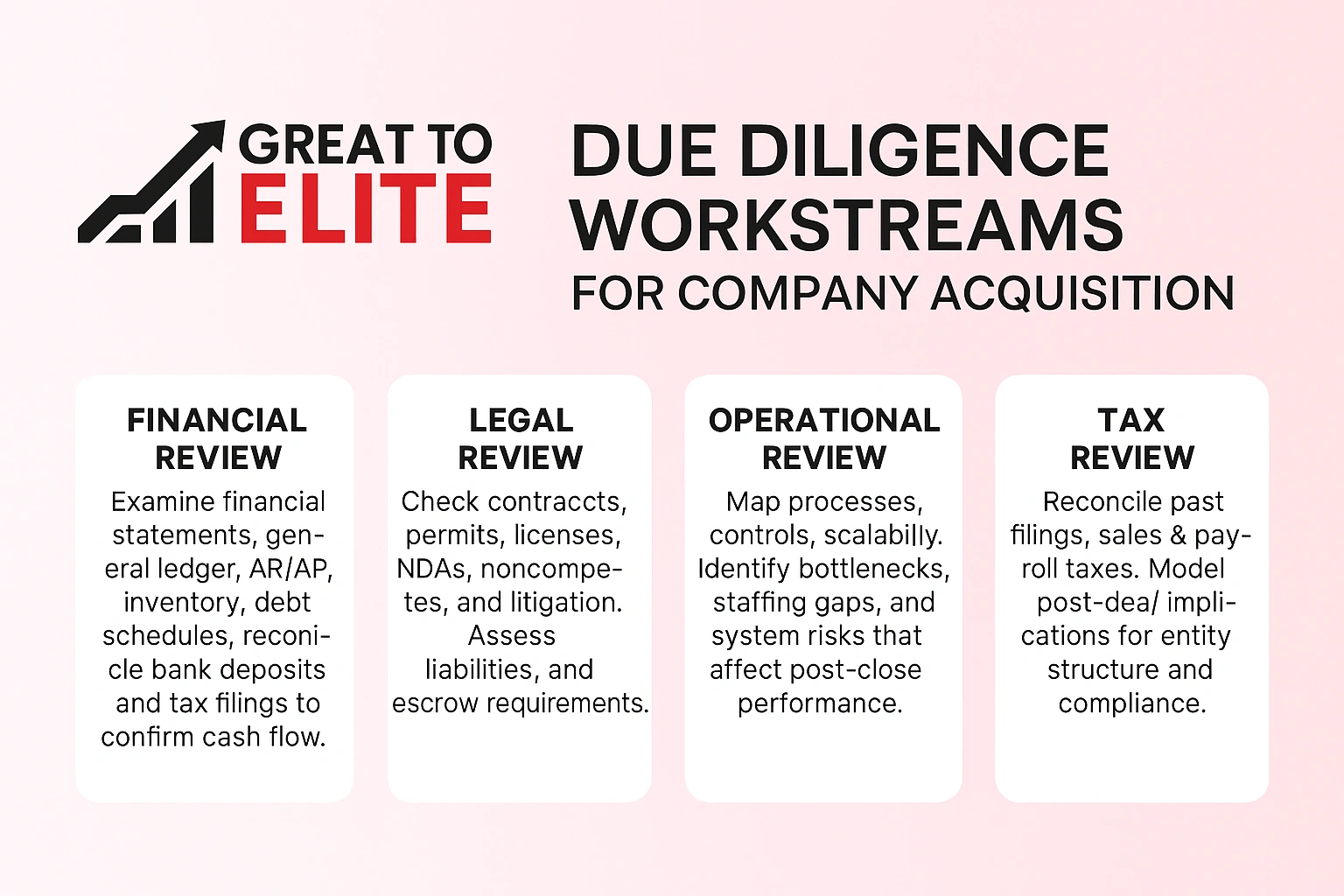
Organize the review into four focused workstreams so each risk area is tested by the right experts. This structure speeds analysis and makes findings actionable for valuation and integration planning.
Financial review: Test financial statements and examine the general ledger, AR/AP, inventory schedules, debt listings, and depreciation methods. Reconcile bank deposits and tax filings to confirm cash flow and sustainability.
Legal review: Catalog contracts, permits, licenses, NDAs, noncompetes, and any litigation. Assess liabilities and contractual limits so you can size indemnities and escrow.
Operational review: Map core processes, controls, and scalability. Identify bottlenecks, staffing gaps, and system risks that could hurt service quality post-close.
Tax review: Reconcile past filings and audits, check sales and payroll tax compliance, and model post-deal implications for entity choice and structure.
Align requests to a standardized checklist and centralize documents by category.
Compare practices to industry norms to spot non-standard accounting or operational anomalies.
Summarize findings with financial impact and mitigation steps for decision-makers.
How Long Should the Due Diligence Period Take
Set a realistic timeline up front so your team can test assumptions, gather documents, and make timely decisions. A well-structured process limits surprises and keeps financing and legal tasks on track.
Typical Timeframe: Thirty To Sixty Days
Plan a 30–60 day period that matches scope and complexity. For many deals, a six-week stretch is efficient and realistic for a U.S. buyer.
A Six-Week Workflow: From LOI To Final Offer
Day 0: LOI signed and LOI date anchors the calendar.
Week 1: Virtual data room launch and prioritized requests issued.
Weeks 2–3: First-pass review, red-flag logging, and missing information tracking.
Week 4: Management sessions and site visits to validate operations.
Week 5: Synthesize findings, score risks, and map remedies.
Week 6: Final valuation, negotiation, and term alignment for closing readiness.
Data Room Readiness And Request Management
Use a secure virtual room as the single source of truth. Assign clear owners and firm due dates for each request to avoid repeated follow-ups.
Week
Focus
Outcome
1
Room launch, prioritized requests
Centralized documents
2–3
First-pass reviews
Red-flag list
4–5
Interviews, synthesis
Risk scoring
6
Negotiation & close prep
Final terms
Choosing Deal Structure: Asset Purchase Versus Stock Purchase
Selecting the transaction form shapes what you actually acquire and who keeps legacy exposure. Your structure choice should protect your cash and match tax goals. Most buyers favor an asset purchase to limit unknown liabilities, but operational continuity and tax trade-offs matter.
Risk containment, indemnities, and escrows
Require the seller to indemnify you for unforeseen liabilities and back that promise with an escrow of part of the purchase price. Negotiate caps, baskets, survival periods, and release triggers in the terms so post-close exposure is capped.
What transfers: assets, contracts, and naming rights
List every asset and contract that moves in the transaction. Include leases, equipment, U.C.C. filings, intellectual property, and exclusive naming rights in the schedules to avoid ambiguity.
Working capital and A/R considerations at closing
Model working capital mechanics and decide who keeps accounts receivable. In stock purchases, normalize working capital and avoid seller retention of A/R. In asset purchases, seller-retained A/R raises the cash you'll need on Day 1 and effectively increases price.
Confirm assignability of property and equipment leases and get landlord consents if required.
Review tax impacts, such as asset basis step-up and legacy tax exposure, with your tax advisor.
Verify employee agreements and benefits so HR obligations transfer as intended.
Financial Diligence Deep Dive: Quality Of Earnings And Cash Reality
Verify the numbers behind reported profits and cash holdings to reveal the true operating picture. Your goal is to confirm that reported earnings and available cash match source records and that any adjustments are supportable.
Audit The Financials: GL, AR/AP, Inventory, And Debt Schedules
Trace headline figures back to the general ledger and supporting documents. Reconcile AR/AP detail, inventory counts, and debt schedules across five years to spot method changes or shifts in accounting treatment.
EBITDA Adjustments And Addbacks: What’s Verifiable
Accept addbacks only if they are quantifiable and documented. Verify seller payroll with tax returns or payroll reports and exclude ongoing benefits that will persist after close.
Revenue Verification: Bank Deposits Reconciliation And Tax Transcripts
Reconcile bank deposits to reported sales and obtain IRS tax transcripts to confirm revenue recognition. Watch for sales pulled forward or one-time spikes that inflate near-term figures.
Trend Analysis: Margins, Seasonality, And Cyclicality Checks
Review multi-year monthly sales and margin trends to assess seasonality and cash flow resilience. Flag AR aging with over 10% past 90 days and test whether the business can service obligations in slower periods.
Action: Tie findings to valuation and adjust the purchase price and terms based on normalized margins and working capital.
Focus
What You Check
Outcome
Revenue
Bank reconciliations, tax transcripts, monthly sales
Verified cash-backed sales
Margins
Gross margin trends, expense classification
Normalized earnings
AR/AP
Aging, credit standards, payables timing
Collection risk & working capital need
Commercial And Operational Checks: Customers, Inventory, And Equipment
Test customer health and operational resilience to spot revenue risks early. Analyze client concentration and the top 10 accounts over three years. If the top three equal more than 35% of sales, model losing two to see the impact on cash flow and valuation.
Customer concentration, retention, and top-account health
Have the seller call major customers with you on the line to confirm future plans. Verify retention rates and check the sales pipeline for signs of pre-sale coasting.
Dependencies on owners, vendors, and key employees
Map owner and key employee roles. Identify single-source vendors and draft transition steps or retention incentives to keep operations stable after purchase.
Accounts receivable quality and credit standards
Review credit policies, aging, and collection steps. Test AR samples against invoices and bank deposits to confirm collectability and revenue recognition.
Inventory salability, turns, and supply chain risks
For service firms, confirm inventory or consumables are usable and not obsolete. Calculate turns and days on hand, and flag slow-moving stock you will exclude from asset value.
Equipment condition, leases, and U.C.C. filings
Physically inspect equipment, check maintenance history, and confirm lease terms. Search U.C.C. filings to ensure property is free of undisclosed liens.
Consider contingent seller notes tied to customer retention or owner transition milestones.
Check
What to Review
Practical Test
Mitigation
Top accounts
Top-10 sales, concentration %
Model loss of top clients
Escrow, earnout, retention notes
AR quality
Aging, credit policy, collections
Confirm deposits, sample invoicing
Adjust working capital, reserves
Inventory & supply
Turns, days on hand, vendor dependence
Physical count, vendor interviews
Price reduction for obsolete stock
Equipment & liens
Condition, leases, U.C.C. records
Site inspection, title search
Require clear title or escrow holdback
Legal, IP, Permits, And Environmental Considerations
Isolate legal, IP, permit, and environmental risks that could halt closing or change value. Collect and index material contracts with officers, directors, shareholders, and affiliates. Include loan and security agreements, guaranties, distribution and supply agreements, and any M&A documents from the last five years.
Catalog intellectual property: patents, trademarks, copyrights, trade secrets, work-for-hire records, and signed assignments or licenses. Verify chain of title and that invention assignment agreements exist for employees and contractors.
Gather governmental licenses, permits, and regulatory correspondence. Check for expirations, pending audits, or enforcement actions that could interrupt operations after purchase.
Run environmental checks: audits, hazardous materials handling, disposal methods, agency letters, and any investigation files. Flag superfund exposure or remediation obligations that create contingent liabilities.
Checklist: confirm assignability, insurance coverage, consent requirements, and change-of-control clauses.
Reconcile litigation disclosures with policy limits and indemnity terms.
Escalate material issues for remediation, escrow, or specific holdbacks before close.
Assessing people and culture gives you early insight into operational continuity and client retention. Start with core records and map roles that hold customer and vendor ties.
Key Roles, Employment Agreements, And Incentives
Review employee lists with positions, current salaries, and three years of pay history. Collect resumes for key staff and identify who owns client relationships.
Examine employment agreements, noncompete and nonsolicit contracts, and stock plans to measure enforceability and exposure.
Compensation, Benefits, And Pending HR Issues
Analyze benefits summaries, retirement plans, health policies, and historical bonuses to forecast payroll post-close. Check leave policies and collective bargaining terms if they apply.
Investigate recent terminations, harassment or discrimination claims, workers’ comp and unemployment filings, and any ongoing labor disputes. Use findings to size reserves, retention incentives, and onboarding priorities.
Map key roles and plan retention offers for revenue holders.
Validate that required licenses and certifications stay with the business, not only with individuals.
Confirm handbooks and policies match actual practice and current law.
HR Area
Documents to Request
Practical Test
Action
Key personnel
Resumes, org chart, tenure, compensation
Interview leaders; verify client contacts
Retention payments, transition plans
Agreements & plans
Employment contracts, noncompetes, stock plans
Legal enforceability review
Amendments, escrow, replacement contracts
Benefits & payroll
Plan summaries, payroll registers, bonus history
Reconcile payroll to GL and offers
Budget for ongoing costs; adjust valuation
HR issues
Claims, grievances, arbitration files
Assess frequency and severity
Remediation plan, escrow, insurance
Due Diligence When Buying a Company
Assemble the core records that prove authority, ownership, and operational scope across every jurisdiction. That initial collection speeds your review and guides focused requests for missing information.
Your Master Checklist: Organization, Financials, Assets, Real Estate
Gather corporate charters, bylaws, minute books, shareholder lists, option agreements, and certificates of good standing. Verify active status in each jurisdiction.
Collect audited financial statements for three years, recent unaudited comparatives, auditors’ letters, GL detail, AR/AP schedules, inventory listings, and tax returns. Include projections and internal controls documentation.
Inventory physical assets, equipment leases, fixed-asset schedules, and U.C.C. filings. For property, obtain deeds, leases, mortgages, surveys, zoning approvals, and any landlord consents.
Confirm intellectual property via registrations, assignments, work-for-hire agreements, and license records. Pull employee rosters, contracts, benefits summaries, and HR claims history.
Red Flags That Warrant Renegotiation Or Walking Away
Inconsistent statements across records or unreconciled bank deposits.
Undisclosed litigation, regulatory enforcement, or material environmental exposure.
Concentrated sales or high churn among key staff that threaten cash flow.
Unverifiable IP ownership, hidden liens, or non-assignable contracts.
Area
Essential Documents
What to Test
Action if Problem
Corporate
Charters, minutes, cap table
Authority, ownership, issuances
Require corrections, escrow, or reps
Financial
Audited statements, GL, tax returns
Reconcile revenue, margins, controls
Adjust price, reserves, indemnity
Assets & Property
Asset schedules, leases, titles
Verify location, liens, assignability
Clear title, holdback, or walk
IP & HR
Registrations, assignments, contracts
Chain of title, key-person risk
Obtain assignments, retention incentives
How Great to Elite Helps with Due Diligence when Buying a Company
Great to E12lite simplifies and streamlines the due diligence process, giving buyers confidence and clarity when evaluating a business. Our team ensures every critical area is reviewed, risks are uncovered, and decisions are data-driven. Key ways we support you include:
Financial Verification: Audit statements, reconcile bank deposits, review AR/AP, inventory, and cash flow to confirm true earnings.
Legal Review: Examine contracts, leases, NDAs, permits, and pending litigation to limit post-close exposure.
Operational Assessment: Map workflows, identify bottlenecks, evaluate scalability, and highlight owner or staff dependencies.
Tax Analysis: Review past filings, payroll and sales taxes, and model post-deal impacts to protect your investment.
Risk Mitigation & Negotiation Support: Organize findings into checklists, score risks, and provide tools like escrows, indemnities, and retention notes.
If you are evaluating a purchase or preparing the diligence process, book a call with Great to Elite to scope the project and receive a timeline, checklist, and fixed-fee proposal.
Conclusion
Wrap up the review with a concise summary that links findings to price, terms, and closing readiness.
Use a structured 30–60 day period to test material risks and validate value. Focus on operations, customers, cash, legal, tax, and industry exposure so you can make a confident decision about the transaction.
Translate verified issues into negotiation levers that protect your investment and shape purchase price, seller obligations, and post-close plans. Proceed to closing only once questions are answered, cash needs are set, and first-90-day tasks are ready.
Engage expert support early. Great to Elite can run the program, prioritize requests, and convert findings into practical terms that speed deal execution and improve outcomes.
FAQs
How do I choose the right advisors for due diligence?
›
Select professionals with experience in M&A, your industry, and the specific risk areas, a CPA for financials, corporate attorney for legal, HR consultant for people risk, and operations expert for process reviews.
What are red flags in a seller’s financial statements?
›
Look for inconsistent revenue patterns, unexplained spikes, repeated restatements, missing documentation, and AR aging over 90 days without justification.
How can I verify customer loyalty before buying?
›
Request to speak with top clients, review retention history, examine churn rates, and model revenue impact if key accounts leave.
What insurance or warranties should I require from the seller?
›
Demand representations and warranties on financials, IP ownership, contracts, leases, and assets. Require escrow or indemnity agreements for material risks.
How do I assess hidden liabilities not listed on the balance sheet?
›
Check for pending litigation, environmental risks, tax exposures, off-balance sheet obligations, guarantees, and undisclosed loans through legal and tax review.
What operational risks are hardest to detect remotely?
›
Owner dependency, key-person reliance, single-source vendor risks, and informal SOPs are often uncovered only via interviews, site visits, or process walkthroughs.
Can cultural fit affect post-acquisition success?
›
Yes. Misalignment in company culture can harm retention of key staff and customers. Review employee engagement, incentives, and workflows to anticipate integration challenges.
How should I prepare for unexpected findings during due diligence?
›
Use a structured risk matrix to quantify issues, negotiate escrows or holdbacks, and be ready to adjust price, terms, or walk away if critical risks are unmitigated.




.webp)