Family Business Succession Planning Consultants: What Are They and What Do They Do
Family Business Succession Planning Consultants: What Are They and What Do They Do

Natalie Luneva
December 21, 2025



Family business succession planning consultants help create a practical plan that balances legacy with the company’s future needs and bring objectivity to sensitive decisions. They identify successor profiles, set decision criteria, and design governance that supports trust and fair selection. That structure reduces risk from emergencies and avoids rushed moves that harm performance.
Without a formal approach, many enterprises face misalignment, costly turnover, and damaged culture. Only a small share reaches a third generation, and few have written plans. Early engagement saves time and builds a stronger leadership pipeline for long-term success.
Great to Elite focuses on measurable outcomes: continuity, alignment among members, and a repeatable approach that companies can refresh over the years.
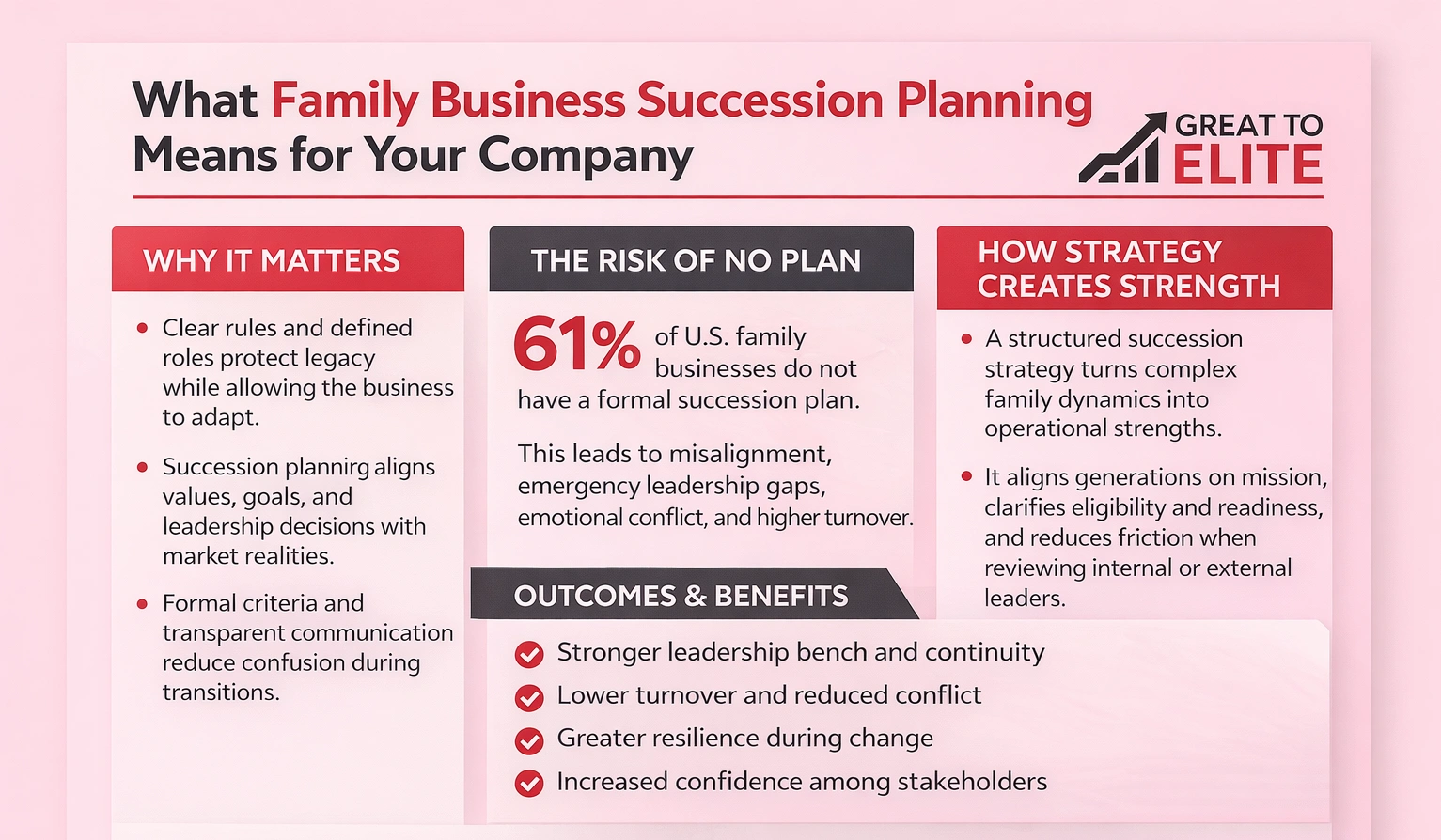
Clear rules and roles keep legacy intact while the company adapts to change. A structured approach aligns values, goals, and leadership so decisions reflect both heritage and market realities. Formal business succession planning creates decision criteria, transparent communication channels, and defined roles that reduce confusion during a transition.
Without a written plan many organizations face misalignment, emergency gaps, emotional conflict, and higher turnover, yet 61% of U.S. family businesses do not have a formal business succession plan in place.
The family business succession planning strategy turns complex dynamics into strengths. It aligns members on mission and future strategy, clarifies eligibility and readiness across generations, and sets governance to lower friction when internal or external candidates are reviewed.
Formalizing the strategy builds stakeholder confidence and preserves culture while allowing room for innovation. Starting early positions leaders to manage the future deliberately rather than reactively.
Acting today creates the space to develop talent, run trials, and reduce rushed decisions later. Many leaders assume a two‑year handover is enough, but evidence shows a 5–10 year horizon often fits complex companies better.
Starting now eases time pressure. With years to work, a company can test candidates in real roles, rotate leaders, and add external experience without jeopardizing operations.
Early work builds emergency readiness. Interim plans and clear interim authorities keep operations stable if an unexpected event occurs.
Proactive strategy makes the process accountable. Milestones, readiness criteria, and objective assessments limit bias and lower emotional strain for involved relatives.
Who holds decision rights matters as much as who will lead next. Clear ownership of the transition process prevents confusion and sets fair expectations for all members.
Members define core values, eligibility rules, and merit-based pathways so criteria are transparent. Early education for interested relatives builds engagement and readiness without guaranteeing roles.
Formal artifacts, charters and a constitution, codify rules and reduce disputes.
The board aligns leadership selection with long-term strategy and mentors candidates against defined success profiles. Directors should insist on a written emergency and interim plan to keep the company stable during gaps.
Independent directors and external advisors add rigor to evaluations and prevent groupthink. Stakeholder input balances interpersonal dynamics with commercial goals and improves fairness.
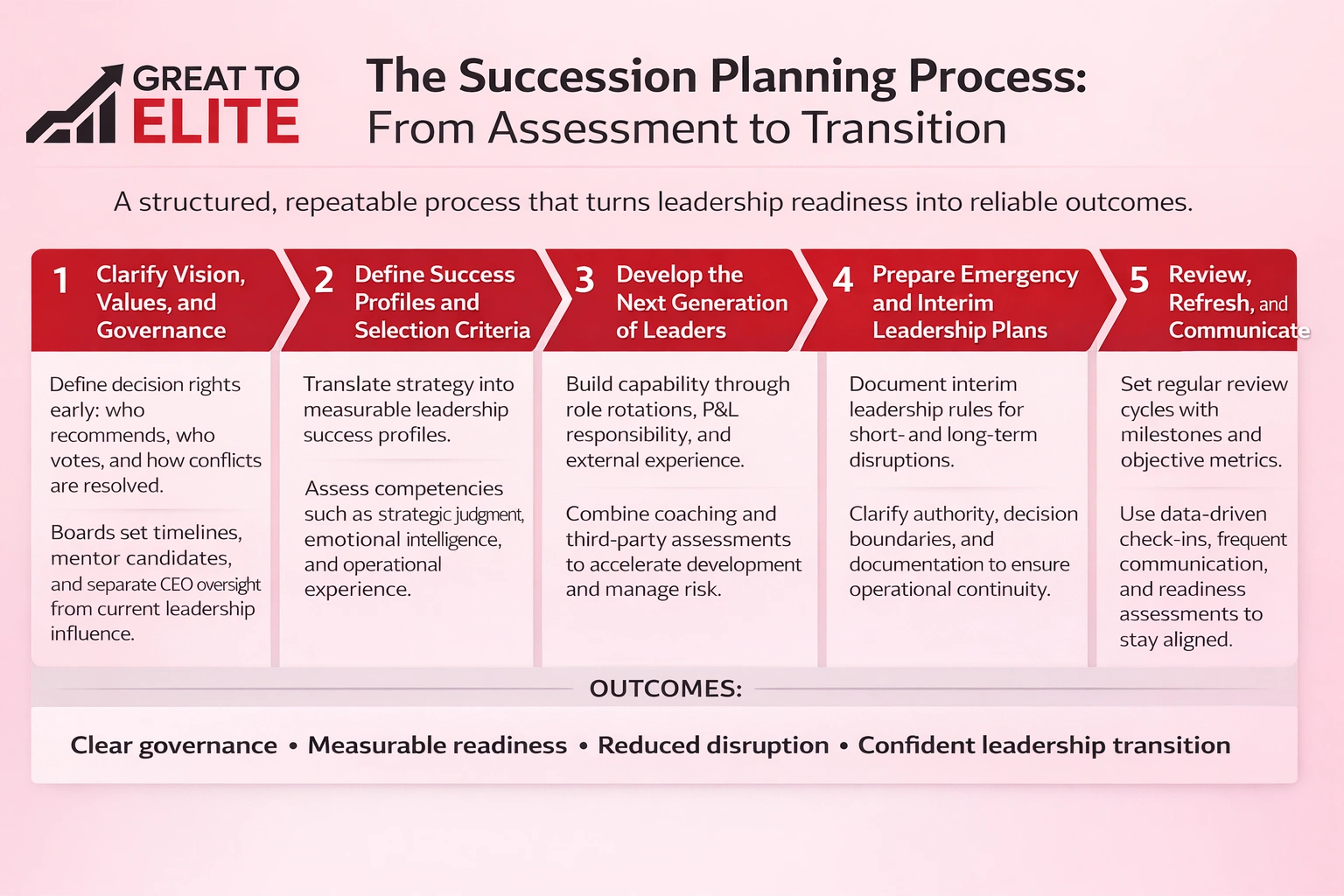
A structured process turns readiness into reliable outcomes during leadership change. Start with a clear framework that ties vision, values, and governance to objective decisions.
Define governance ground rules early: who recommends, who votes, and how conflicts are resolved. Boards should set timelines, mentor candidates, and separate CEO selection oversight from the current CEO’s influence.
Translate strategy into measurable success profiles. Include competencies such as strategic judgment, emotional intelligence, and operational experience.
Use rotations across functions and P&L roles to build breadth. Require external roles or board exposure where appropriate.
Combine coaching and third‑party assessments to accelerate development and calibrate risk.
Establish short‑ and long‑term interim rules that name who acts, what authority they hold, and how decisions are documented. This keeps operations steady during sudden gaps.
Set a review cycle with milestones and data‑driven check‑ins. Revisit the process annually to reflect market or company shifts.
When affection drives selection, objective criteria must restore balance to leadership choices. Clear rules keep emotion from deciding who moves into a key role. This preserves trust and operational performance.
Set eligibility rules that link roles to measurable experience and external exposure. Make it clear roles are earned, not guaranteed.
Offer regular development feedback and document progress. This depersonalizes selection and helps interested members see a pathway without promises.
Encourage candid, inclusive discussions that surface risks and alternatives. Use structured deliberations and appoint a devil’s advocate to test assumptions.
Bring in independent advisors to add objectivity and break echo chambers. Facilitation channels dynamics into constructive debate and preserves morale across employees.
Family business succession planning consultants are independent advisors who help owner-led companies prepare for leadership and ownership transitions in a structured, deliberate way. Their role is to remove uncertainty and emotion from critical decisions by aligning family values, governance, and business strategy into a clear, executable plan.
Working with a succession planning consultant can transform how your business navigates leadership transitions. These professionals bring expertise, objectivity, and proven strategies, and help ensure a smooth, well-structured process that safeguards your company’s legacy while preparing it for future growth. The benefits are:
Advisors deliver targeted services that turn intent into measurable change across governance and talent. These offerings bridge emotions and operations while protecting continuity and performance.
What we build: criteria-based roadmaps, emergency and interim frameworks, and clear transition milestones. Teams create role definitions, readiness metrics, and an executable timeline that fits company scale.
Facilitated forums and structured mediation improve transparency and trust. Workshops and regular updates reduce rumors and keep executives aligned with objectives.
Programs codify values, clarify roles, and teach governance, finance, and stewardship skills. Learning modules and coaching upskill members to meet objective eligibility requirements.
Services include board design, director search, successor mentoring, and impartial assessments. Independent reviews validate readiness and strengthen oversight.
Scalable engagements match company size and ownership complexity, delivering measurable success: higher readiness, clearer decision rights, and improved culture health.

A clear timeline turns intentions into verifiable progress toward leadership handoff. Use realistic horizons to avoid rushed moves that harm performance.
Two‑year handovers often fall short. Experts recommend a 5–10 year horizon for complex companies.
Indicative schedule:
Track progress with objective metrics. Use competency ratings, 360 feedback, and performance in stretch roles to quantify readiness.
Reassess annually, run table‑top exercises for interim plans, and publish timelines and metrics so everyone knows expectations. Success equals a seamless handoff, preserved legacy with renewed strategy, and stable or improved performance.
A clear, experienced partner turns transition risk into predictable progress. Great to Elite works with owner-led firms to design a rigorous path from assessment to handoff. Our approach balances legacy, performance, and measurable development so the company keeps moving during change.
We provide targeted services that combine advisory rigor with hands-on execution. Our work reduces bias, strengthens leadership depth, and protects operations if a leader departs suddenly.
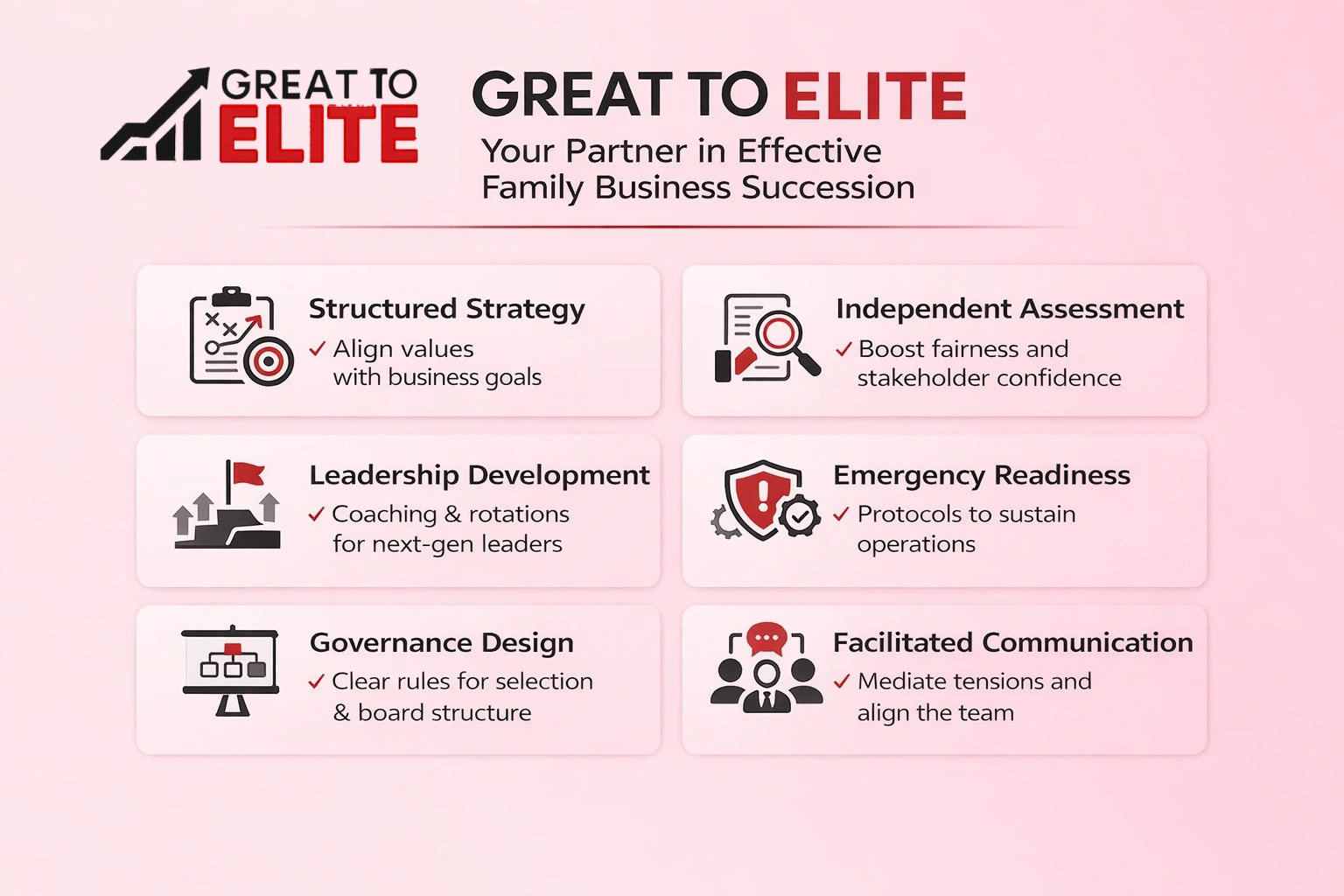
Engagements scale from a rapid diagnostic and roadmap to full lifecycle execution. Measurable outcomes include higher readiness scores, improved alignment, continuity of performance, and preserved legacy.
Book a call with Great to Elite to review your current succession plan and map a clear path forward.
Move from intention to action with a deliberate plan that protects legacy and performance.
Successful succession planning requires clear governance, time to develop the next generation, and documented emergency readiness. Align values with strategy using transparent criteria and a repeatable process.
Regular reviews, objective assessments, and tested interim rules sustain momentum over years. Clarify roles for family members and the wider team so decisions stay fair and measurable.
Great to Elite guides companies from initial assessment to transition execution. We deliver measurable outcomes, culture stewardship, and a staged path that turns good intent into effective succession.