Exit Strategy for Small Business

Exit Strategy for Small Business

Natalie Luneva
December 21, 2025
Exit Strategy for Small Business
BG Shape
Perspective Grid Shape
Table of Contents:

An exit strategy for a small business is a structured plan that guides an owner through a transition of ownership, whether by sale, internal transfer, or orderly wind‑down, so that the business and its stakeholders are protected and value is maximized. It is about preparing the business to operate independently, clarifying financial and personal goals, and responding strategically to market or life changes.

A thoughtful business exit plan aligns operational readiness with valuation, legal and tax considerations, leadership succession, and communication plans that together create a smoother, more predictable transition.

Despite its importance, most small business owners do not have a formal exit strategy in place. According to a recent survey, 79% of small business owners have no exit plan, leaving them vulnerable to rushed decisions, lower sale prices, or forced exits due to unforeseen events.

Key Takeaways

  • A proactive plan shapes direction and prepares owners for market and future change.
  • Viewing this as a strategic business decision enables a smooth transition for stakeholders.
  • Clear planning ties goals to value and safeguards the company through changes.
  • Integrating finance, operations, and leadership keeps operations steady during handover.
  • Early planning helps owners capture value and choose timing and structure wisely.

What An Exit Strategy Is And Why It Is Important

Preparing how a company moves from daily operations to a planned handover protects value and people. A well-built plan recognizes true worth, supports future goals, and turns a final phase into a controlled change rather than a sudden end.

Definition: From Endgame To Strategic Transition

An exit strategy is a comprehensive plan that guides a company through a planned transfer of ownership or wind-down. It covers finance, operations, roles, and timing so the process is orderly and predictable.

Key Benefits: Value, Marketability, And Smooth Transition

  • Clearer valuation through documented financials and operations.
  • Stronger marketability that attracts a serious buyer and shortens diligence time.
  • Defined roles and documentation that create a smooth transition for employees and customers.

Why Start Early: Proactive Planning For Unexpected Changes

Starting now gives owners time to fix gaps, align the company with goals, and improve negotiating position. It also builds options across different exit strategies, from external sale to internal transfer or orderly wind-down.
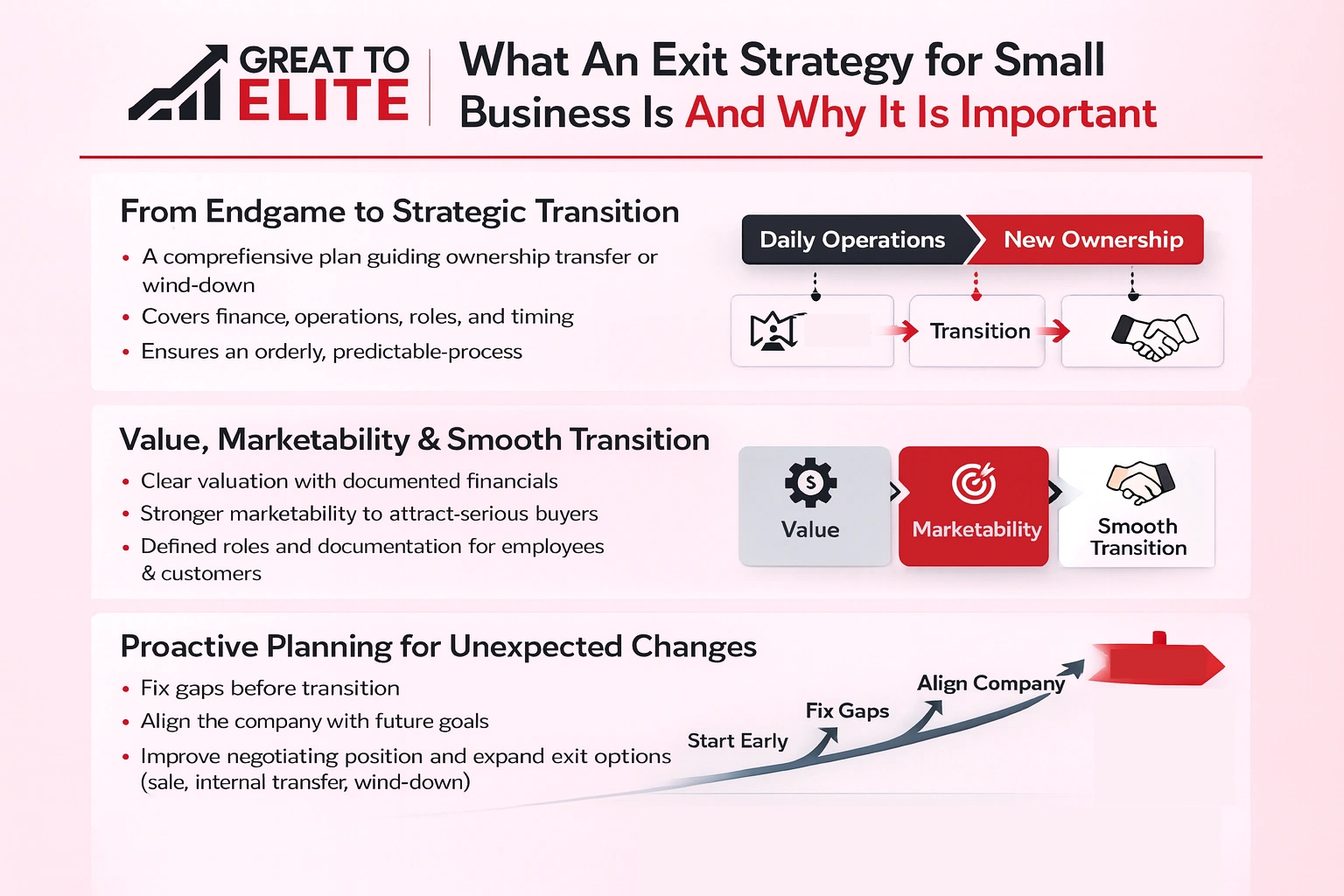
what is an exit strategy for small business and why it is important

Set Your Direction: Goals, Readiness, And Planning Foundations

Clarify what success looks like to you, both personally and for the company, so planning stays focused and measurable. List lifestyle needs, liquidity targets, and any desired role after transfer. This makes financial choices and timing clearer.

Build a professional team early: a financial advisor, tax expert, attorney, banker, and valuation specialist. Together they model outcomes, quantify goals, and address legal and tax items that affect timing and value.

Clarify Personal, Financial, And Business Goals

Document current compensation, benefits, and personal cash flow needs. Define minimum net proceeds and preferred buyer profiles to guide decisions. Set milestones and a target timeline to measure readiness.

Build A Professional Team: Advisor, Tax, Legal, Valuation

Use the team to translate goals into a practical plan, spot risks, and map the process steps. Agree on communication protocols to save time during diligence and keep management aligned.

  • Document key operations and processes to lower owner dependency.
  • Create a readiness checklist: financials, contracts, corporate records, and compliance items.
  • Define decision criteria such as minimum proceeds and desired post-transfer role.
Advisor Role
Main Contribution
When To Engage
Financial Advisor
Models proceeds, cash needs, and post-transfer income planning
Early planning phase (3–5 years prior)
Tax Professional
Optimizes tax outcomes and identifies timing impacts
Before deal structuring and annual reviews
Valuation Expert
Assesses company value and growth drivers
Once financials are stable and audited
Legal Counsel
Prepares documents, corporate records, and compliance checks
Throughout planning and during negotiations

Know Your Numbers: Valuation, Financial Prep, And Deal Design

Begin with a clear calculation of current value and the levers that move that number upward. An accurate valuation highlights drivers buyers pay for: margins, recurring revenue, and customer concentration.

Calculate Business Value And Drivers Of Growth

Obtain a professional business valuation for exit strategy and list key growth drivers. Focus on profitability, recurring streams, team depth, and systems that reduce owner dependence.

Close The Gap Between Needed Proceeds And Current Value

Quantify the gap between required net proceeds (after tax) and current enterprise value. Map initiatives, pricing, product mix, cost controls, to close that gap.

Explore Sale Structures: Installments, Minority Retain, Annuity

Consider installment payments, keeping a minority stake, or annuity-like payouts. Each option affects cash flow, tax timing, and risk; coordinate early with tax and legal advisors.

  • Track KPIs buyers use: EBITDA quality, revenue visibility, and churn.
  • Prepare clean financials, normalized adjustments, and defensible forecasts.
  • Plan capital needs for transition: working capital, payoffs, or refinancing.
Structure
Cashflow
Tax & Risk
Installment
Staggered receipts
Tax over time; buyer credit risk
Minority Retain
Partial liquidity + upside
Future taxable events; alignment with management
Annuity-like
Predictable payments
Long-term tax deferral; counterparty risk

Choosing Your Path: Exit Strategy For Small Business Options

A clear choice among sale, internal transfer, ESOP, or wind‑down shapes outcomes for owners, staff, and customers.

Selling To An External Buyer: Maximizing Price And Pace

External sales often deliver higher proceeds and a faster timeline. They may require integration with a new buyer and can change operations or culture.

Some owners remain during transition to protect customers and preserve value.

Selling Internally: Family, Partner, Or Key Employee With Seller Financing

Transfers to family, partners, or key staff support continuity. Seller financing commonly bridges capital gaps and helps the company maintain momentum.

Employee Stock Ownership Plan: Aligning Legacy And Employee Incentives

An ESOP sells shares to employees through a tax‑favored trust and ties incentives to performance. It needs careful administration and may create repurchase cash obligations.

Closing Or Liquidation: Winding Down And Paying Creditors

Liquidation converts assets to cash to satisfy creditors first. Quick sales can raise tax bills and reduce net proceeds.
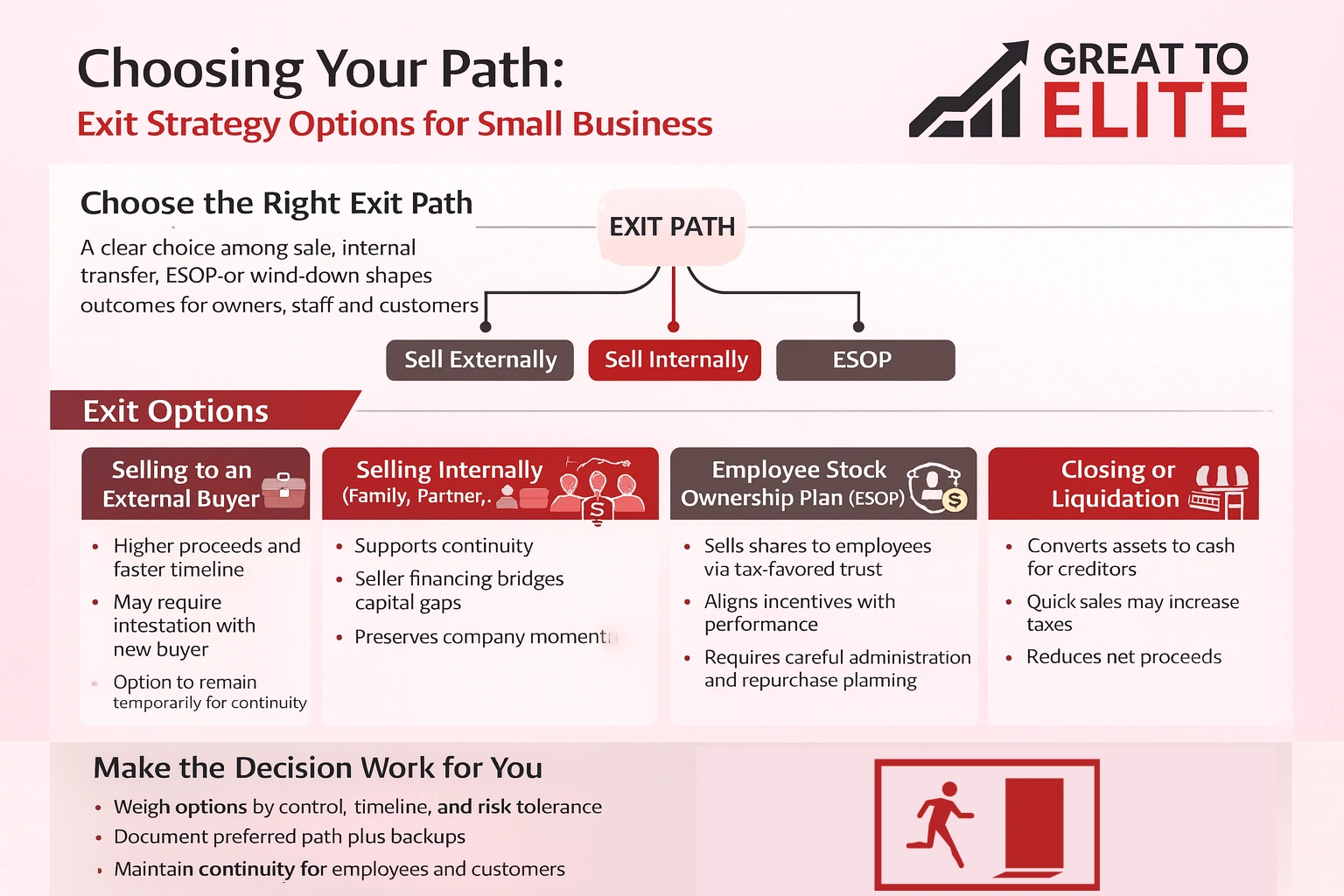
  • Weigh each option against control, timeline, and risk tolerance.
  • Document a preferred path plus backups to pivot if a buyer stalls.
  • Keep service continuity for customers and employees during transition.
  • Create a short list of buyer profiles or successor criteria to focus outreach.
busienss exit strategy options for small businesses

Succession And Leadership: Ensuring Operations Continue Without The Owner

Choosing the right management team preserves company culture and protects long-term value. Select leaders who match mission and have clear decision rights. That alignment prevents missteps and keeps customers satisfied.

Map Roles, Responsibilities, And Cultural Fit

Document critical roles and who makes which decisions. Create simple org charts and responsibility matrices so duties are clear.

Assess cultural fit when naming successors. A new manager who shares company values reduces friction and preserves legacy.

Reduce Owner Dependency To Protect Business Value

Build the management bench with training and measurable KPIs. Use SOPs and governance cadences to show operations run without the owner.

Plan contingencies: cross-train key staff and define succession depth for mission‑critical functions. Tie incentives to post‑transfer goals to keep employees aligned.

  • Map decision rights and key role coverage.
  • Document SOPs, KPIs, and governance rhythms.
  • Develop training, cross‑coverage, and incentive frameworks.
Action
Owner
Timeline
Impact on Value
Role mapping & decision matrix
CEO + HR
30–60 days
Reduces ambiguity; raises buyer confidence
SOP and KPI documentation
Operations lead
3–6 months
Shows operational resilience; supports valuation
Management bench & training plan
HR & Dept Heads
6–12 months
Limits owner dependency; smooths transition
Contingency cross‑training
Team leads
Ongoing
Mitigates key‑person risk; preserves continuity

Communication And Transition Management For A Smooth Exit

A staged messaging plan reduces rumors and preserves customer trust during transitions. Start with a clear timeline and assign a small team to manage all communications.

Sequence Messaging To Stakeholders, Employees, And Customers

Begin with investors and key stakeholders. Share financial summaries, the plan, and any repayment or governance details. Keep documents factual and time-bound.

Next, brief employees in a transparent forum. Provide Q&A, describe leadership roles, and explain how day-to-day operations will stay steady. Offer channels for anonymous questions.

Finally, notify customers. Confirm service continuity, provide contact points, and, when relevant, introduce new leadership or ownership to preserve relationships.

  • Use consistent policy language to limit confusion across groups.
  • Assign a transition team to log questions, update messages, and track timelines.
  • Protect confidential details until the proper time to avoid market disruption.
  • Capture feedback and adjust the process quickly to meet stakeholder needs.
Audience
Main Message
Timing
Investors / Stakeholders
Plan overview, financials, repayment terms
First
Employees
Process, roles, stability, Q&A
After stakeholders
Customers
Service continuity, contact updates, introductions
Last

Tax, Legal, And Timeline Considerations In The United States

A U.S.-focused timeline that aligns tax moves, licenses, and payroll prevents costly surprises at closing.

Begin with a compliance checklist to avoid penalties and preserve value. File dissolution forms if winding down, cancel state registrations and professional licenses, and confirm final payroll filings and tax deposits. Retain corporate and tax records for three to seven years as advised.

Compliance Checklist: Dissolution, Licenses, Payroll, Records

  • File state dissolution and notify taxing authorities; close sales tax and employer accounts.
  • Cancel professional licenses, permits, and registrations tied to operations.
  • Complete final payroll, issue W-2s/1099s, and comply with labor notice requirements.
  • Archive financials, corporate minutes, and tax returns for the recommended retention period.

Plan Timing: Multi‑Year Roadmaps And Year‑Of‑Sale Tax Impacts

Coordinate early with tax and legal advisors to model outcomes under different deal structures and timelines. Spreading large asset sales across years can lower immediate tax burdens and give time to improve company fundamentals.

Issue
Impact
Action
Revenue timing
Affects taxable year and rates
Plan recognition to balance income
Depreciation recapture
Can raise ordinary income
Model cost basis and consider installment options
State obligations
Additional filings and tax
Review nexus and file required returns

Ensure employee communications and benefits changes meet legal requirements. Time closings to balance operational performance, buyer readiness, and tax efficiency so owners keep more of the proceeds and the process runs smoothly.

How Great to Elite Helps You Plan And Execute A Successful Exit

Great to Elite partners with business owners to build clear plans that protect value and preserve legacy. Early, coordinated planning aligns personal needs, cash goals, and company priorities. That alignment strengthens business value and improves market readiness.

Strategic Support Tailored To Your Business

Services focus on practical results: improving KPIs buyers care about, documenting operations, and preparing management to run without the owner. Advisors work with your tax and legal team to shape deal options and timing.
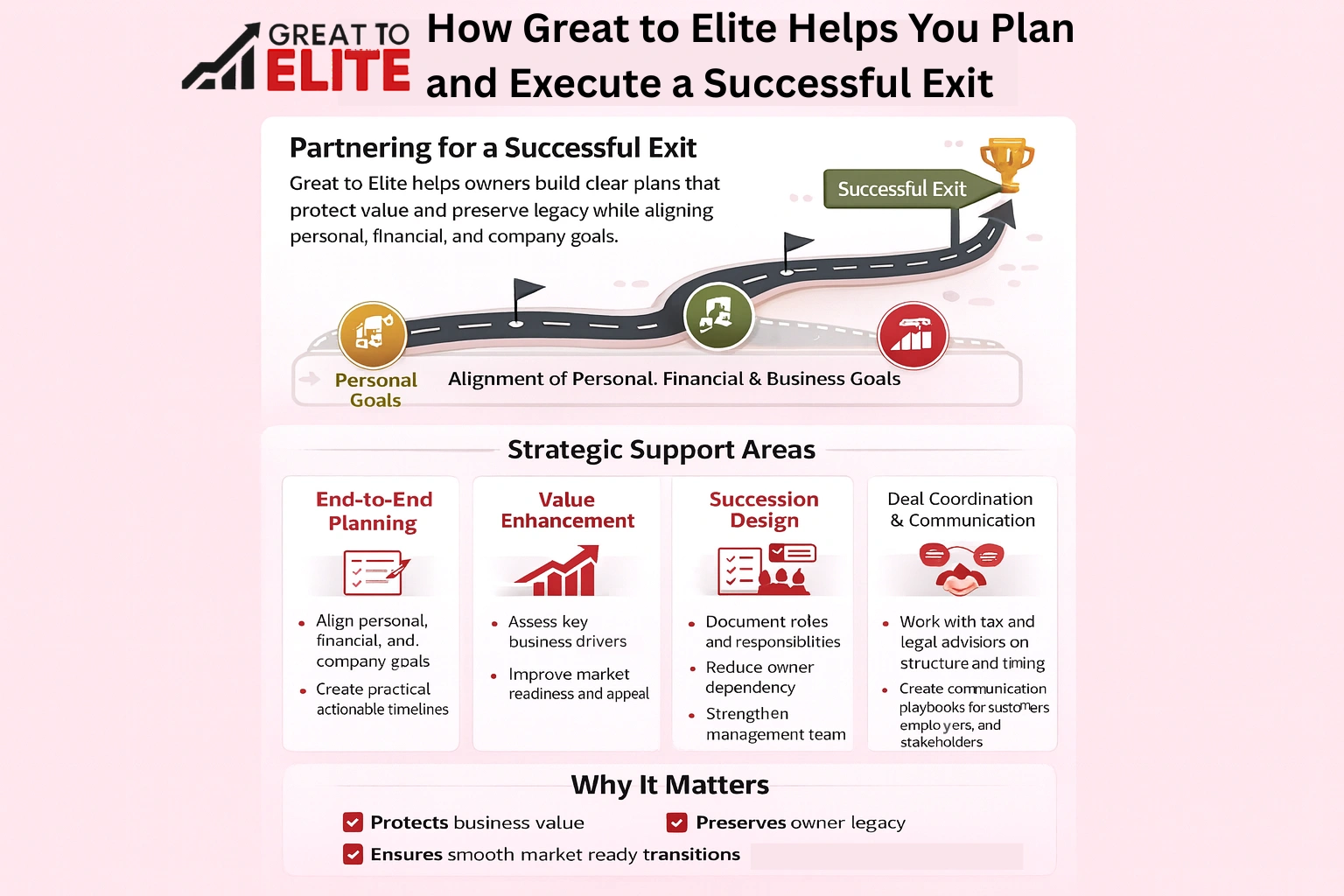
  • End-to-end planning: Align personal, financial, and company goals into a practical timeline.
  • Value enhancement: Assess and improve business drivers to increase market appeal.
  • Succession design: Document roles, reduce owner dependency, and strengthen management.
  • Deal coordination: Structure terms with tax and legal advisors for efficient outcomes.
  • Communication playbooks: Sequence stakeholder messaging to protect customers and staff.
how great to elite helps you plan and execute a successful exit

Ready to move from planning to action? Book a call with Great to Elite to review goals, test readiness, and build a roadmap toward a successful outcome.

Conclusion

A concise roadmap helps owners protect value, prepare leaders, and control timing as they move toward a planned transfer.

Define goals, assemble advisors, quantify value, and close the gap between current worth and required proceeds. Pick an approach, selling, internal transfer, ESOP, or wind‑down, and prepare management and succession steps.

Early work improves negotiation with buyers, expands options, and often yields better tax outcomes over time. Document the plan, assign responsibilities, and set firm deadlines so execution stays steady amid changes.

When ownership, succession, and operations align, companies retain customers and preserve legacy. Finalize priorities, validate the numbers, and set a time‑bound plan to move confidently toward your chosen exit path.

FAQs

How long does an exit strategy for a small business typically take to execute?

The timeline varies widely based on readiness, industry, and the chosen exit path. For most small businesses, a well-executed exit takes one to three years from planning to close. Owners who start earlier often gain flexibility to improve performance, wait for favorable market conditions, or pivot to a different structure if circumstances change.

Do I need an exit strategy if I am not planning to sell soon?

Yes. An exit strategy is not only about selling; it is about preparedness. Even if a sale is years away, having a plan protects the business against unexpected events such as health issues, market shifts, or unsolicited offers. Early planning keeps options open and reduces pressure-driven decisions.

What risks do small business owners face without an exit strategy?

Without a plan, owners risk forced exits at reduced value, operational disruption, and confusion among employees and customers. Lack of preparation can also lead to unfavorable tax outcomes, stalled deals, or family and partner conflicts during transitions.

Can I change my exit strategy once planning has started?

Yes. Exit planning is iterative, not fixed. As goals evolve, markets shift, or valuations change, the strategy can be adjusted. Building flexibility into the plan allows owners to switch paths, delay timing, or renegotiate terms without losing momentum.

Will buyers take my business seriously if I am still actively involved?

Yes, as long as there is a clear plan to transition responsibilities. Buyers expect owner involvement during handover but want proof that the business can operate independently over time. A documented transition plan reassures buyers and often improves deal terms.

How do I know when my business is “exit ready”?

Exit readiness is determined by clarity of goals, clean financials, documented operations, and reduced owner dependency. A readiness assessment helps identify gaps and prioritize actions so owners can move forward confidently when the right opportunity or timing appears.