How to Buy a Company: The Complete Guide

How to Buy a Company: The Complete Guide

Natalie Luneva
November 27, 2025

How to Buy a Company: The Complete Guide
BG Shape
Perspective Grid Shape
Table of Contents:

Buying a company is one of the fastest ways to step into proven revenue, existing customers, and an operating model that already works. Instead of starting from zero, you acquire momentum. But getting a deal across the finish line takes more than interest; it takes a clear, structured process. The moment you decide to buy a business, your path begins with defining what you want, researching targets, and verifying that the numbers and operations truly support the price.

When you buy a company, you move through four core stages: preparation, sourcing, due diligence, and closing. Preparation clarifies your budget, preferred industries, financing options, and the size of business you can realistically acquire. Sourcing introduces you to on-market and off-market opportunities through brokers, listings, and industry networks. 

Due diligence digs into financials, customer concentration, legal risks, and operational health so you know exactly what you’re buying. And closing combines negotiation, financing, contracts, and transition planning so the handoff is smooth and the business keeps running from day one.

Key Takeaways

  • Acquisitions can accelerate your plan, as they provide immediate revenue and systems.
  • Half of deals fail in diligence; inspect financials, contracts, and operations closely.
  • Understand valuation drivers so you can verify asking price against real value.
  • Explore financing that preserves cash and aligns incentives post-close.
  • Plan the first 90 days to protect revenue, staff, and client relationships.
  • Great to Elite offers targeted support for service businesses at every stage.

Why Buy an Existing Business Right Now

An active business brings momentum: customers, cash flow, and tested processes that speed results. You skip long setup phases and can focus on growth instead of building core systems from scratch.

Momentum, Cash Flow, And Installed Systems

When you step into an existing business, trained staff and vendor relationships cut onboarding time. That stability helps support debt service and early reinvestment, provided numbers are verified.

Check for owner dependence and revenue concentration. Some listings are for distressed operations, so trends and client mix matter before you advance a deal.

Current Market Snapshot In The United States

For the full year of 2024, global M&A volume reached approximately $3.4 trillion, with the U.S. accounting for around 50% of the activity. This depth means active buyers, lenders, and market data you can use for comps and price context.
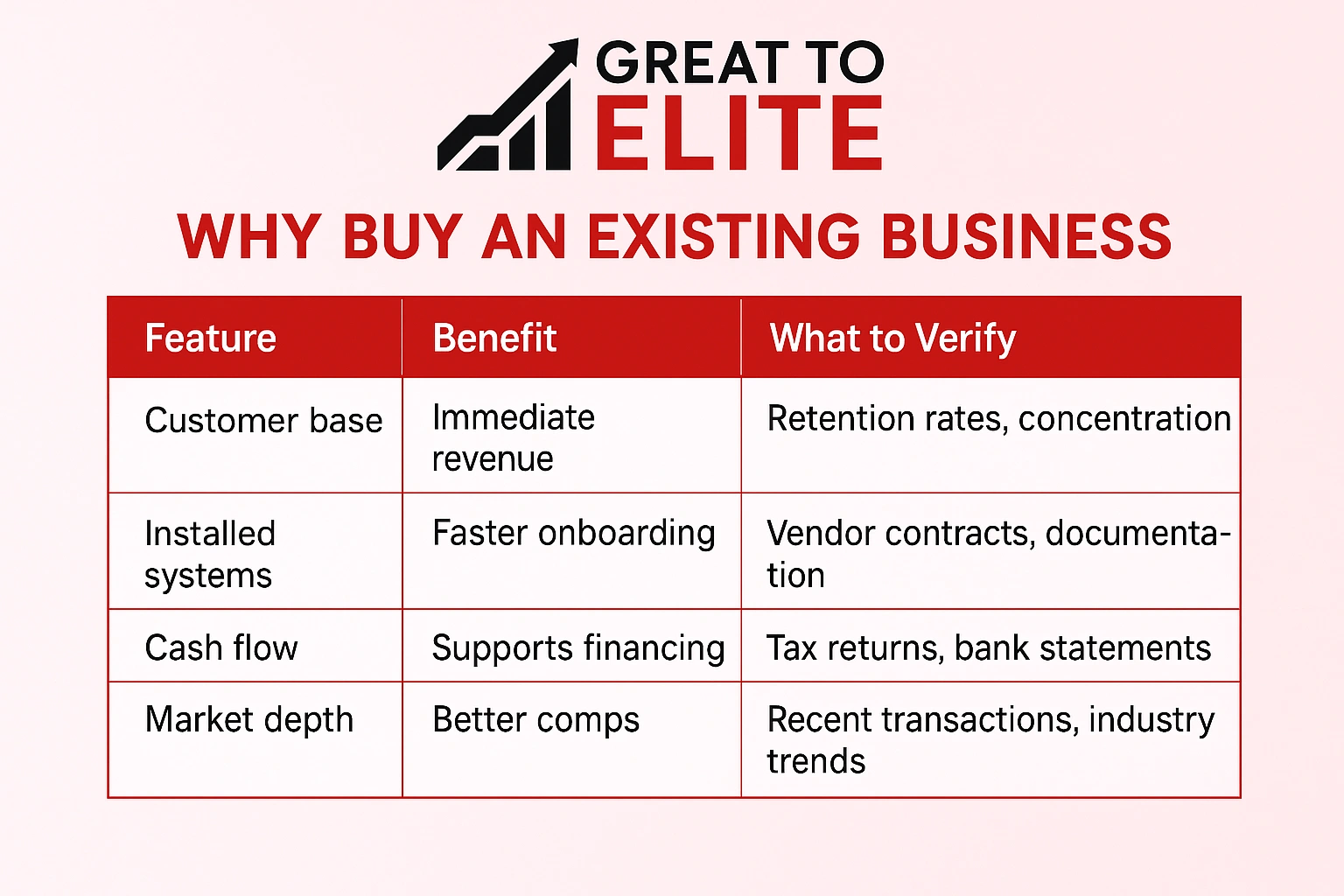
  • Capitalize on existing demand and working processes.
  • Use documented systems to lower execution risk.
  • Frame expectations with market comps and industry cycle data.
Why buy an existing business

How to Buy a Company

Aligning your experience, available hours, and tolerance for risk narrows searches and lowers execution risk. Clarify what you can run well and what you cannot. That clarity saves time and prevents chasing deals that look good on paper but fail in practice.

Map Your Skills, Lifestyle, And Risk Tolerance

List your core skills and the daily time you can commit. Some models need hands-on leadership; others run on documented systems.

Set risk bounds for finance and operations. Knowing your appetite helps you choose size thresholds that match debt capacity and resources.

Define Industry, Size, Location, And Owner Involvement

Narrow by industry familiarity to shorten the learning curve. Pick revenue and headcount ranges that fit your plan for growth.

  • Decide acceptable owner involvement and a replacement plan for key roles.
  • Choose locations where you can hire, manage vendors, and meet licensing rules.
  • Set go/no-go criteria on unit economics, churn, backlog, and pipeline.
  • Outline value-creation levers, pricing, cross-sell, procurement, or process upgrades.
Fit Area
What You Assess
Signal You Want
Action If Mismatch
Skills & Bandwidth
Operational strengths, weekly hours
Owner duties match your skills
Plan training or hire a manager
Scale
Revenue, EBITDA, headcount
Within debt and resource limits
Lower target size or secure capital
Industry
Product/service familiarity
Known customers and pricing dynamics
Engage an advisor or choose an adjacent field
Owner Involvement
Key-person roles and overlap
Clear handoff plan and transition support
Negotiate extended seller retention

Where To Find Businesses For Sale

Start your search with channels that actually produce vetted opportunities in the U.S. market. Cast a wide net across online marketplaces, reputable brokers, and your local network. Each source brings different lead quality and verification standards.

Focus on listings that include clear financial statements and a believable seller narrative. That saves time and reduces wasted effort.

Marketplaces, Brokers, And Your Network

Market listings can show volume, but screen for documentation before deeper review.

Brokers often pre-vet sellers and can surface deals that match your criteria.

Your network and word-of-mouth find quieter opportunities and spares public competition.

Signals A Listing Is Worth Your Time

  • Consistent profit and verifiable tax returns.
  • Documented systems and process manuals rather than informal notes.
  • Reasonable seller involvement and a clear transition plan.
  • Concrete growth levers like pricing or cross-sell opportunities.
  • Manageable concentration risks and lender-friendly records for financing.
What to Check
Good Signal
Red Flag
Financials
Multi-year profit, tax returns
Patchy records, unexplained adjustments
Operations
Documented systems, trained staff
Owner-dependent workflows
Seller Story
Specific reason, realistic timeline
Vague reasons or rushed exit
Growth Potential
Clear levers and capacity
No obvious path to improve margins

Valuation Methods And What Drives Price

A clear valuation framework helps you turn financials into a defensible offer. Match the method to the business profile and the data you can verify.

Income multiples and discounted cash flow

For many small firms, earnings multiples offer a fast baseline. Small, steady operations often trade at roughly 2x–4x normalized earnings. Confirm this against multi-year records and a quality-of-earnings line-by-line review.

Use discounted cash flow when margins or growth will change over the next years. DCF captures planned initiatives, but it requires realistic revenue and capex assumptions.

Asset-based and market comparables

Apply an asset-based approach when tangible assets drive most of the value. Adjust for fair market value and remaining useful life.

Market comparables help when recent, local sales exist. Remember that sparse or uneven sales data can mislead price expectations.

Qualitative drivers and red flags

Qualitative factors, owner dependence, staff depth, reputation, and scalability, move multiples up or down. Model conservative scenarios for volume and margins so you don’t overpay.

  • Watch for missing records, unexplained sales spikes, or weak sale reasons, these are common overvaluation signals.
  • Integrate findings from due diligence into your final value and keep multiple approaches for a defensible result.
Method
Best Use
Key Check
Earnings multiple
Stable profits
Normalize owner pay
Discounted cash flow
Planned growth or margin change
Realistic forecast
Asset-based
Asset-heavy models
Fair market adjustments
Market comps
Active recent sales
Local sales relevance

Financing Options To Close The Deal

Financing choices shape deal timing, monthly cash flow, and your ability to preserve working capital after close. Pick paths that match your risk appetite and the business profile while meeting lender documentation needs.

SBA Loans: Requirements, Terms, And Timelines

SBA-backed loans can cover up to about 90% and often run up to 10 years. Expect competitive rates, low down payment needs, and an approvals process that can take several weeks.

Typical lender asks include strong personal credit, multi-year financials, and a clear business plan. Prepare tax returns, bank statements, and forecasts before applying.

Seller Financing: Structure And Pros/Cons

Seller notes let you spread part of the price over time and bridge valuation gaps. They reduce immediate cash needs and align incentives but may include covenants or standby clauses if paired with SBA debt.

Bank/Credit Union Loans And Investor Capital

Traditional lenders require more down payment and scrutinize collateral, industry experience, and cash coverage. Investor capital brings governance and growth support but creates dilution and reporting obligations.

Personal Savings, Retirement Funds, And Blended Structures

Personal funds or retirement rollovers offer direct control but carry tax and risk implications. Many buyers use blended structures, SBA plus seller note and a small equity check, to optimize price and preserve reserves.

  • Compare options by total cost, amortization, covenants, and closing time.
  • Prepare P&Ls, tax returns, and realistic forecasts to keep underwriting on schedule.
  • Model conservative post-close cash flow so debt service fits real operations.
Option
Typical Terms
Pros
Cons
SBA Loan
Up to 90% financing, up to 10 years
Low down, long amortization
Long approval time, strict docs
Seller Note
Partial price, negotiated term
Reduces upfront cash, aligns seller
Seller risk, possible covenants
Bank / Credit Union
Shorter terms, higher down
Stable rates, local relationships
Stricter collateral and covenants
Equity / Personal Funds
Varied; no repayment schedule for equity
No debt service, faster close
Dilution or personal financial risk

Due Diligence That Protects Your Investment

Due diligence separates confident offers from costly mistakes when evaluating an operating business. Plan a focused review that treats each area as a gate: fail any gate, and you either walk or renegotiate.

Financials You Must Verify

Request three years of P&L, balance sheets, cash flow statements, and tax returns. Reconcile reported revenue with bank activity and payroll. Analyze seasonality and stress-test cash flow for debt coverage.

Legal, Contracts, Licenses, And Liabilities

Inspect contracts, leases, and permits for transferability and change-of-control clauses. Search for pending litigation and confirm insurance limits. Note any regulatory gaps that could create future liability.

People, Processes, And Operational Health

Review the org chart, compensation, and retention risk for key staff. Walk core processes from sales intake through billing to verify documented procedures match practice. Audit vendor terms, equipment age, and inventory condition.

  • Verify financials against tax filings to confirm revenue quality and margin improvement.
  • Confirm contracts can transfer or budget for renegotiation costs.
  • Test customer concentration, churn, and satisfaction to measure durability.
  • Mark red flags and require deeper diligence or a price adjustment.
Area
Key Documents
What You Check
Financial
P&L, cash flow, tax returns (3 years)
Revenue quality, seasonality, working capital needs
Legal
Contracts, leases, litigation records
Transferability, hidden liabilities, insurance gaps
Operational
Org chart, SOPs, vendor agreements
Retention risk, process gaps, equipment condition

Diligence often ends deals; accept that outcome as protection. When you catch a material problem, you’ve saved money, time, and future headaches.

Negotiating Terms And Drafting The Letter Of Intent

Start negotiations and define what changes hands, the payment mix, and which contingencies protect your capital. A clear letter of intent lets both sides agree on the framework before deep diligence begins.

In the LOI, state the proposed price, which assets and contracts are included, payment terms, and an exclusivity window. Include contingencies for financing, satisfactory diligence, and third-party consents so you can walk if fundamentals shift.

What’s Included, Price, And Payment Terms

Spell out cash at close, seller note mechanics, and any earn-out triggers. Use holdbacks or escrow for known risks and link earn-outs to measurable business metrics.

Transition Support And Performance-Based Clauses

Negotiate specific owner support: training hours, customer introductions, and vendor handoffs. Define durations and deliverables so both sides measure performance objectively.

  • Exclusivity: limited window for diligence and negotiation.
  • Contingencies: financing, satisfactory diligence, consents.
  • Payment mix: cash, note, earn-out, holdback.
  • Transition: hours, timeline, introductions.
LOI Element
Purpose
Typical Detail
Buyer Protection
Price & Payment
Sets economic terms
Cash %, seller note, earn-out
Staggered payments, escrow
Assets Included
Clarifies scope
Inventory, contracts, IP
Exclude liabilities, list exceptions
Contingencies
Exit gates
Financing, diligence, consents
Walk-away rights, timelines
Transition Support
Protects operations
Hours, introductions, training
Penalty or extension terms

Draft the letter so it dovetails with the definitive agreement. That reduces re-trading and keeps the deal aligned with financing and diligence realities.

Deal Structure, Agreements, And Closing Documents

Select the transaction format that matches your risk appetite, lender requirements, and tax plan. That decision guides consents, liability exposure, and which documents you must deliver at closing.

Asset Purchase vs. Equity Purchase

In an asset purchase you pick specific assets and assumed liabilities. This often limits legacy liability and can step up asset basis for tax benefit.

In an equity purchase you acquire the entity outright. That eases continuity for licenses and contracts but may include hidden liabilities.

Core Documents And Allocations

The purchase agreement should allocate risk through clear representations, warranties, indemnities, and survival periods.

  • Bill of sale and assignments for owned assets and contracts.
  • IRS Form 8594 with a defensible allocation of price among asset classes.
  • Non-compete, IP assignment, lease consents, and bulk sale notices when required.

Closing Logistics And Practical Steps

Coordinate lender schedules, required certifications, and release of funds with the closing checklist. Confirm landlord approvals, review personal guarantees, and budget legal and filing costs plus a modest working capital cushion so the business runs on day one.
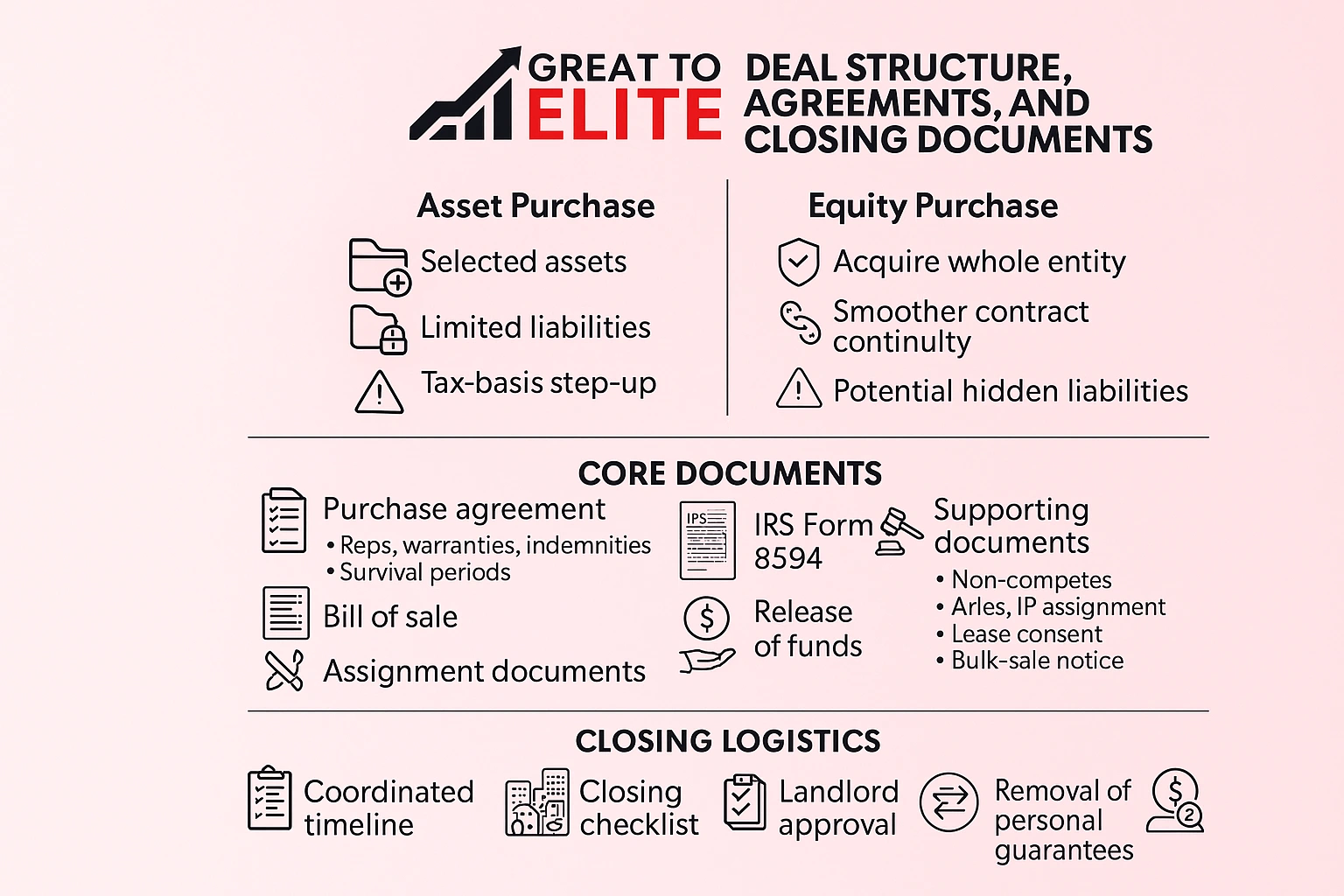
deal structure and what to consider when buying a buiness

Post-Close Transition And First 90 Days

Start the post-close phase with clear milestones that protect revenue and keep the team focused. Use a short, structured plan that balances immediate stability with gradual change.

Seller Handoff, Team Communication, And Vendor Intros

Agree on seller availability for 30–90 days and set weekly agendas for knowledge transfer. Record sessions and capture tribal knowledge in written guides.

Tell the team what will change, what stays the same, and who will make decisions. Clear messages reduce uncertainty and lower retention risk.

Prioritize vendor and key customer introductions in the first week to preserve relationships and prevent service gaps.

Protecting Cash Flow And Change Management

Tighten billing, accelerate collections, and pause nonessential spend to protect cash and cash flow. These actions give you breathing room while you learn operations.

Run a 30-60-90 plan that sequences process fixes. Aim for early wins that preserve the revenue line before you alter major systems.

  • Standardize the way work is done with quick SOP updates and simple dashboards.
  • Track leading indicators: pipeline, utilization, and on-time delivery.
  • Test system backups, access controls, and compliance tasks immediately.
  • Reserve weekly owner debriefs to capture context that won’t appear in documents.
Window
Priority
Result
Days 0–30
Customer/vendor intros, billing, team brief
Continuity and stabilized cash
Days 31–60
Process standardization, SOPs, dashboards
Fewer errors, clearer roles
Days 61–90
Targeted improvements, handoff closeout
Measured gains without service disruption

Common Risks, Costs, And Ways To De-Risk The Process

Risk creeps in quietly; catch it early with clear controls and simple protections. Deals often fail during due diligence when undisclosed debt, bad leases, or heavy owner dependence appear. Plan practical steps that reduce exposure and preserve value.

Hidden liabilities, key-person risk, and customer concentration

Map owner tasks and client relationships. Document who runs critical work and build redundancy before closing. That lowers retention risk and keeps operations steady.

Quantify customer concentration and set acceptable thresholds. If top clients account for most revenue, negotiate protections or staged payments tied to retention over the first years.

Setting contingencies and using escrow

Scrub tax, payroll, and litigation records and tie protections to specific agreements. Use tighter representations and survival periods for high-risk items.

  • Use escrow, holdbacks, and earn-outs to align payment with performance.
  • Calibrate terms, seller notes, earn-outs, holdbacks, so risk is shared and the seller stays invested.
  • Secure vendor, landlord, and partner consents before signing to avoid a broken transaction.
Risk
Control
Typical Cost Impact
Outcome
Owner dependence
Task mapping, training, redundancy
Low–medium (training, short-term hires)
Reduced key-person exposure
Customer concentration
Thresholds, contracts, cross-sell plan
Medium (discounts, legal fees)
Stabilized revenue mix
Hidden liabilities
Targeted due diligence, reps, escrow
Medium–high (escrow, indemnity reserves)
Preserved value, lower surprise costs
Integration costs
Reserve capital, phased changes
Medium (systems, staff overlap)
Maintained liquidity during transition

How Great to Elite Helps Service Businesses Acquire With Confidence

Service acquisitions need hands-on guidance; Great to Elite gives practical steps and templates you can use now.

You get focused support that fits people-driven models. The approach centers on preserving revenue and retaining staff while closing deals.

  • Acquisition readiness: Clarify target criteria, budget, and the profile you seek so you pursue the right businesses and avoid wasted effort.
  • Deal flow and screening: Systematize sourcing and apply fast filters for fit, cash strength, and growth potential so your team spends time on viable leads.
  • Financial and operational diligence: Analyze revenue quality, margins, client contracts, and org design with a service-minded lens.
  • Negotiation and terms: Frame valuation ranges, structure earn-outs and seller financing, and shape transition agreements that align incentives.
  • Post-close growth plan: Execute a focused integration plan that stabilizes operations, protects cash, and sequences quick wins.
  • Strategic support: Receive templates, checklists, and hands-on guidance tailored for recurring delivery and people-heavy processes.

If you want a proven way to evaluate, negotiate, and integrate your next purchase, book a call with Great to Elite and get started with a clear plan and the right resources for your team.

how great to elite helps service businesses pre and post company acquisition

Conclusion

Use this summary as a checklist for clear decisions during any purchase of an existing business. Keep valuation realistic, confirm records, and plan integration so the purchase matches projected value and risk.

Frame your offer with a clear letter intent and defined terms that protect cash and set the path for the definitive agreement. Treat the transaction as layered: valuation, financing, documentation, and transition each matter.

Pick financing and capital mixes that preserve runway and buy time for early wins. Protect sales, retain key staff, and track leading indicators so value unfolds over the next years.

If you want expert help evaluating a target, shaping the agreement, and running the first 90 days, reach out to Great to Elite and start your process with confidence.

FAQs

What Size of Business Should a First-Time Buyer Target?

Most first-time buyers perform best with companies earning between $250K and $2M in EBITDA. This range offers enough stability to support debt while still being simple enough to learn quickly. Going too small increases volatility; going too large increases operational complexity and capital needs.

How Long Does It Usually Take to Buy a Business?

A typical acquisition takes three to six months from first conversation to closing. Timelines vary based on lender speed, seller responsiveness, contract reviews, and the depth of diligence. Deals involving SBA financing or heavy regulation tend to extend toward the longer end.

Do You Need Industry Experience to Buy a Company?

You don’t always need direct industry experience, but you do need transferable skills. Buyers who understand sales, people management, and financial controls usually adapt well. If you lack technical exposure, plan for a longer transition period or hire experienced operational leaders.

How Do You Know If the Asking Price Is Fair?

Compare normalized earnings to local and industry multiples and test scenarios that show margin compression or slower growth. Validate numbers against tax returns and bank statements. If value depends on major assumptions, model downside cases to confirm you’re not overpaying.

What Should You Ask the Seller During First Conversations?

Ask why they’re selling, how involved they are in day-to-day work, how stable the customer base is, and what they believe the next owner should improve. Early answers reveal alignment, risk, and how realistic the seller is about transition and pricing.

What Happens to Existing Employees After the Purchase?

In most small-business acquisitions, employees remain with the company under similar terms unless an asset purchase requires new contracts. Retention matters; losing key staff early can jeopardize client relationships and knowledge transfer. Communicate early and clearly to keep the team stable. The primary reason deals fail is mismatched expectations uncovered during diligence. Buyers discover inaccurate financials, inflated sales claims, excessive owner dependence, or undisclosed liabilities. Strong documentation and a disciplined diligence process protect you from inheriting avoidable risk.