Buying a Plumbing Business: A Complete Guide
Buying a Plumbing Business: A Complete Guide

Natalie Luneva
December 10, 2025




Buying a plumbing business starts with one thing: knowing exactly what you’re buying. The process begins with defining the type of plumbing company you want, service-heavy, construction-heavy, or mixed, because that choice controls margins, revenue stability, and lender appetite.
Once your target profile is clear, you move into verification: pulling financials to calculate SDE and EBITDA, checking job-costing to confirm margins by service line, and validating licenses, insurance, and technician certifications. From there, you build a shortlist, request preliminary documents, and run diligence on technician tiers, revenue per truck, price books, dispatch efficiency, equipment condition, and compliance gaps.
Only after this groundwork do you structure the deal: aligning valuation to normalized earnings, planning working capital, preparing your lender package, and mapping your 100-day plan for pricing updates, mix shifts, and technician reallocation.
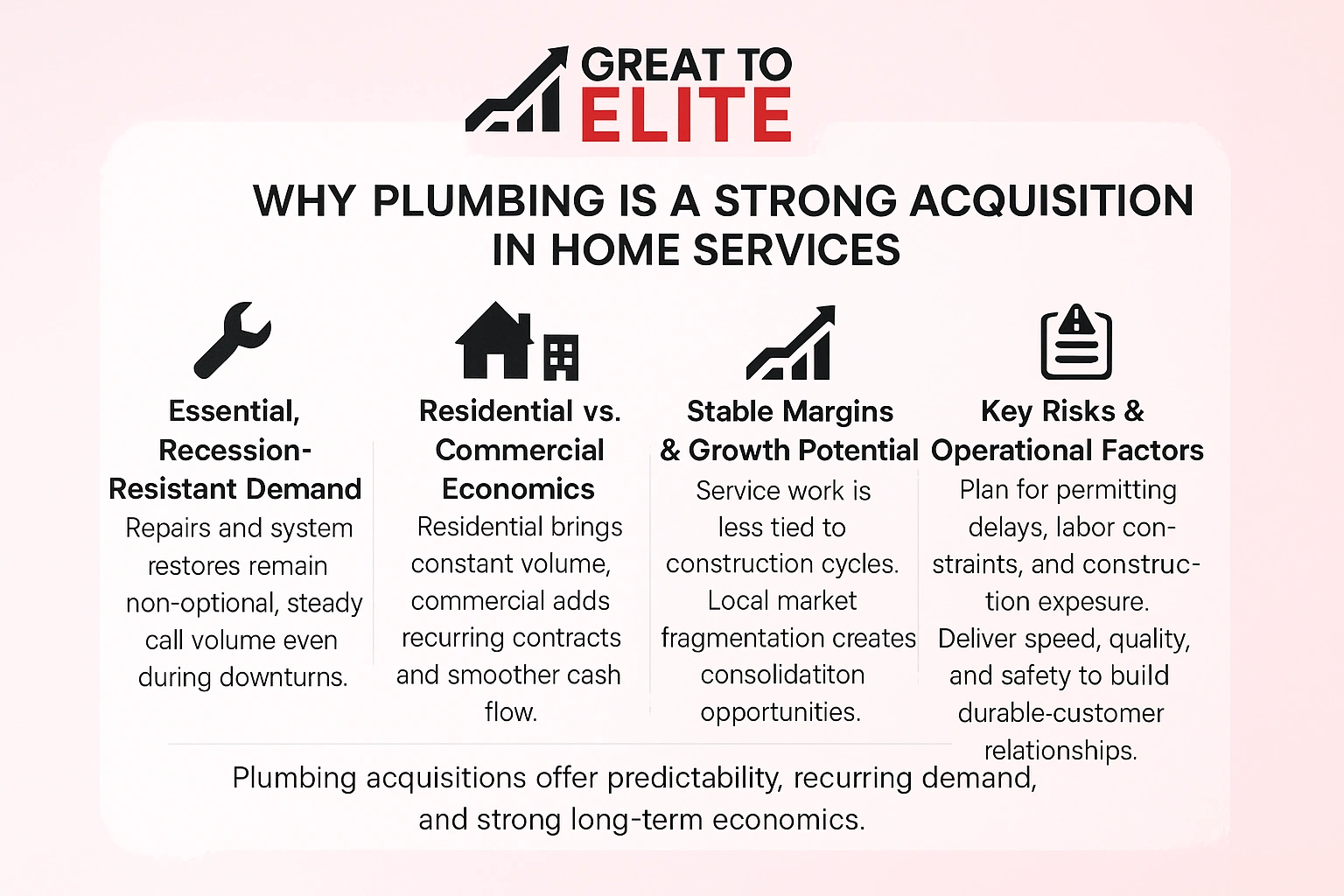
Essential service demand keeps phone lines active even when other projects pause. Repairs and system restores, water, sewage, and hot water, are not optional for most owners, so you get steady, needs-based work through downturns. This is exactly why buying a home service business, especially in plumbing, offers a level of predictability many other industries can’t match, as the U.S. plumbing industry was estimated to be worth around US$169.8 billion in 2025.
Residential work produces constant call volume from individual homeowners. Commercial contracts add cadence and recurring revenue, which smooths cash flow and creates upsell paths.
Service work is less tied to new construction cycles. While construction margins typically sit near 15–30% and swing with the economy, repair and maintenance stay steady.
That stability helps stabilize dispatch, utilization, and margins when discretionary projects slow.
Residential calls deliver volume and repeat customers. Commercial accounts create locked-in schedules and predictable revenue, which lowers seasonal risk.
Understanding customer expectations for speed, quality, and safety helps you build durable relationships and better lifetime economics for the company you acquire. For strategic help, bring Great to Elite in during planning and valuation.
Define your target profile and service focus. List whether repair/maintenance or construction will form most revenue. Note ticket size, call volume, and territory constraints. Prioritize companies with strong SOPs and repeat service work that delivers higher margins.
Screen for margin mix by line of work and verify revenue vs. invoices and job costing.
Build a diligence checklist: licenses, insurance, safety records, SOPs, price books, estimating, and dispatch workflows. Review technician tiers, certifications, and capacity to shift labor toward 50–65% margin service lines.
Structure offers around normalized earnings, seasonality, and working capital. Prepare lender materials that highlight systems, compliance, and growth levers.
Not all work earns the same profit, and that difference affects valuation. You should focus on how mix drives gross profit and the cash cycles tied to each line.
Construction jobs often sit near 15–30% gross margin and need tight estimating and project controls. That exposure can swing your forecasting during downturns.
Basic residential service can yield roughly 50% gross margins. Commercial maintenance inspections typically run 35–40%, while repairs found during visits often exceed 50%.
Contracts with quarterly or semi-annual cadence create steady pipelines and higher technician utilization. Use price books and upsell paths to protect margin and lift average ticket size.
Match technician skill to profitable work to lift margins and scale faster. Focus on clear tiers, then build training and scheduling systems that move capable techs into premium roles.
Tier 1 typically delivers about $200,000 revenue per truck at ~50% gross margin. These techs handle common calls and require SOP-driven ride-alongs to maintain quality.
Tier 2 averages roughly $300,000 per truck with similar margins. These techs often have 3+ years of experience and need stronger safety and pricing discipline to protect margins.
Tier 3 generates $350,000–$400,000 per truck and 60–65% margins. Scarcity of certified techs makes this the highest-margin area. Move construction-experienced staff here to unlock gross profit without higher overhead.
Valuation starts with clear math: gross profit, normalized earnings, and how mix shifts change value. You must distinguish SDE (discretionary earnings) from EBITDA and know which lenders or buyers use each metric.
Revenue alone can mislead. A $4M revenue company may deliver $2M gross profit; mix shifts that raise gross profit 20% lift gross to $2.4M and boost EBITDA materially.
Keep overhead flat and move technicians to higher-margin work. That operating leverage can increase EBITDA by roughly 40% in the example above. Normalize earnings to remove one-offs and owner perks before you set price expectations.
Evaluate trucks, jetters, and excavation gear for condition and replacement cycles. Asset-heavy add-ons like hydro-jetting show strong hourly economics but raise capex and working capital needs.
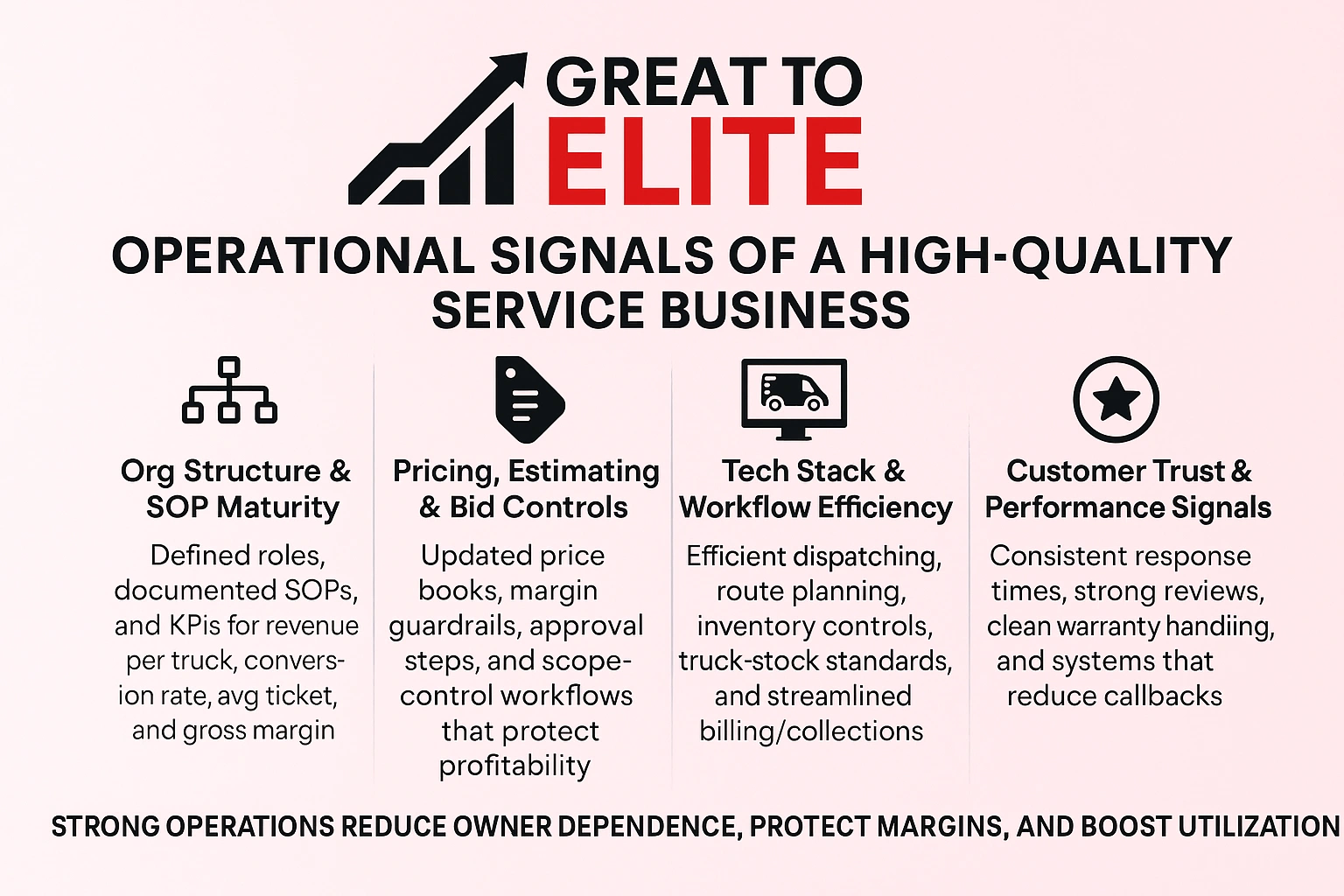
Operational maturity often shows up in repeatable workflows and clear ownership for daily tasks. These signs tell you whether the team can run without heavy owner involvement and where quick improvements pay off.
Check for documented job descriptions and an org chart that assigns responsibilities. Verify SOPs for intake, diagnosis, safety, and quality control.
Confirm KPIs for truck revenue, conversion rate, average ticket, gross margin by job type, and SDE. If these items are missing, plan for change management costs.
Look for maintained price books with update cadence and margin guardrails. Review estimating workflows and approval gates to prevent scope creep and protect gross profit.
Inspect dispatch efficiency, route planning, and schedule adherence that maximize billable hours. Evaluate inventory controls, truck stock standards, reorder triggers, and vendor-managed restock.
Confirm billing and collections workflows shorten cash cycles and reduce write-offs. Reputation signals, reviews, response times, and warranty handling, serve as customer trust proxies.
After close, focus on predictable revenue streams that stabilize tech utilization and lift margins.
Launch quarterly or semi-annual maintenance plans to lock steady work, increase repeat visits, and create upsell paths. Inspections often run 35–40% margin; discovered repairs commonly exceed 50% margin.
Productize hydro jetting with fixed hourly pricing near $300 where the market supports it. Offer bundled water-treatment options in hard-water zones to capture premium customers.
Evaluate HVAC and boiler overlaps in your area to add services where technician certification matches. Bundles that cover heating, cooling, and drains boost average ticket and retention.
The due diligence when buying a company starts with license verification; gaps here can stop jobs and derail financing. You should confirm that the company and every field tech hold active state and local credentials for the review period. Lenders will pause or deny funds if documentation is incomplete.
Check corporate licenses, trade registrations, and each plumber's individual license. Validate active status online and capture expiration dates.
Confirm transfer rules so licenses remain valid after the purchase. If subcontractors work on jobs, verify their credentials before assignment.
Certifications show adherence to standards and raise credibility with customers and commercial accounts. Record certificates that matter for high-margin work and include them in bid packages.
Verify policy types and limits, general liability, commercial auto, and workers’ comp. Review claims history and safety records to assess operational risk.
Tie compliance strength to valuation and deal protections. Use escrows, reps and warranties, and post-close reserves when gaps exist. Proper diligence protects your owner transition and increases the chance of success for this potential acquisition.
Quantify addressable homes, then model a decade of expansion that keeps your share under 20% for sustained upside.
Estimate total households in target ZIPs and define realistic serviceable share based on routing, shift lengths, and tech capacity. Use census trends and local permitting data to project new units and construction pipelines.
Count households within practical drive time. Convert that to monthly call volume and apply incidence rates. From there, set a serviceable share that reflects fleet size and peak-day limits.
Apply the 10x-in-10 rule: pick regions where current share plus projected growth keeps you below 20% if you scale revenue tenfold. Avoid small, static markets unless strong population growth exists.
Map seasonal peaks and plan staffing to smooth utilization. Measure review density and average rating as proxies for reputation. Faster response times and clear guarantees lift conversion and lifetime value.
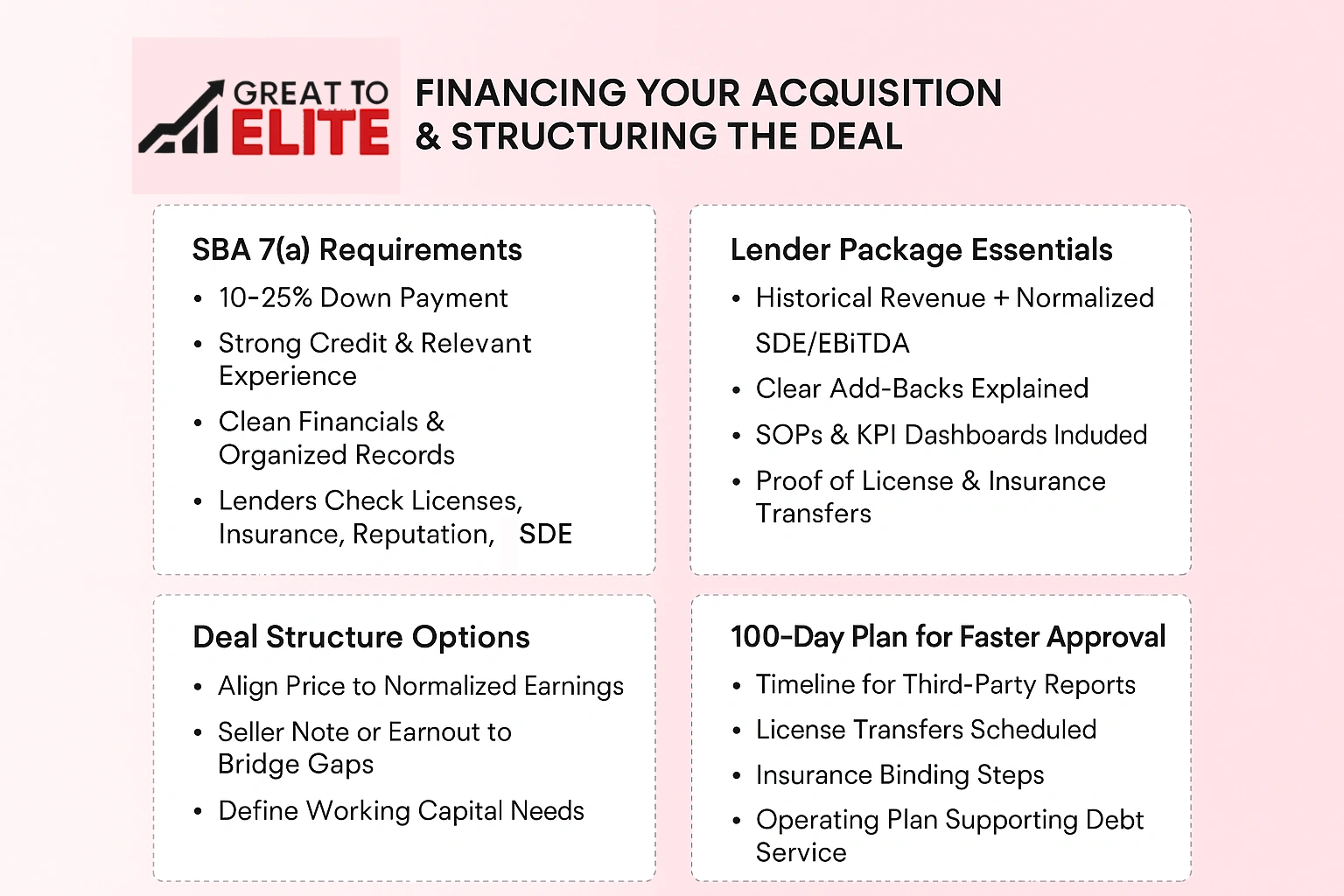
Banks want proof: experience, orderly records, and realistic cash-flow forecasts. For many buyers, SBA 7(a) loans are the primary route. Typical terms call for 10–25% down, solid credit, and relevant trade experience. Lenders will dig into licenses, insurance, reputation, and normalized discretionary earnings.
Prepare an organized lender package that shows historical annual revenue, SDE/EBITDA normalization, and clear add-backs. Include SOPs, KPI dashboards, and evidence of transfers for licenses and insurance.
Finish your package with a 100-day plan. Show timelines for third-party reports, license transfers, and insurance bindings. That narrative reduces transition risk for the lender and the seller, and it speeds closing on the right price.
Acquisitions succeed when strategy, systems, and execution align, Great to Elite makes that alignment practical and repeatable. You get a clear playbook for deal selection, tight diligence, and fast post-close lift. The approach focuses on the service mix and technician tiers that drive margin and long-term growth potential.
Book a call with Great to Elite to discuss your acquisition goals and build a tailored plan for buying and scaling your plumbing company.
You’ve seen why a plumbing acquisition can be resilient: needs-based work, repeat customers, and diversified services that protect revenue during slow periods.
Prioritize service mix over construction for margin stability. Map technician tiers to per-truck economics and use mix shifts to lift EBITDA instead of just adding headcount or trucks.
Lock predictable cadence with maintenance contracts, hydro jetting, and regional water-treatment offers to raise average ticket and retention. Verify licenses, insurance, and SOPs to reduce deal risk and win lender confidence.
Size your area with the 10-year, under-20% share rule and align price, financing, and your post-close plan. With clear execution, this opportunity can deliver durable cash flow and scalable value for owners and customers alike.