How to Buy a Home Services Business and What to Consider
How to Buy a Home Services Business and What to Consider

Natalie Luneva
November 27, 2025




Buying a home services business is a practical path into a steady, recession-resistant industry powered by aging U.S. housing and constant repair demand. The process starts when you define the exact type of business you want, HVAC, plumbing, roofing, electrical, and building deal flow through brokers, direct outreach, and local networks.
Once you find a target, you evaluate cash flow, technician stability, customer mix, equipment condition, and backlog. From there, you negotiate valuation and terms, often using SBA financing and seller notes to lower your upfront cost. A clear transition plan keeps staff, customers, and revenue steady from day one.
Demand patterns and demographic shifts are aligning to support steady returns for local repair and upkeep firms. According to a recent industry report, the U.S. home services market was valued at roughly USD 211.71 billion in 2024 and is projected to grow to USD 893.18 billion by 2032.
Deferred moves and budget-conscious upgrades keep homeowners investing in repairs instead of relocating. That behavior cushions revenue during downturns.
The professional market totals roughly $600 billion, and aging dwellings create recurring work cycles: roofs, HVAC, plumbing, exterior upkeep. Roofing alone sees about 90% replacement work and grew near 2.7% annually from 2015–2020.
HVAC and plumbing show multi-year momentum. HVAC had a large global footprint and steady CAGR forecasts; plumbing product demand is rising too. You can measure local demand by home age, weather, income bands, and turnover.
Local territories often support fewer active providers per trade than crowded consumer niches, giving you room to capture share with targeted marketing and operational discipline.
Residential work yields volume and frequency. Select commercial lanes, HOAs and light facilities, add larger tickets and smooth seasonality. Plan capacity, margins, and staffing based on your intended mix to lock in profitable growth.

Begin with a clear sourcing plan that balances listed opportunities and owner referrals. Use curated listings, local brokers, direct outreach to retiring owners, and vetted franchise opportunities to widen your funnel.
Broker listings give screened deals. Direct outreach uncovers motivated sellers. Franchises supply playbooks, training windows (3 days to one month), and ongoing fees for marketing and tech.
Score targets on services offered, territory demographics, five-year revenue trend, gross margin by line, and customer concentration. Evaluate owner involvement, cross-training of techs, and documented SOPs.
Deciding between a franchise and an independent path shapes your risk, capital needs, and growth speed. Each route gives clear trade-offs in training, fees, and brand control. Use the points below to weigh structure against freedom.
Franchises typically deliver initial training (three days to one month), operations manuals, national marketing funds, and tech platforms with monthly fees. Those systems aim to shorten ramp time and standardize quality.
Independent operators keep pricing control, choose vendors, and change offerings fast. This path reduces royalty drag and lets you test local tactics without approvals.
Study the franchise disclosure for territory rules, transfer clauses, renewal terms, litigation history, average unit economics, and required local marketing spend.
Before you sign papers, clear valuation rules and deal mechanics must support your investment thesis. Normalize earnings to reveal true SDE or EBITDA.
Adjust for owner pay, related-party costs, one-time repairs, and seasonality. Use historical replacement cycles, roofing ~90% replacement, HVAC and plumbing demand, to set realistic trailing averages.
Quantify working capital needs: AR days, inventory turns, deposits, and prepaid media. Model sensitivity to lead volume and crew utilization to reflect local market seasonality.
Adjust multiples for customer concentration, tech dependency, and vendor reliance. Translate your thesis into term sheet levers, price, structure, transition services, and non-compete, and align lender forecasts with defensible local demand.
A focused diligence plan helps you verify claims and size operational gaps quickly. Use this checklist to inspect operations, customers, people, legal records, and franchise obligations. Keep notes, photos, and timestamps for every item you verify.
Inventory equipment condition, fleet age, maintenance logs, warranties, and replacement capex. Verify utilization and downtime trends against service levels.
Audit scheduling systems for routing efficiency, average response times, and cancellation rates. Confirm SOPs for estimates, change orders, and job closeouts are documented and followed.
Analyze lead sources, conversion rates, and booked-job ratios by channel. Map seasonality curves tied to roofing, HVAC, and plumbing cycles.
Calculate churn by segment and review repeat-customer rates to validate revenue stability.
Map who sells, who estimates, and who trains technicians. Plan coverage for critical roles if owners depart.
Review technician headcount, certifications, W-2 vs. 1099 mix, pay structure, turnover, and customer review scores to assess cultural health.
Confirm licenses, permits, insurance, safety records, customer contracts, and lien or litigation searches. Conduct a quality of earnings review focused on revenue recognition, cash vs. accrual, and normalized expenses.
Validate pricing discipline and discounting patterns versus local industry benchmarks.
If applicable, review the franchise disclosure for territory rules, required spend, training windows, and tech fees. Interview current franchisees to test promised support and network health.

Financing choices and a clear closing timeline will shape your first 100 days of ownership. Get lender alignment early to avoid delays on permits, insurance, and training windows. Plan capital to cover seasonal slowdowns and initial marketing push.
Compare SBA 7(a) versus 504 for down payment, term length, and eligible uses. Lenders often underwrite franchise and independent firms with collateral-light assets and focus on normalized earnings and backlog.
Structure seller notes with interest-only periods to preserve working capital through seasonality. Consider minority equity to fund capex and hiring while keeping control through governance terms.
Map diligence sprints, lender approvals, legal docs, landlord consents, permit filings, and insurance binding on a master timeline. Lock transition services and knowledge transfer terms into the purchase agreement.
Align capital to your 100-day plan for lead generation, technician onboarding, and route efficiency. Confirm compliance requirements in your state and municipality before closing to prevent operational gaps.
Start with high-impact, low-friction changes, better web pages, review capture, and tighter dispatch. These moves often unlock demand quickly for legacy operators who under-invest in digital channels.
Upgrade your website for fast load times, clear calls-to-action, and conversion-focused landing pages targeting priority offerings. Optimize on-page SEO and your Google Business Profile to lower cost per lead and improve map-pack visibility.
Implement automated review capture and response workflows to compound trust and lift rankings. Track cost per lead, book rate, and reviews velocity on a simple dashboard.
Test complementary lines that match crew skills and routing. Pilot cleaning services packages and residential cleaning tie-ins to raise visit frequency and lifetime value.
Offer window services add-ons and junk removal upsells where ticket economics make sense. Evaluate remote cleaning coordination if it fits your model.
Improve routing density, standardize truck stock, and tighten inventory controls to improve margin without major new spend. Use call scripting and dispatch SOPs to raise booking rates and cut cancellations.
Align incentives and training so technicians confidently sell add-ons. Monitor KPIs, average ticket, first-time completion, and technician utilization, to manage growth.
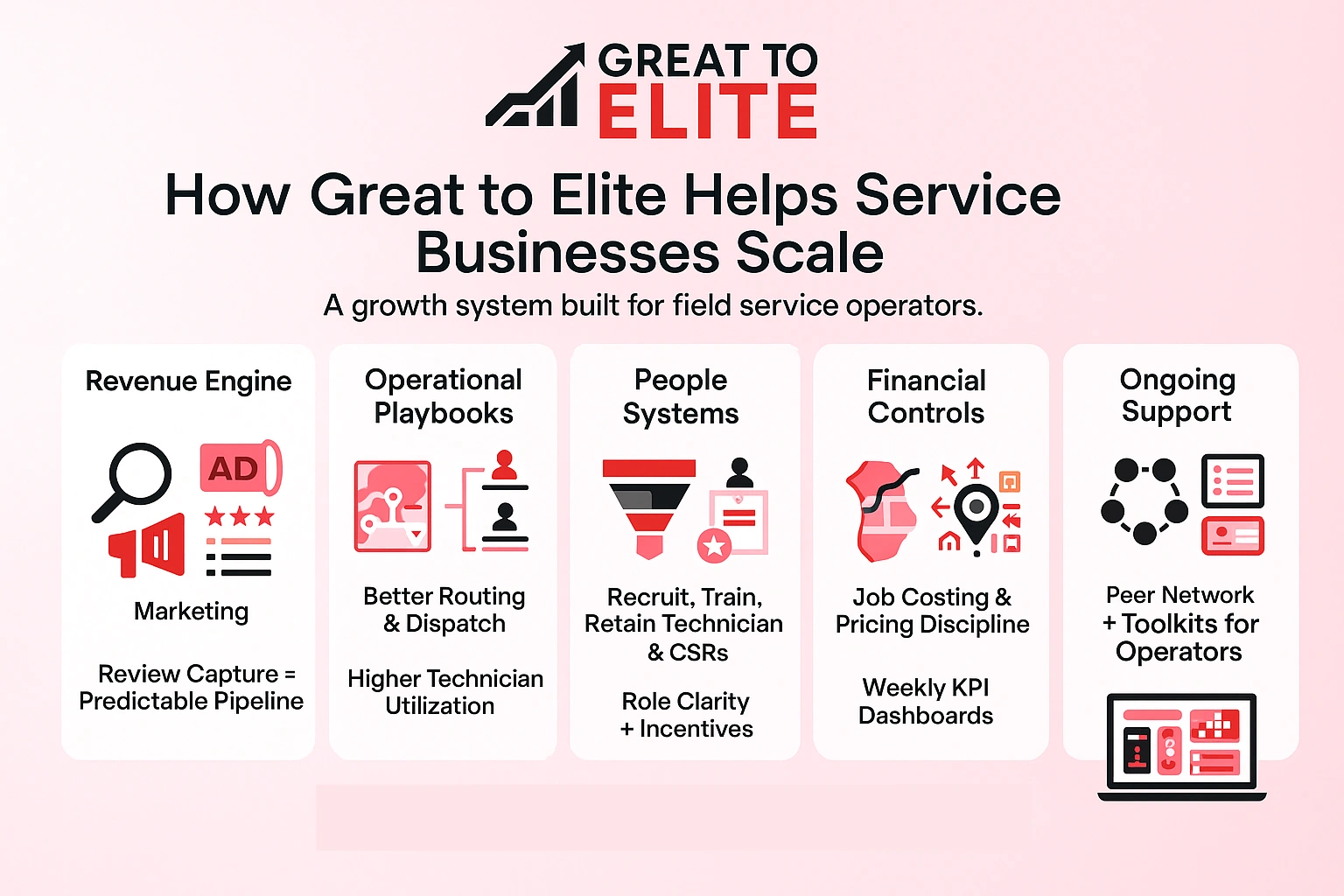
Great to Elite turns common gaps into repeatable growth paths for local operators. Many operators under-leverage digital marketing and structured operations. Applying systematized revenue, operations, people, and finance frameworks accelerates growth after acquisition.
You’ll get focused support that moves metrics fast. The program blends local SEO, paid acquisition, and review acceleration with SOPs for routing and dispatch.
Compare outcomes:
You’ll gain ongoing support and a peer network that shortens your learning curve. Great to Elite provides toolkits for both franchise and non-franchise models so owners and business owners can scale with clarity.
Ready to accelerate growth? Book a call with Great to Elite to see how the system applies to your company and market.
You now have a concise playbook to test deals, manage transition risk, and scale local operations methodically.
Use the checklists and valuation rules to pressure-test targets. Focus on crews, equipment, routing, and client retention during the first 100 days. Validate franchise disclosure items if a franchise path applies and interview franchisees for real-world context.
Apply digital upgrades to capture demand fast, optimize your site, review systems, and map cross-sell offers like window services, residential cleaning, or commercial cleaning where unit economics fit.
Keep momentum: revisit your shortlist, contact sellers, and use Great to Elite for execution support and access to a network that helps new owners move from plan to profitable operation.