Business Succession Planning Consultants: What Are They and What Do They Do
Business Succession Planning Consultants: What Are They and What Do They Do

Natalie Luneva
December 19, 2025



Business succession planning consultants are advisors who design and run a structured process to ensure the right people are ready to step into critical leadership roles when change happens. They evaluate current leaders, identify potential successors, define what each role actually requires to succeed in the future, and create a clear development plan tied to timelines and measurable readiness.
Their job is not to “name a replacement.” It is to reduce risk. They use assessments, role criteria, governance rules, and scenario planning to show who is capable, who needs development, and where gaps could disrupt the business. This turns succession from guesswork or politics into an evidence-based decision process.
Without a formal succession planning framework, organizations lose momentum, high performers leave, and value erodes at the exact moment stability matters most. Succession planning consultants create continuity, as they make leadership transitions planned, testable, and executable instead of reactive.
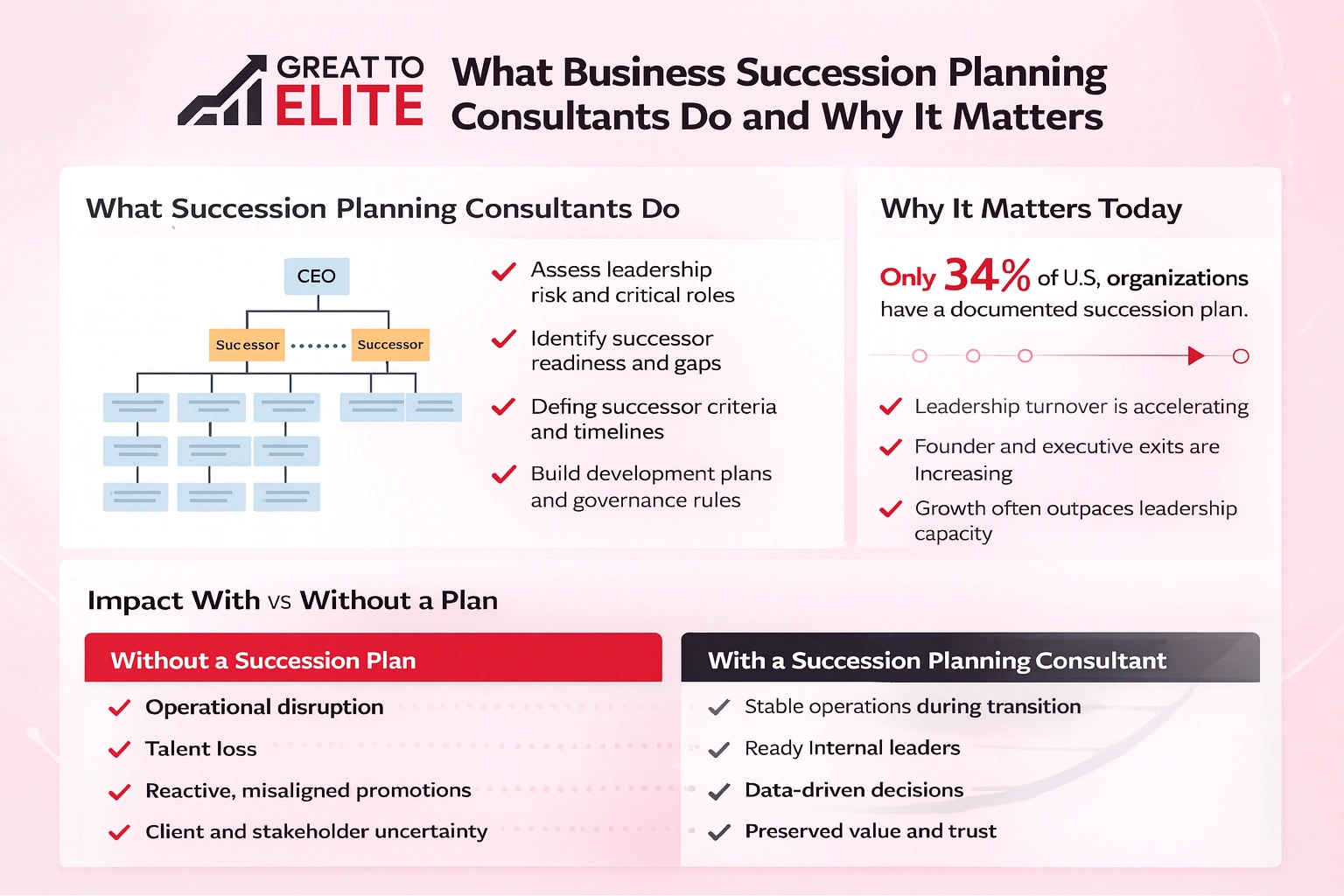
Business succession planning consultants assess leadership risk and turn it into an executable continuity plan. They analyze who holds critical decision-making authority today, who could replace them tomorrow, and what would break if that transition happened suddenly. From that analysis, they define successor criteria, readiness thresholds, development actions, and governance rules so leadership changes do not disrupt operations. Despite this importance, only about 34% of U.S. organizations have a documented succession plan in place, leaving most unprepared for leadership change.
What they do matters today because leadership turnover is accelerating while tolerance for disruption is shrinking. Founders are exiting, senior executives are aging out, and growth often outpaces leadership capacity. Without a formal process, companies default to reactive promotions or rushed external hires that do not match future strategy.
Assessments start with the evaluation of the current leadership, management gaps, and organizational goals. Advisors map decision rights and create milestones that move a team from the present state to transition readiness.
Without a formal process, operations face interruption and clients grow uncertain. High-potential talent may leave, and reactive hires often lack the skills needed for future demands.
Adaptive roadmaps and analytics turn talent signals into actionable promotion decisions. This section describes a dynamic, ongoing approach that keeps the succession plan current and decision‑ready as conditions change.
Teams use internal and external data to map readiness across roles. Regular reviews update the process when goals or market needs shift.
Scenario models and dashboards reveal pipeline health and the impact of specific decisions. That clarity helps leaders prioritize development and timing.
Advisory services link valuation, tax strategy, estate coordination, and exit options to the succession plan. This multidisciplinary lens helps owners balance liquidity, taxes, and legacy goals.
Executive coaching and targeted development accelerate readiness with measurable milestones for management transitions.
Great to Elite combines these tools and services to help organizations choose successors who fit future strategy, not just past roles. The result is a measurable, risk‑controlled process that preserves value and keeps operations steady during change.
A clear, staged process turns uncertainty into defined tasks and timelines. The approach maps discovery, assessment, and execution so the organization can act with confidence.
Project initiation sets scope, deliverables, governance, and reporting cadence. This step ensures decisions stay on track and timeboxes key milestones.
Fact‑finding uses document reviews, interviews, surveys, and focus groups to surface needs and leadership gaps. Work sessions then align the team on goals and success indicators.
Assessments measure strategic needs, current talent, and pipeline health. Results translate into templates and toolkits that scale across the organization.
Readiness dashboards and assessment outputs create clear development paths and reduce risk exposure for critical roles.
Successor criteria define competencies, experience, and values tied to role outcomes. Scenario planning sets timelines and contingency paths for common challenges.
Owners receive governance and liquidity guidance, interim coverage plans, and cross‑training to keep management focused on core operations.
Great to Elite uses this structured method to deliver a tested plan that scales across organizations. The result is a repeatable process that keeps operations running while leaders change.
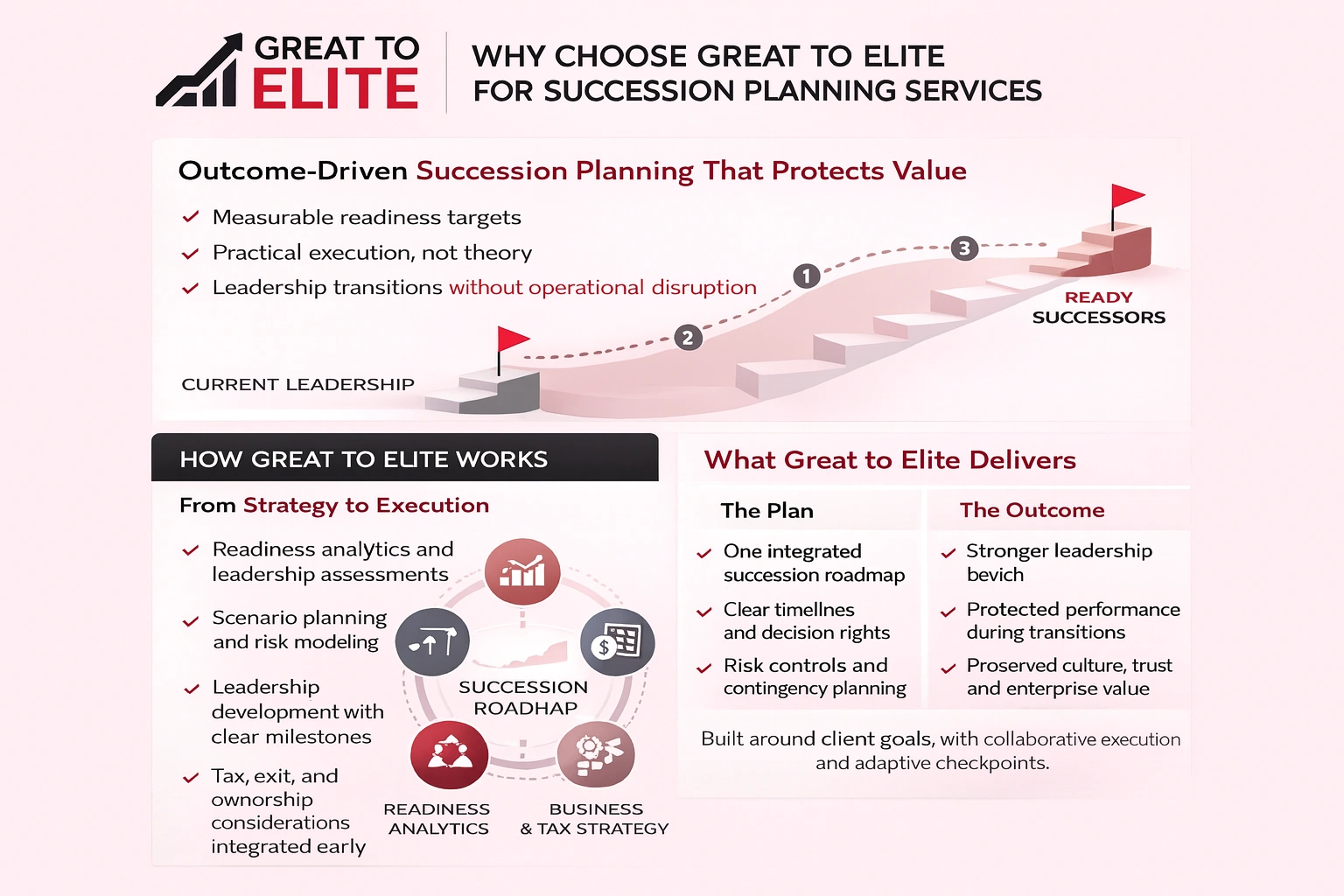
A clear, outcome-driven approach keeps leadership transitions from derailing daily work. Great to Elite pairs measurable targets with practical steps so the organization keeps moving while leaders change.
We tie strategy to execution with tools that show readiness, risk, and timelines. That keeps talent development on track and aligns the plan with owner goals.
Our approach blends analytics, scenario work, leadership development, and tax and exit considerations. Teams gain a single roadmap that protects value and reduces disruption during transition.
What Great to Elite delivers:
Ready to review options and test your plan? Book a call to discuss goals, timing, and next steps with our team.
Treating leadership change as an ongoing discipline makes future shifts predictable. Succession planning that uses regular assessment and analytics stabilizes operations and protects value.
A practical plan links assessment, pipeline visibility, development, and governance so an organization stays focused on growth and serving clients. Periodic reviews and scenario tests keep the plan current as markets evolve.
Owners gain more when tax and exit factors are integrated early. An evidence-based approach improves selection quality, speeds experience building for candidates, and strengthens culture and performance.
If you want to align leadership and formalize a clear plan, get in touch. Book a call with Great to Elite to discuss how we can tailor a path and keep everyone accountable.