Business Exit Planning Services: Why Do Businesses Need These
Business Exit Planning Services: Why Do Businesses Need These

Natalie Luneva
December 21, 2025



Business exit planning services are a structured set of advisory and execution services designed to prepare a company and its owner for a future transition, whether that transition is a sale, internal succession, recapitalization, or gradual step-back from ownership. These services go far beyond selling a business. They align personal goals, business performance, tax outcomes, and timing into a single, deliberate plan that protects both value and the owner’s future.
Businesses need exit planning services because most companies are not transferable in their current state. Almost half of business owners have no business exit plan in place despite planning to step away from their business in the next decade, leaving them at risk of lower valuations and rushed decisions, a gap that strategic exit planning directly addresses. Buyers and successors pay for reliable cash flow, documented systems, leadership independence, and low operational risk, not just revenue.
Good planning turns proceeds into lasting wealth and gives owners confidence about the future. Great to Elite provides a comprehensive, goal-driven plan that maps milestones, closes gaps, and positions the company to command stronger terms when it’s time to transition.
Today’s market means owners must assess risks and timing before making a move that shapes their future. Buyers now focus on earnings quality, predictable cash flow, documented systems, leadership depth, and legal or operational risk. These factors drive valuation and closing certainty more than top-line revenue.
Early preparation lets owners anticipate buyer criteria and connect market conditions to optimal timing. When financials, governance, and customer concentration are addressed ahead of a sale, valuation discounts and extended diligence become less likely.
Exit choices determine after-tax proceeds and whether the firm will support the owner’s desired lifestyle. Clear goals align personal timelines with company readiness and buyer demand.
A disciplined approach protects wealth and creates a smoother path to a successful business exit, preserving legacy and continuity for employees and customers.
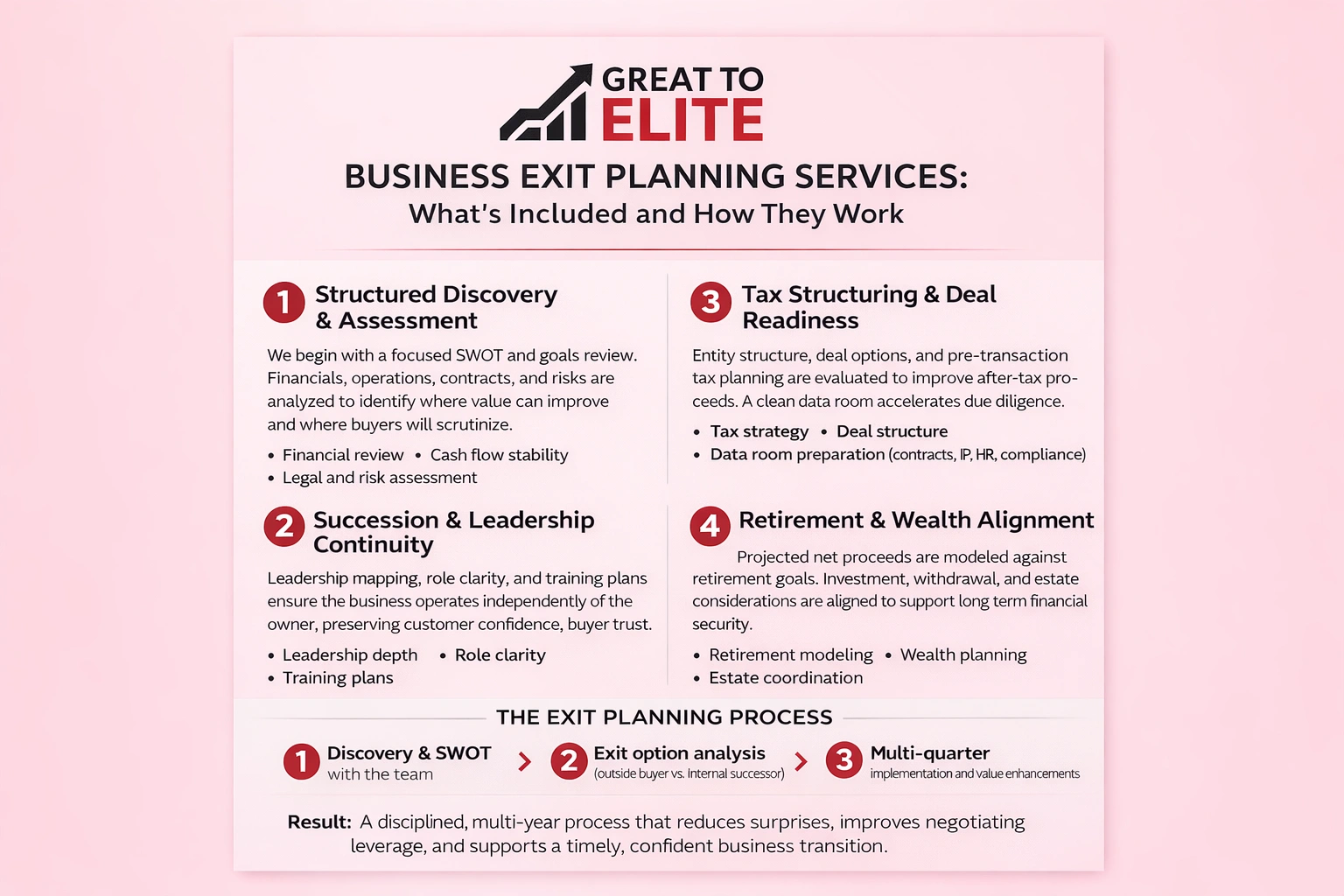
A structured discovery sets priorities. Great to Elite begins with a focused SWOT and goals review. We examine financials, operations, contracts, and risks to reveal where value can improve.
We document owner objectives and quantify gaps. Financial statements, cash flow stability, and legal records are reviewed to shape targeted actions.
Leadership mapping, role clarity, and training plans keep the firm running without the owner. This reduces buyer concern and preserves customer confidence.
Entity design, deal form options, and pre-transaction reorganizations are evaluated to enhance after-tax proceeds.
We also prepare a clean data room: contracts, IP, HR files, and compliance records to accelerate diligence.
Projected net proceeds are modeled against retirement goals. Investment and withdrawal strategies are coordinated with estate and shareholder agreements.
Result: a disciplined process that reduces surprises, improves leverage, and supports a timely transition.
A focused valuation approach shows what buyers truly pay for and where value gains are possible.
Valuation reflects normalized earnings, working capital needs, and revenue quality, not just top-line sales. Buyers look for durable cash flow, low customer concentration, and recurring revenue streams.
Target improvements that raise margins and shorten cash conversion cycles. Typical actions include systematizing processes, building recurring models, and strengthening leadership depth.
A sequenced roadmap prioritizes quick wins, profit margin fixes, pricing discipline, then tackles structural work like scalable systems and diversification.
Early tax work shapes deal structure and net proceeds. Quality-of-earnings reviews, contract summaries, compliance files, and KPI dashboards speed diligence.
Result: Targeted improvements and organized documentation create a stronger deal thesis, shorten diligence, and improve outcomes when you plan an eventual exit.
Coordinating income, estate, and trust matters early can change what an owner keeps after a sale. Smart alignment reduces tax drag and preserves family goals.
Income tax, estate tax, and trust design should work together. Entity type, asset versus stock sale treatment, and basis adjustments all affect net proceeds.
Pre-transaction reorganizations and gifting strategies can shift tax exposure. Proper documentation and defensible valuations help to withstand scrutiny.
Model retirement income before you finalize terms. Translate proceeds into a sustainable withdrawal strategy and portfolio allocation that match lifestyle needs.
Consider liquidity for taxes, debt payoff, and near-term spending to avoid forced sales of investment holdings after the close.
Result: Integrating tax, retirement, and estate work creates a clearer path to protect wealth and family legacy during a transition.
Choosing the right path for your company shapes value, timing, and who carries the mission forward. Common routes include a third-party sale, a private equity recap, or an internal transfer to family or management. Market conditions and runway influence what’s feasible.
Strategic buyers may pay for synergies. Financial buyers focus on cash flow and multiple expansion. Private equity can offer partial liquidity while letting the owner stay involved for growth.
An effective business exit strategy planning builds contingency plans for shifting markets. Clean documentation, a clear growth story, and realistic timing reduce surprises and speed momentum for a successful business exit.
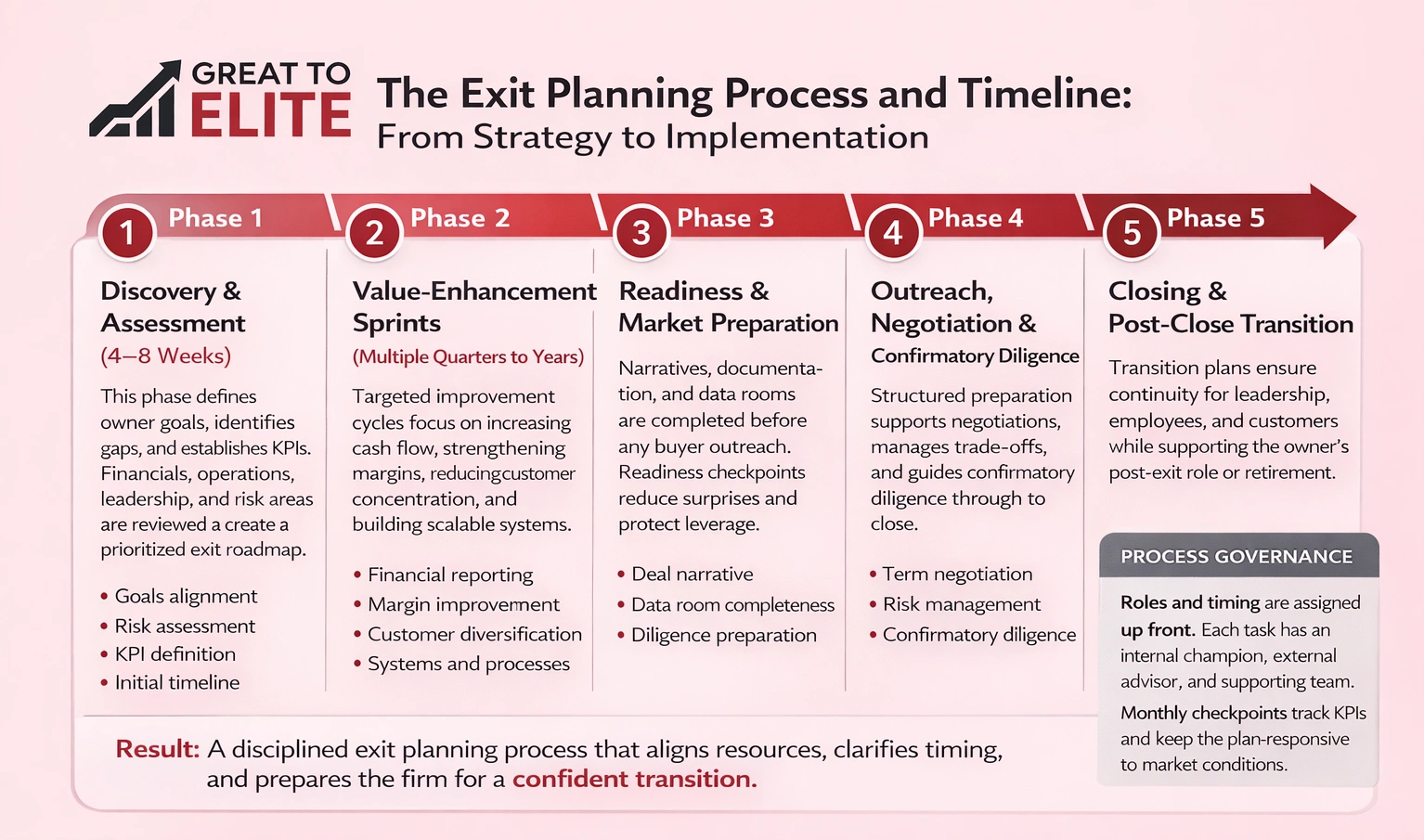
A practical roadmap lays out tasks, owners, and checkpoints so momentum replaces uncertainty. The sequence begins with discovery and assessment, then moves into value-enhancement sprints, documentation and diligence prep, outreach (if appropriate), negotiation, confirmatory diligence, and closing with a post-close transition plan.
Roles and timing are assigned up front. Each major task lists the internal champion, external advisor, and supporting team. Regular reviews keep the plan responsive to market signals and risk findings.
Project management tools and monthly checkpoints measure progress against milestones and KPIs. Resource allocation, internal champions plus external advisors, keeps momentum and reduces delays.
Result: a disciplined strategy and process that aligns resources, clarifies timing, and readies the firm for a confident transition.
We align owner goals, operational readiness, and tax considerations into a single action plan that drives measurable progress.
Great to Elite offers a structured engagement that starts with discovery and ends at close. Our approach combines objective analysis, targeted value work, and hands-on execution.
Specialists and resources from Great to Elite combine strategic direction with practical tools you can deploy immediately. We evaluate sale and internal options, calibrate expectations, and prepare for buyer and lender requirements.
Next step: Book a call with Great to Elite to assess readiness, align goals, and start building a confident path to your business exit. Schedule a consultation today to translate objectives into an actionable plan.
A focused strategy turns uncertainty into a timeline of purposeful steps for stronger outcomes.
Effective planning links owner goals, company readiness, and market timing to drive better value and smoother transition. A complete plan covers valuation, value enhancement, tax coordination, succession, and documentation so buyers can move with confidence.
Start today to allow sufficient time for improvements that reduce risk and improve financial credibility. A disciplined process builds leadership continuity and clearer post-close wealth planning for the business owner and family.
Great to Elite helps move you from uncertainty to a prioritized plan and timeline. Book a consultation to assess gaps and begin a structured path toward a successful business exit.