How to Buy a Landscaping Business: The Complete Guide
How to Buy a Landscaping Business: The Complete Guide

Natalie Luneva
December 10, 2025




Buying a landscaping business starts with validating real revenue, checking equipment condition, and confirming that customers and crews will stay after the owner exits. Map your local market, compare service models (lawn care, full-service, or commercial), and define exactly what type of operation you want to acquire. From there, you request five years of financials, reconcile deposits to bank statements, and segment profit by service line so you know what actually drives earnings.
Next, you evaluate contracts, route density, and customer concentration to understand stability and churn risk. You inspect trucks, mowers, trailers, handhelds, and shop setups to calculate near-term replacement costs. Once you have a factual earnings profile and a clear picture of the assets, you write an offer with contingencies, complete a Quality of Earnings review, secure financing, and run permit, insurance, and contract-assignment checks.
The last step is planning the first 90 days: retaining crews, communicating with customers, stabilizing routes, and keeping pricing and schedules consistent while you learn the operation.
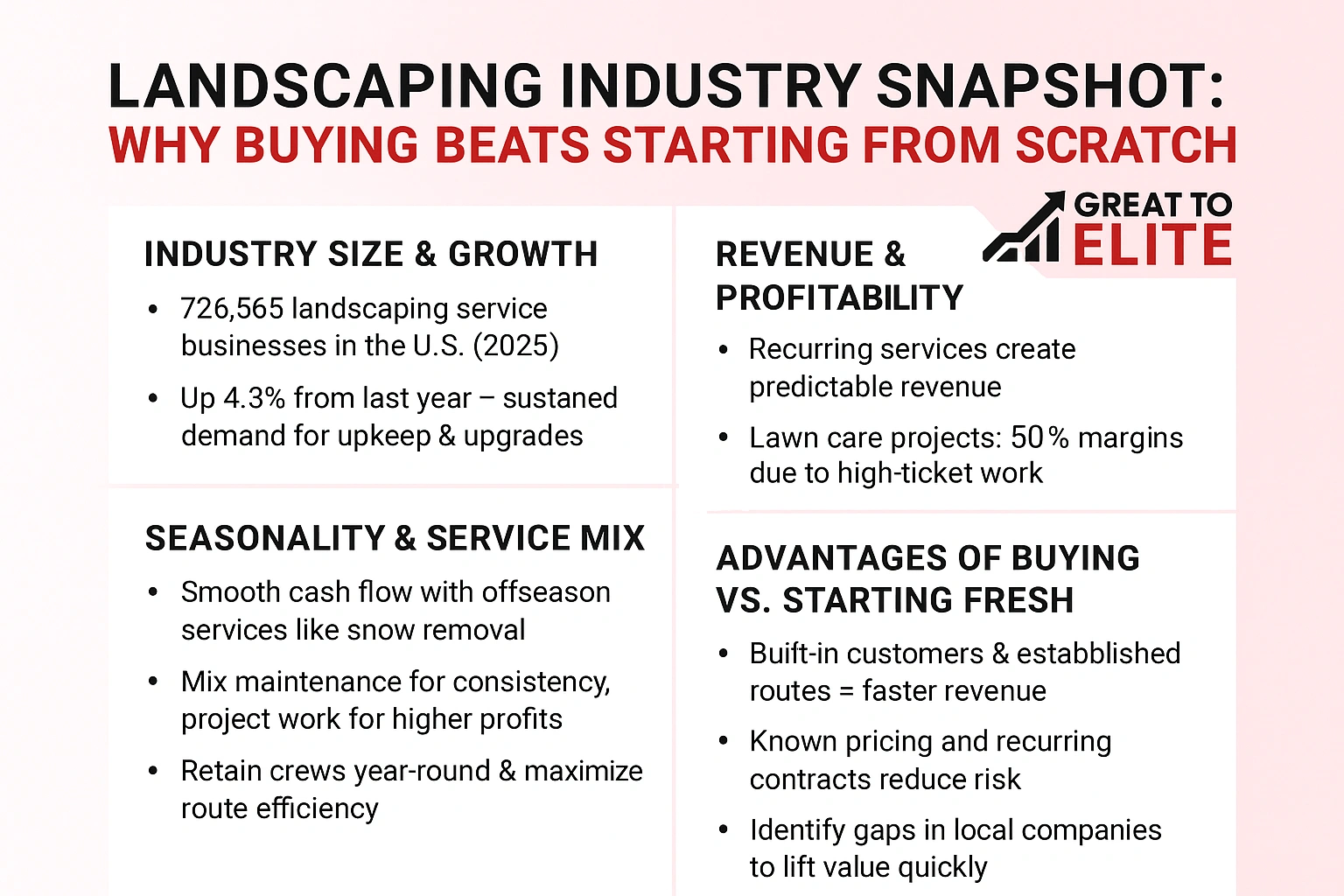
The market for established lawn and exterior services offers clear revenue paths and built-in customers. In 2025, there are estimated to be 726,565 landscaping service businesses operating in the U.S., up 4.3% from the previous year. That pattern signals sustained demand for upkeep and upgrades.
Recurring work, weekly maintenance, fertilization, pest control, and irrigation checks, creates predictable revenue that compounds as routes fill. Profitability varies by offering: lawn care margins often sit in the mid-teens to 40%+, and hardscape projects can exceed 50% because of higher ticket sizes.
Seasonality is real, but you can smooth cash flow if you add snow removal and other offseason services. Those additions retain crews, boost annual value per customer, and reduce downtime.
Before you make an offer, set a clear buyer strategy that links local demand, capital, and crew capability. This step frames which targets fit your timeline and skills.
Quantify demand, and map neighborhoods and commercial corridors. Check pricing, route density, and visible service gaps. Scout competitors online and on the ground to see who wins repeat work.
Choose the model that matches your strengths. Lawn care routes emphasize efficiency and volume. Full-service adds project margins but needs varied equipment. Commercial focus relies on contracts and steady payments from commercial clients.
Validate seller reasons beyond the P&L. Retirement often signals smoother transitions. Personal finance issues may need earn-outs or protections. Watch for new, well-funded companies expanding quickly; they can threaten customer retention.
When writing offers for buying landscaping business targets, present credibility while keeping flexibility for diligence findings. A strong thesis protects value and steadies the customer base after close.
Financial verification is where deals live or die. Due diligence when buying a company requires demanding complete records and using them to build a factual earnings picture you can trust. If the seller resists or provides fewer years without a clear reason, treat that as a red flag, as skipping this step can hide liabilities, inflate earnings, or mask operational issues that could cost you after closing.
Request at least five years of tax returns, billing exports, expense ledgers, AR aging, and full bank statements. Reconcile sales deposits to bank activity and look for timing gaps or one-off inflows.
Segment profit by service line. Lawn care margins often run 15–45%; hardscape work can exceed 50% because tickets are larger. Verify contract terms, renewal clauses, price escalators, and customer concentration.
Walk or drive target neighborhoods and combine that with search results to reveal true market leaders. Field observation paired with local search gives a clear picture of who wins work and why.
Create a competitive map and note frequent crews, truck signage, and service patterns. Cross-check those finds with local search rankings and social listings.
Flag new entrants with modern equipment and capital; they can pressure pricing and change route economics fast.
Review online ratings, response quality, and BBB entries for patterns that indicate recurring issues.
Cross-check internal records for customer tenure and customer retention to confirm reviews match real loyalty and value.
Inventory and machines define much of the real value you inherit when a route or company changes hands. Get a line-item list with serials, purchase dates, usage levels, maintenance logs, and any active warranties before you sign.
Separate owned items from leased ones and summarize lease terms so you know which obligations follow the sale. Verify titles, keys, manuals, and digital records during diligence.
Match the included equipment against current services and route volumes. Flag gaps that could slow crews or raise liability and estimate near-term replacement capex for planning.
Negotiate price adjustments or holdbacks if condition or missing items reduce perceived value. A clean asset handoff keeps routes running from day one.
Careful sequencing of legal, financial, and operational tasks shortens close time while protecting revenue and value. Your LOI should state price, key terms, exclusivity, and clear contingencies that allow adjustment after a Quality of Earnings (QoE) review.
Define what counts as earnings and which months are seasonal outliers. Commission a QoE that isolates recurring sales, verifies margin drivers, and confirms customer concentration.
Use the QoE findings to finalize the purchase price, any holdbacks, and the Final Investment Decision checkpoint.
Compare SBA loans, investor equity, and private capital for speed, cost, and covenant flexibility. Tie your 12–24 month operating plan to lender requirements and show clear paths to profit growth.
Align working capital with collections and payables so the company never faces cash shortfalls during slow months.
Inventory required licenses, permits, and insurance for your state and municipality. Confirm assignability of customer, vendor, and lease agreements to avoid service interruptions.
Define seller support and training periods, and include non-compete and non-solicit language that protects value while you step into leadership. Sequence legal, financial, and operational tasks so you compress time without sacrificing diligence quality.
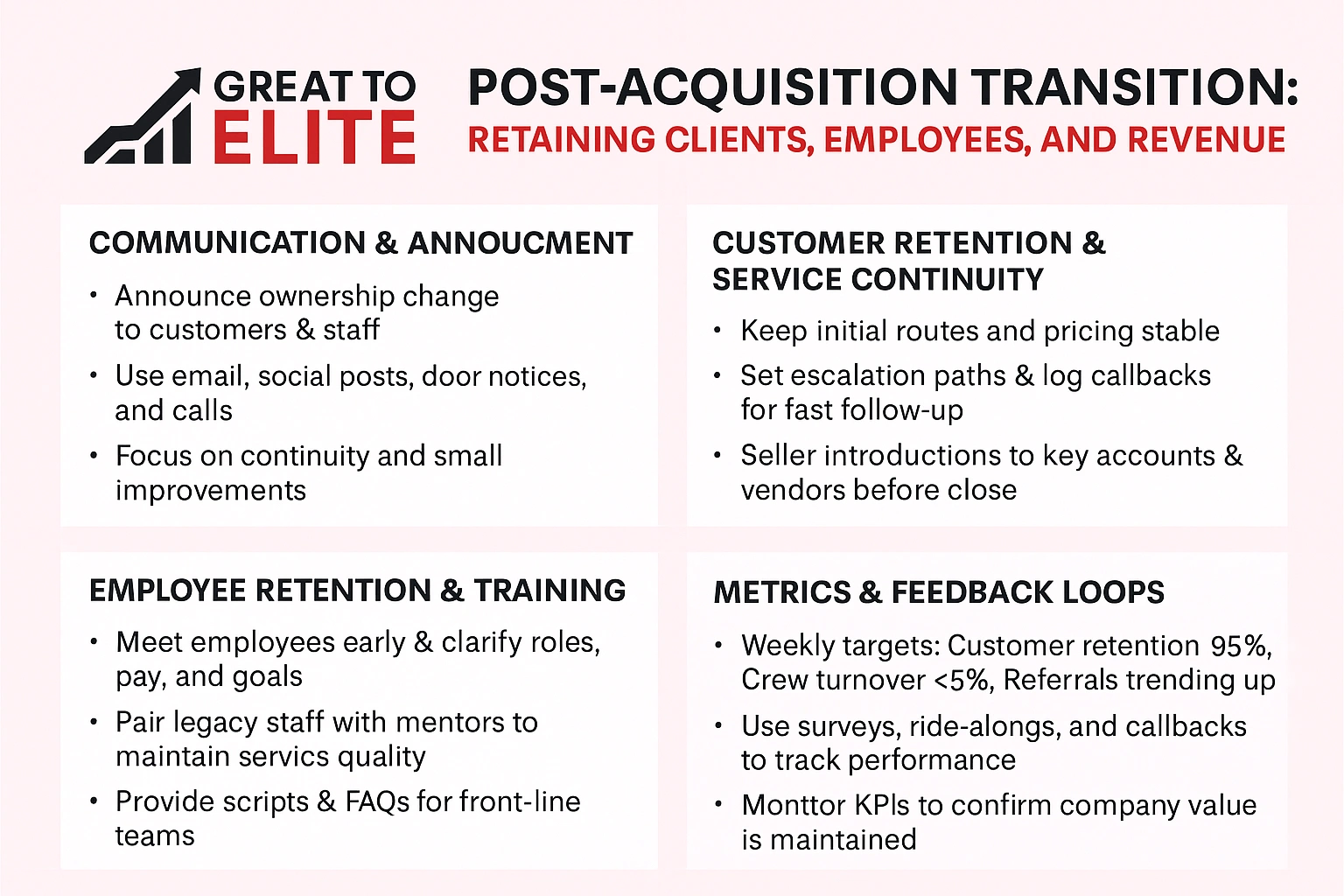
A smooth ownership change preserves revenue and keeps crews working without major interruption. Announce the change directly to customers and staff, focusing on continuity and small improvements you will make. Use email, door notices, social posts, and phone outreach so nothing is missed.
Meet with employees early. Be transparent about roles, pay, and short-term goals. Offer quick training and pair legacy staff with mentors to keep service quality steady.
Equip your front-line team with scripts and FAQs. Teach CSRs how to reassure clients, confirm schedules, and present any value-added services you plan to add.
Transfer licenses and insurance promptly and align scheduling systems and routing apps the first week. Reinforce brand signals across uniforms, trucks, and invoices so the company looks consistent.
Map feedback loops: surveys, supervisor ride-alongs, and callbacks. Track retention, referrals, and crew stability weekly to confirm the company is holding value while you make measured improvements.
Stabilize cash flow, expand your service catalog and tighten operations. Add high-value offerings that smooth seasonality and lift average ticket. Snow removal, pest control, and irrigation checks help keep your crew busy in slow months and protect annual revenue.
Introduce snow removal and winter programs paired with preventive pest and irrigation inspections. Price packages so recurring clients see clear value. This approach preserves staff, reduces bench time, and increases overall profit.
Audit your CRM, scheduling/routing, accounting, and field apps. Choose scalable systems that share data and cut double entry. Unified workflows improve dispatch accuracy and speed cash conversion from estimate to invoice.
Great to Elite helps operators turn acquisitions into predictable, local growth engines. You get practical frameworks that match local markets and crew realities.
Our support covers deal readiness and due diligence, plus field-ready transition playbooks that protect revenue the day you take over an existing landscaping business.
To get started, book a call with Great to Elite. We will review your goals, evaluate your target or existing landscaping business, and map next steps that accelerate value for your team.
Taking over an existing operation hands you routes and systems; your priority is preserving and improving them.
Prioritize clean financials, durable contracts, and verified equipment condition before signing. Test customer tenure and referral patterns so service continues day one.
After close, focus on clear communication, employee safety training, and measured KPI tracking for job quality, average ticket, and crew utilization. Add seasonal services and targeted upsells to smooth revenue.
If you’re ready to buy landscaping and scale responsibly, revisit your thesis, align financing, and move from LOI with a tight integration plan. Great to Elite can help you shortlist targets and preserve value through close and beyond, get started when you are ready.