How to Buy a HVAC Business: A Comprehensive Guide
How to Buy a HVAC Business: A Comprehensive Guide

Natalie Luneva
December 8, 2025




When you buy a HVAC business, you need to evaluate far more than the asking price; you’re buying technicians, maintenance agreements, brand reputation, equipment, operational systems, and a revenue cycle that changes with the seasons.
To buy a HVAC business, define your acquisition criteria, including service mix, target territory, residential vs. commercial focus, and the minimum amount of recurring contracts you want in place. From there, you analyze financials for true cash flow, checking how many customers are on long-term service agreements, how much revenue depends on new installs vs. maintenance, and whether labor costs are stable or inflated.
You also need to assess licensing needs, technician skill levels, dispatching systems, fleet condition, supplier relationships, and whether the seller is willing to provide a transition period that protects customer retention.
Acquiring an existing company accelerates wealth creation because you inherit technicians, active customers, and proven systems.
Success hinges on aligning target criteria, running disciplined diligence, and structuring financing that fits seasonal cash cycles.
The interplay of replacement timelines and emergency calls underpins steady work in this sector. Residential systems typically last 12–15 years, which creates a predictable stream of replacement demand. That cadence pairs with urgent service during heating and cooling peaks, as the U.S. HVAC industry is projected to grow from $17.15 billion in 2024 to $26.93 billion by 2032, driven largely by rising demand for maintenance and replacement services.
Residential demand spikes around seasonal extremes and equipment age. Home owners call for repairs, replacements, and efficiency upgrades.
Commercial cycles often follow lease, retrofit, and construction calendars. Projects can be larger but more lumpy than home service work.
Heating and cooling seasons create clear demand windows. Emergency repairs sustain technician schedules even in slow markets.
Energy-efficiency upgrades and maintenance plans add off-season work and cross-sell opportunities in the home market. Diversified job mix and service agreements level revenue swings and protect cash flow during downturns.
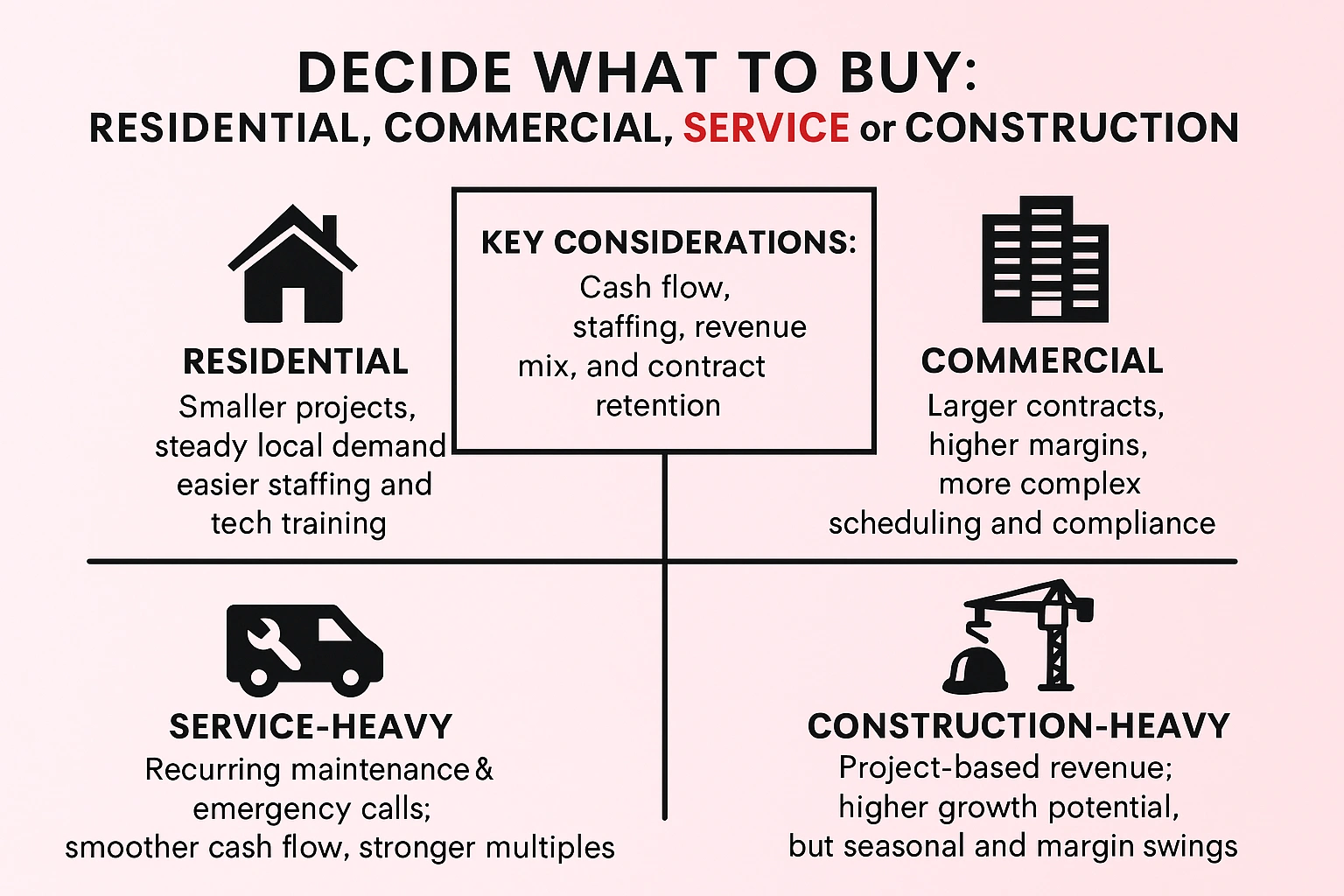
Picking the right segment shapes cash flow, staffing, and growth. Decide whether your target will lean residential or commercial, and how much of the revenue will come from service versus construction.
Service-heavy firms generally deliver steadier cash and stronger multiples. Recurring maintenance plans, emergency calls, and repeat customers smooth seasonality and raise long-term value.
Service work tends to be higher margin and less tied to economic cycles. That puts predictable revenue on the P&L and gives you pricing power through response times and contracts.
Construction revenue can boost top-line growth but brings backlog risk and margin swings. During slow markets, project pipelines can dry up and valuations are often discounted.
Valuation hinges on normalized earnings and market multiples that reflect operational strength. Convert reported pre-tax results into Seller’s Discretionary Earnings (SDE). SDE includes pre-tax income plus owner pay, interest, depreciation, amortization, and one-off adjustments.
Normalize payroll and discretionary expenses so the number shows true cash flow for an incoming owner. Add back owner compensation and non-recurring costs. That gives you the baseline profit figure you will value.
A company with $600,000 SDE often begins near a 3.5x multiple before adjustments. Multiples rise with strong service mix, deep leadership, low customer concentration, and modern systems.
Review FF&E and rolling stock condition. Material equipment value relative to price reduces downside risk and can justify a higher offer.
Brand moat, local reviews, referrals, and organic presence, supports demand durability and can lift multiples when documented.
Use sensitivity runs around concentration, margin trends, and maintenance plan retention to refine your price range. Document the add-backs and assumptions so you can defend valuation during negotiation with clear, data-backed rationale.
Start with a concise roadmap that turns intent into monthly cash flow and reliable field operations. Use a thesis that favors service-heavy profiles, strong culture, and durable margins.
Define geography, revenue range, SDE targets, service agreements, and the leadership bench you will inherit. Screen for seasonality fit and contract depth before outreach.
Move from verbal offers to an LOI with timelines, exclusivity, and data access. Run focused diligence across financials, ops, legal, and HR with clear pass/fail gates.
Plan financing that blends an SBA loan, a seller note, and a line of credit so payroll and parts are covered during shoulder seasons.
The due diligence when buying a company starts with a focused checklist that uncovers earnings quality, operations risk, and customer stability before you commit. Use short, testable gates so critical issues are found early.
Scrutinize the P&L and a QoE report to confirm reported profit and cash conversion. Map revenue by maintenance, repair, retrofit, and construction to spot margin shifts.
Model seasonality and working-capital needs. Verify job costing and gross-profit trends for the last three years.
Check licenses, certifications, dispatch systems, and the experience of technicians. Rate training cadence and leadership depth as retention indicators.
Quantify service agreements, count maintenance plans, and measure retention and average ticket. Assess customer concentration and referral sources.
Review online presence and local reputation as a marketing moat that supports ongoing value.
Your funding plan will decide how quickly you can stabilize operations and invest in growth. Choose mixes that match seasonal cash flow and the company's asset needs. Plan conservatively so parts, payroll, and training are covered in slow months.
SBA loans offered favorable terms for small business purchases, but they required equity injections and detailed paperwork. Lenders reviewed tax returns, SDE support, and personal covenants.
Expect longer underwriting timelines and appraisals. Prepare a clean package with add-backs and clear SDE justification so the process moves faster.
Seller notes can reduce upfront cash needs and align incentives. Structure payments with performance milestones or interest-only periods to ease early cash strain.
Negotiate terms that protect you if revenue drops, such as caps on acceleration and clear cure periods for missed payments.
Use bank term loans or equipment financing for vehicles and tools at predictable cost. A separate line of credit smooths seasonal dips and covers parts inventory.
Layered financing, SBA, seller, and a line of credit, let you fund stability and investments. Run sensitivity models for cost and cash, and prepare lender-ready financials to speed approval. Great to Elite can help align financing choices with integration and growth plans.

Final offer terms should separate core company value from inventory and receivables. That clarity prevents surprises at closing and keeps negotiations focused on what really drives value.
Translate your valuation into an enterprise price plus working capital. Use an inventory true-up at closing so physical parts and spare vehicles match the agreed figure.
Normalize trailing earnings for seasonal swings and set timing for counts and AR verification. For companies with heavy construction work, discount the enterprise price or tie part of the funds to future project conversion.
Use earn-outs when maintenance plan retention or backlog conversion is uncertain. Link payouts to measurable KPIs like retention rates or revenue from converted backlog.
Manage timelines tightly so diligence findings convert into targeted terms rather than reopening the entire negotiation. Maintain rapport with the seller and work collaboratively to close the deal. Great to Elite can help structure these levers so you protect cash and preserve customer trust.
Legal clarity at close keeps technicians working and customers served from day one. Focus on practical checks that prevent interruptions and shift liabilities cleanly.
Verify the company holds required state and local licenses and permits for hvac services. Confirm certified refrigerant handling, disposal procedures, and energy regulation compliance for installed systems.
Use a Transition Services Agreement that spells out owner availability, timelines, and knowledge-transfer milestones. Negotiate a reasonable non-compete and non-solicit that protects territory and customer lists while remaining enforceable in your state.
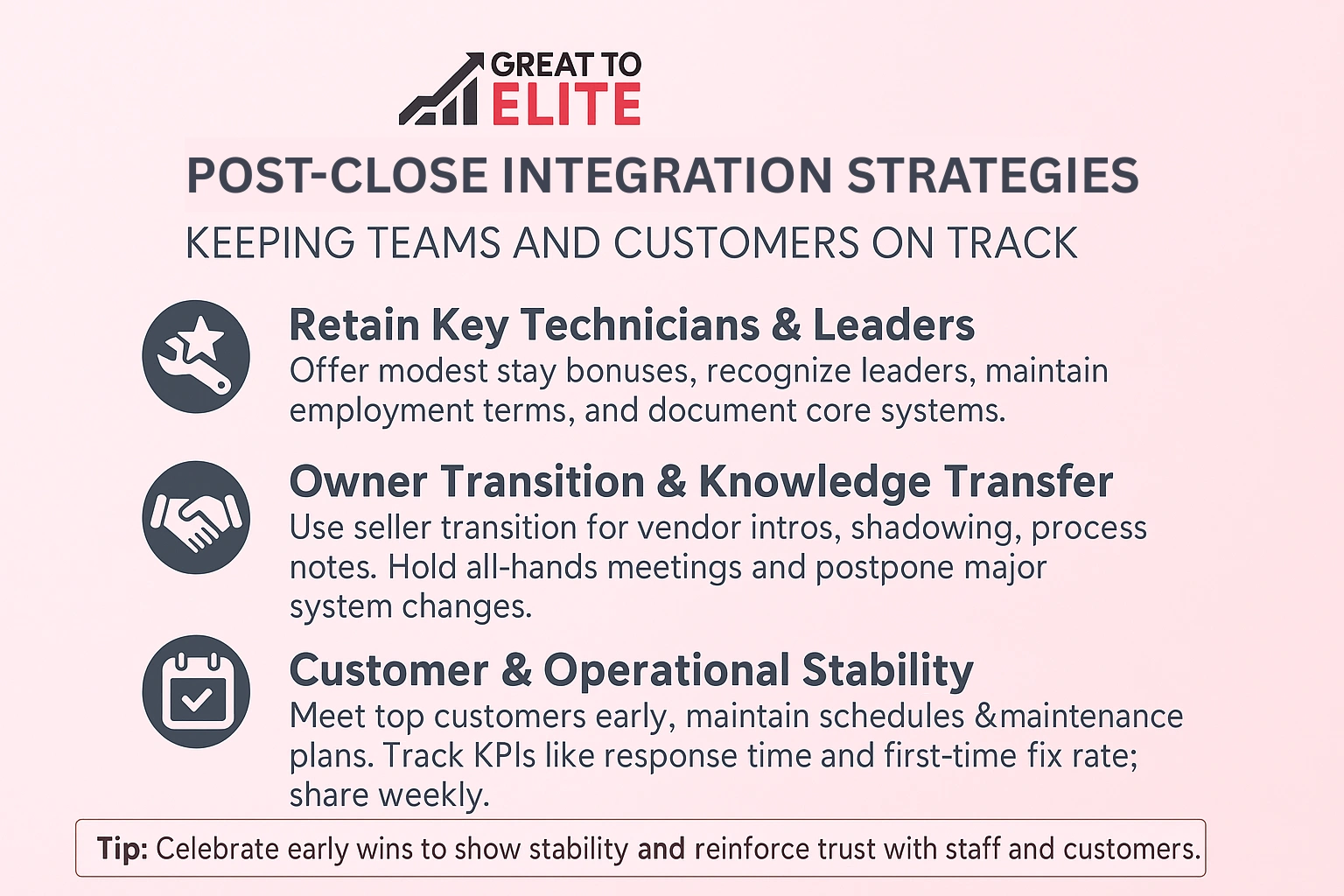
After closing, your first priority is keeping field teams steady while customers see no drop in service. Early stability reduces churn and preserves revenue.
Prioritize retention with modest stay bonuses and clear career paths. Recognize frontline leaders publicly and meet technicians on the truck for ride-alongs.
Keep employment terms steady in the short term and document core systems so everyone knows what stays the same.
Use the seller’s transition period for vendor introductions, process notes, and shadowing. Hold an all-hands meeting in the first week to set expectations and invite feedback.
Postpone big systems changes until trust is built. When upgrades roll out, pair them with training and show practical benefits for employees and customers.
Safety and quality checks should be non-negotiable. Regular inspections protect employees and customers and reinforce professionalism in all work. Clear, respectful communication combined with practical support keeps your new team focused on service and steady operations.
Growth plays here emphasize repeatable service offerings, energy upgrades, and targeted outreach. These levers raise predictable revenue and improve customer lifetime value when executed with clear scripts and capacity planning.
Design service contracts that bundle tune-ups, filter swaps, and priority response. Clear pricing and renewal reminders lift retention.
Train technicians to sell plans on visits. That builds steady cash and smooths seasonal swings for home and commercial work.
Teach teams to present savings from efficient systems and available rebates. Show simple payback examples and comfort benefits.
Price retrofit options to balance initial cost, monthly savings, and air conditioning upgrades where relevant.
Fragmentation in local markets draws strategic and financial buyers that favor operational strength and clear growth paths. For U.S. buyers this means the pool of targets often includes small, service-led firms ripe for roll-ups.
Roll-up buyers prize recurring service revenue, documented processes, and strong leadership. Firms with predictable margins and minimal owner dependence often earn higher multiples. Clean financials and systems reduce diligence friction and increase buyer confidence.
Prepare for exit and diversify customers, tighten contracts, and build a growth pipeline that shows plan expansion and efficiency upgrades. Train a management team to run daily ops with low owner involvement.
Great to Elite partners with operators and buyers to turn acquisition plans into steady operations and measurable growth. You get a practical, stepwise approach that keeps customers and employees steady during change.
Clear acquisition strategy: sharpen your thesis, set target profiles, and build a repeatable sourcing process tailored for hvac and field services.
.webp)
Ready to move from plan to action? Book a call with Great to Elite and we will assess your goals, review opportunities, and map the fastest way to acquire or scale your hvac company.
Use this closing summary as a quick playbook for making disciplined offers and running integrations that protect revenue.
You now have a practical roadmap to acquire an hvac company with confidence, from thesis and sourcing through diligence and closing. You understand how service mix, culture, and leadership shape valuation and price.
Pick financing that fits seasonal cash flow, then prioritize technicians, customers, and scheduling in your first months. Focus growth on maintenance plans, energy upgrades, and local marketing that produce steady returns for home markets.
Finalize criteria, start conversations with owners, and keep timelines tight so every hour counts. If you want experienced support at each step of the way, connect with Great to Elite and accelerate your path to ownership and performance.