How to Sell a Business Without a Broker
How to Sell a Business Without a Broker

Natalie Luneva
December 18, 2025
.webp)



Selling a business without a broker means running a direct, owner-led sale where you control the process, the negotiations, and the final outcome. Instead of paying a commission, you handle the core steps yourself: preparing your financials, valuing the business realistically, packaging it for buyers, marketing the opportunity, screening inquiries, negotiating terms, and closing through an attorney and escrow. It’s a lean, transparent approach that works when you’re organized, understand your numbers, and can communicate the value of the business clearly.
Great to Elite acts as a focused marketing partner: we promote your listing for a monthly fee and send buyer leads while you handle negotiations directly. That model keeps confidentiality tight and fees low, and it speeds the overall sale process.
In this approach, short outreach to natural buyers, quick NDA execution, a right-sized CIM, and a clean data room move talks fast toward LOIs. You’ll also learn how non-price terms, employee protections, customer continuity, PR plans, and TSAs, often unlock more value than minor price tweaks.
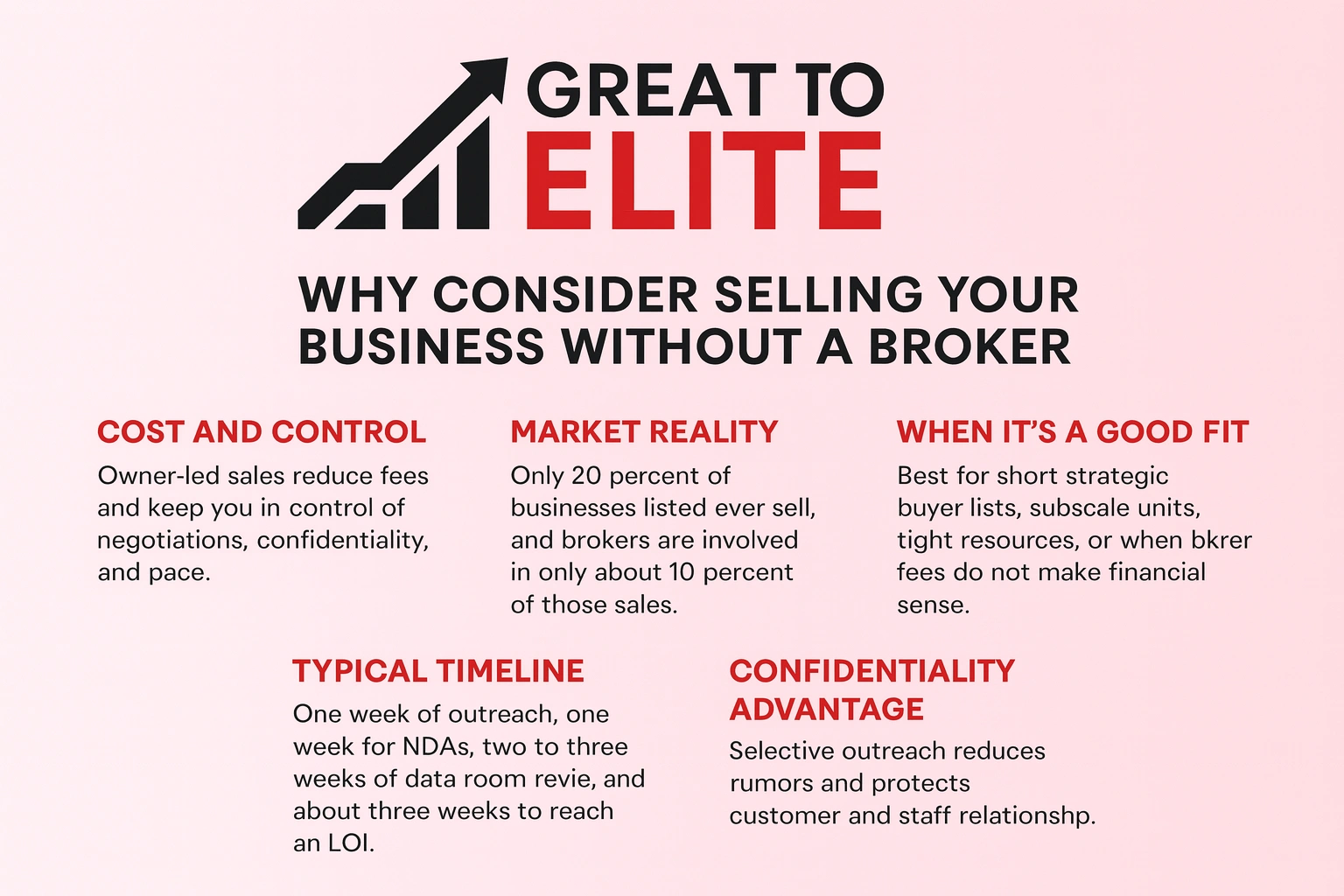
If your resources are tight or the unit is subscale, running an owner-led sale can cut costs and speed outcomes. You keep control of calls, confidentiality, and negotiation tone. Great to Elite supports this path ad amplifies outreach for a monthly fee while you handle deals directly. This is not a broker model. Only about 20% of businesses listed for sale ever sell, and business brokers are involved in just around 10% of those deals, meaning many owners either sell themselves or don’t sell at all
Weigh the trade-offs. You gain lower fees, tighter discretion, and faster decision cycles. You also accept the work of finding and vetting buyers and managing diligence.
Before you start outreach, take a clear inventory of what you want from this transaction and why. Write down motives, timing, and what success looks like beyond the check. This keeps you in control during every negotiation and decision.
Describe the buyer fit you value: product adjacency, customer overlap, operating capability, and appetite for integration. Prioritize cultural alignment as much as price. Create a short scorecard to rank buyers on readiness, financing, cultural match, and willingness to meet non-price priorities.
List red lines: no large benefit cuts for 12 months, customer pricing stability for year one, and seller-friendly PR framing. Map post-close needs, licenses, data access, limited TSAs, and realistic knowledge-transfer windows. Set your valuation range and an acceptable floor informed by shutdown costs so you can act quickly when offers arrive.
Set a realistic asking price and triangulate market signals, income forecasts, and asset replacement costs. Use three simple approaches so you can pick a defensible target that fuels outreach rather than stalls it.
Compare recent comps in your market to see what similar companies fetched. Then run an income approach: a discounted cash flow or multiple of EBITDA gives forward-looking worth. Finally, list tangible assets and stranded costs for an asset-based floor.
If buyers and your expectation differ, bridge the gap with terms. Offer earn-outs tied to performance, limited seller financing, or priced TSAs that turn stranded costs into recurring revenue.
Keep price expectations pragmatic. Overpricing repels qualified buyers; underpricing leaves value behind. Use a one-page valuation memo with comps, multiples, and rationale to set clear expectations early.
Set a clear, accelerated calendar that protects your team's time and moves talks forward. Use a six- to ten-week baseline so you know when decisions must land and when to reallocate effort.
Start with outreach in week 1, NDAs in week 2, data room review in weeks 3–5, and LOIs in weeks 6–8. Keep confirmatory diligence tightly scoped after LOI and aim for quick close windows.
Set a firm LOI deadline that concentrates buyer attention and clarifies required non-price priorities. Gate information releases: NDA, LOI, escrow readiness. This reduces scope creep and speeds the review for businesses that must conserve time and cost.
Plan fallback paths. If interest stalls, pause, refine materials, and expand your list. If interest spikes, run a short competitive mini-process. Decide where Great to Elite can compress outreach and run targeted marketing in parallel with your direct calls.
Shape concise materials that protect sensitive items while answering buyer questions fast. You control disclosure: Great to Elite promotes your listing but does not share sensitive materials or negotiate. Build materials that move the sale forward without exposing customers or trade secrets.
Create a one-page teaser that highlights the value proposition but avoids customer names and pricing. Right-size a CIM using existing financial and management decks so you save time and provide what buyers expect.
Standardize a short NDA that is practical and quick to sign. Excessive edits often signal low seriousness and waste time. Stage access: teaser first, NDA second, then data room for qualified prospects.
Structure three core folders: financials, operations, and legal. Include reconciled statements, revenue proofs, SOPs, KPIs, contracts, and IP logs. Configure analytics and payment reports for read-only review.
Make sure you keep version control of included assets and maintain a clear list of excluded items. This reduces negotiation time and eases drafting later agreements.
Map who gains most from your products and where natural strategic fits live. That list becomes your outreach backbone and keeps effort focused on high-probability prospects.
Use suppliers, partners, former inquirers, and industry executives as first contacts. Add banker referrals and internal teams for names that match product and customer adjacency.
Build a short list of natural buyers and rank them by fit, urgency, and cultural match. This saves time and reduces needless disclosures.
Call funds and corporate development groups directly. Private equity screens deals daily; a clear teaser and brief call often gets attention without third-party commissions.
Balance confidentiality with demand creation and use targeted emails and calls rather than public listings. Great to Elite markets your listing for a monthly fee while you keep all buyer conversations and negotiations direct.
Define the minimum proof you need before spending management hours on any potential buyer. You own qualification: Great to Elite may deliver leads, but you decide who advances and you run all discussions directly.
Ask for proof of funds or lender pre-approval early so you don’t waste time. Serious buyers move quickly on NDAs, confirm meeting slots fast, and outline a path to an LOI.
Watch legal spend: buyers who engage counsel and are willing to cover limited diligence costs show commitment. Listen for integration questions and operational specifics; these indicate intent rather than casual market research.
Prioritize practical terms that limit distraction and speed closing timelines. You lead all negotiations; Great to Elite does not participate in bargaining and does not act as a broker.
Use an LOI as a clear roadmap. Make sure it shows economics, structure, exclusivity length, diligence scope, and a target date for definitive documents.
Keep exclusivity short and milestone-based to maintain pressure and momentum.
Negotiate TSAs that list exact services, SLAs, market-based pricing, and finite terms. TSAs can turn stranded costs into short-term revenue and cut distraction during handover.
Protect people with benefit and pay stability for 12 months. Safeguard customers with pricing holds, continuity plans, and escalation routes.
Trade modest price moves for cleaner reps, fewer legal risks, and simpler closing mechanics. Capture agreed points in a term sheet or LOI addendum so drafting the definitive agreement is faster.
Finalize clean paperwork early so closing day is a checklist, not a scramble. Most small transactions use an Asset Purchase Agreement (APA). You and your counsel must draft clear definitions of included assets, assumed liabilities, and closing conditions.
Negotiate the APA with precise schedules for assignments, vendor consents, and license transfers. Include a brief LOI or letter intent that frames price, earnest money, and exclusivity before you draft the final agreement.
Route funds through reputable escrow that releases cash after agreed deliverables and confirmations. It’s common to hold domain transfer until escrow confirms conditions are met.
Great to Elite markets leads only; you execute documents directly with your counsel. Keep management exposure limited and use staged sign-offs for handover calls.
Confirm tax impacts, asset versus equity treatment can change valuation and net proceeds. Discuss this with your CPA before locking price or structure.
Plan a short true-up window to reconcile trailing revenues and expenses that post after closing. Update regulatory registrations and licenses promptly to avoid service interruptions.
Archive the data room and set retention policies for legal and tax records. Debrief your team to capture lessons and finalize PR aligned with agreed messaging. This keeps your m&a path tight and reduces surprises for the buyer and your company during the sale process.
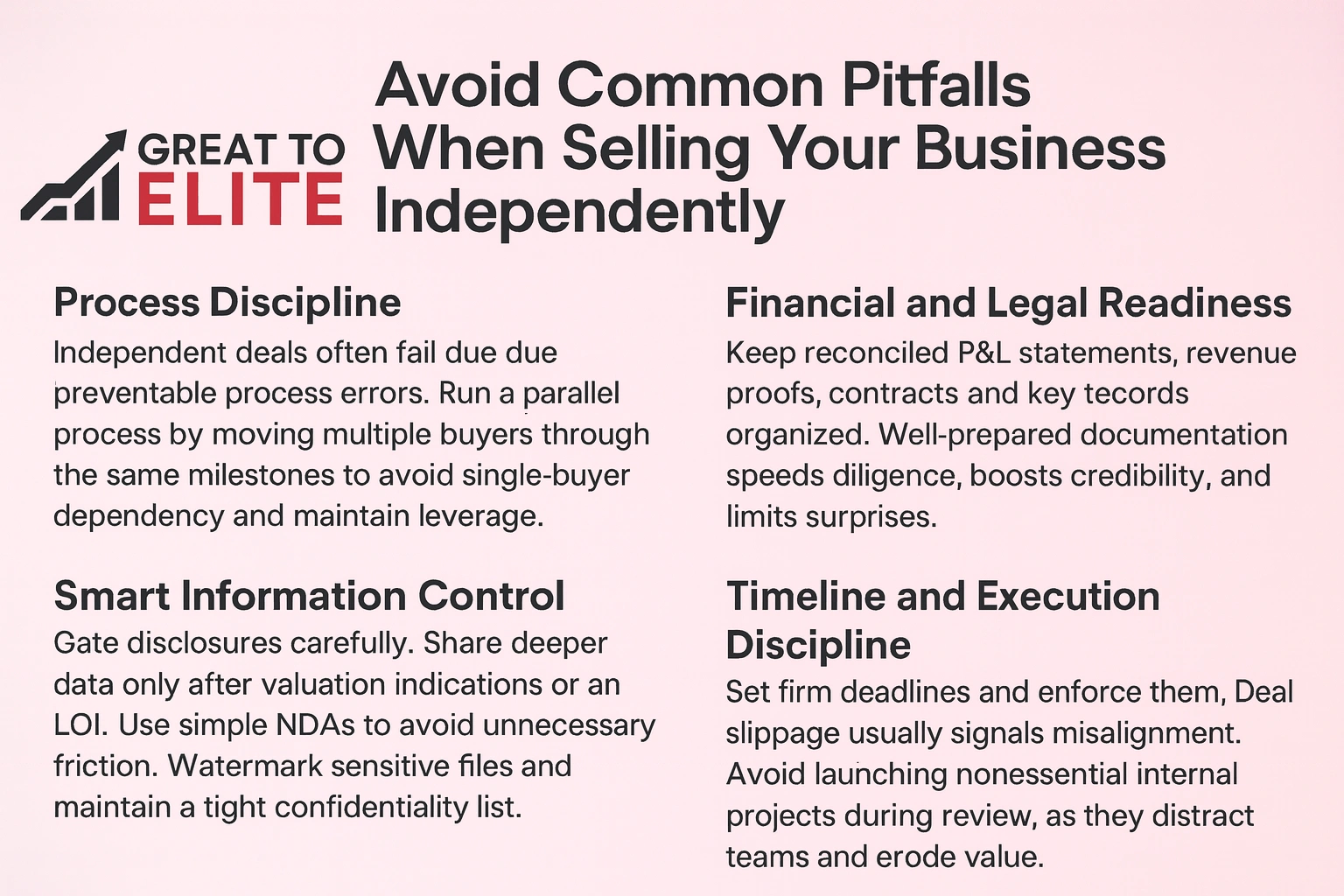
Independent deals often fail not from market weakness but from predictable process errors you can prevent.
Focus on parallel engagement: move multiple buyers through the same milestones so you avoid single-buyer risk. That keeps leverage and shortens timelines.
Keep records tidy. Reconciled P&L statements, clear revenue proofs, and organized contracts make diligence fast and credible.
Gate disclosures. Grant deeper data only after valuation indications, an LOI, or legal engagement. This limits scope creep and protects operations.
Calibrate valuation early so you spend time only with aligned parties. If costs or distraction mount, plan a fallback, pause the process or use targeted marketing help like Great to Elite to widen the funnel without complicating your workflow.
Great to Elite amplifies your outreach with targeted campaigns that keep you in command of conversations. We promote your business listing to channels that reach likely buyers and send qualified leads straight to your inbox. You retain negotiation control and full confidentiality at every stage.
Our monthly marketing package bundles placement, message testing, and reporting. You choose the buyer profile and timeline milestones we align campaigns to. That keeps outreach focused and saves you time on prospecting.
For lean divestitures, this approach boosts reach without complicating diligence or legal flows. You keep multiple buyers engaged and control exclusivity windows. We handle marketing; you handle the sale.
Ready to see a sample outreach plan and pricing? Book a call and we’ll map a short campaign that targets strategic and financial buyers for your business without broker involvement.
Close with confidence: center the final phase on staged disclosures, proof of funds, and clear non-price protections for people and customers.
Run the disciplined process that reaches LOI in weeks: targeted outreach, tight NDA/CIM/data room flow, early valuation signals, and focus on TSAs and employee safeguards. Keep control from outreach through the agreement and escrow steps.
Use market-informed valuation and firm timelines to attract the right buyer and speed the deal. Great to Elite can boost qualified interest with a monthly marketing package while you manage negotiations directly.
Ready to move? Book a call and we’ll tailor an outreach plan that brings buyers to your inbox and helps you close the sale on your terms.