Buying a Construction Company: How to Do It and What to Consider
Buying a Construction Company: How to Do It and What to Consider

Natalie Luneva
November 27, 2025




Buying a construction company is one of the fastest ways to enter the industry, or scale your existing operation, but it’s not a move you make lightly. Construction businesses are complex, asset-heavy, and deeply shaped by reputation, contracts, and relationships. The right acquisition can give you instant crews, equipment, backlog, and market presence. The wrong one can saddle you with hidden liabilities, outdated processes, or projects that lose money the moment you take over.
This guide walks you through how to buy a construction company the right way. You’ll learn what to look for, how to evaluate financial and operational health, which risks matter most, and how to structure a deal that protects you. Whether you’re an investor, an established contractor, or an entrepreneur expanding into the trades, this introduction sets the stage for a clear, confident acquisition process.
Rising project backlogs and skilled-labor shortages set the stage for strategic deals. The construction industry shows modest growth, about 4.7% from 2023 to 2033, which supports disciplined mergers and acquisitions as conditions normalize after the 2020 downturn.
Revenue gains come from steady residential work and institutional projects. Margin control and on-time delivery drive profit. Well-run firms convert higher backlog into predictable cash flow and value for investors.
Buyers pursue service diversification, for example adding concrete pours or roofing crews to remove bottlenecks. Geographic expansion leverages local relationships to win new jobs. Acquihires secure scarce field supervisors and skilled crews.
A clear match between your daily habits and the firm's needs determines whether ownership will suit you. Test leadership capacity and how much day‑to‑day involvement you tolerate. Managing bids, subs, and architects requires both field attention and office discipline.
Set a realistic time frame for integration and returns. Expect 12–36 months to stabilize operations and see outcomes from process changes.
Map personal risk tolerance to the firm's size and complexity. A streamlined firm needs hands‑on owners; larger firms demand systems management and layered staff.
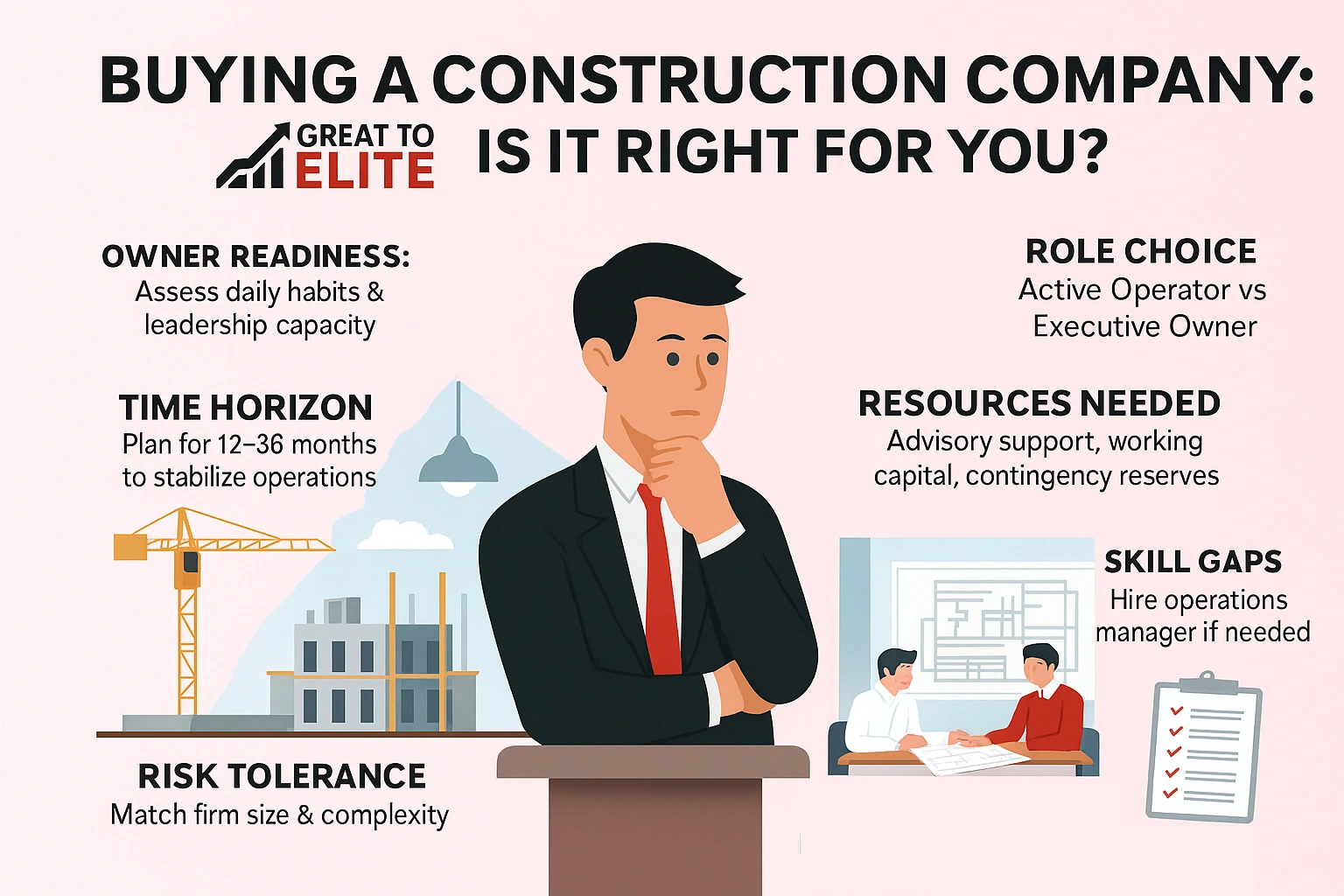
Document assumptions and the decision process to avoid emotional overreach during negotiations. Use the self‑check to confirm you bring operational discipline and financial oversight to the deal.
Before you search, gather local signals that reveal real demand and service gaps. Start with public sources: building permits, housing starts, and municipal project announcements. These help you estimate near‑term jobs and the flow of work over the next year.
Use surveys and short phone polls of local property managers and architects to test demand. Scan competitor sites and reviews to spot niche openings, for example, luxury kitchen remodels or tilt‑up commercial shells that command higher margins.
Submit test inquiries to measure response time and backlog. Fast replies often signal available capacity or strong customer service; long delays may mean full schedules or weak client care.
Build a simple scorecard: crew size, major equipment, trade partners, bonding limits, and common review themes like communication or cleanup. Use these ranks to prioritize targets where you can add clear value.
Go/No‑Go Framework: Prioritize searches where margins look healthy, niche positioning is defensible, and your team can close capability gaps within one year. Favor markets with steady permit flow, manageable seasonality, and clear service gaps you can fill.
Start your search and map every avenue where deals surface, from public listings to quiet referrals. Cover online sale boards, sell‑side brokers, and local introductions. Each source gives different lead quality and pricing dynamics.
Use buy‑side representation to move quickly. A buyer rep signals pre‑qualification and can surface off‑market opportunities that never hit public listings. That improves alignment and often lowers closing time.
Track listings and broker contacts in the same log. Add notes on response speed and exclusivity. Prioritize leads that match your size and service thesis.
Prepare a concise buyer profile and outreach pack for brokers and sellers. Include financial capacity, target size, and critical terms to increase credibility. Once you find a promising prospect, line up lenders, attorneys, and CPAs to speed diligence.
A clear valuation begins with clean financials and repeatable cash generation, not headline revenue. Choose an income or asset focus based on fleet intensity and working capital needs. For trades with heavy equipment, combine income methods with an asset‑based check.
Compute SDE by adding back interest, depreciation, amortization, owner pay, and discretionary expenses. Normalize rent, personal vehicle costs, family payroll, and remove PPP/EIDL distortions.
Smooth volatility with weighted years: 50% latest year, 37.5% prior year, 12.5% oldest year. Use that blended SDE to map to realistic pricing.
Use EV/EBITDA for larger firms with layered management and measurable EBITDA. An EV/EBITDA below 10 generally signals a reasonable market multiple in this sector.
Adjust enterprise value for equipment condition, inventory, WIP, and over/under‑billings. Treat WIP schedules and backlog as working capital drivers that can add or subtract value.
Size, specialization, recurring clients, and low owner dependence raise value. Turnarounds or heavy owner reliance reduce the multiple.
Match lender terms to project cash rhythms and owner risk. Choose sources that protect cash and fit seasonal cycle in the field. Plan for both term debt and short-term lines to cover pay‑app timing.
The SBA 7(a) can fund up to $5 million for acquiring an existing business when eligibility is met. Typical advantages are long repayment and lower monthly pressure if credit and size limits are satisfied.
Seller financing often mirrors bank loans with a down payment, interest, and set term. Use seller notes to bridge valuation gaps and keep the seller aligned after close.
Partner capital can reduce personal equity needs while adding skills. A thoughtful partner strengthens operations and raises the chance that lenders view the purchase favorably.
Link part of the price to performance with earn-outs or milestones. This reduces downside risk when backlog or margins vary.
Build a 24–36 month model that stress‑tests cash, flow coverage, and severe scenarios. Include base, downside, and recovery cases before signing.
Due diligence is the safeguard that turns promising targets into predictable investments. Start with clean records, then layer operational and people checks to protect value through the transition.
Obtain five years of financial statements, ideally monthly. Add detailed WIP reports and contract schedules to verify revenue recognition, margins, and timing.
Compare contract assets and liabilities to assess billing discipline. Contract liabilities often signal strong billing; persistent contract assets can flag collection or billing issues.
Review customer concentration, bonding limits, and surety history. Check subcontractor tenure and reliability to avoid labor gaps on live projects.
Measure turnover and role clarity. Identify any key‑person risks and require mitigations like retention pay, shadowing, or a seller stay‑on period.
Process Tip: Use a checklist, organized data room, and clear task assignments across your advisory team to make diligence repeatable and defensible.
Getting legal, licensing, and integration steps right prevents costly delays and preserves value after closing. Focus on clear ownership transfer, timely paperwork, and an actionable 90‑day plan to keep work flowing and the team aligned.
Compare stock versus asset purchases to clarify ownership transfer, liability allocation, and tax treatment for both parties.
Work with tax counsel to model outcomes and pick the structure that matches your risk tolerance and tax goals.
Spell out indemnities, representations, warranties, and escrow arrangements to handle uncovered liabilities after closing.
Validate all contractor license statuses and transferability; if a license cannot transfer, plan interim supervision or apply early to avoid downtime.
Obtain a bill of sale, updated insurance binders effective at closing, and DMV paperwork to transfer vehicle and equipment titles.
Audit equipment records for maintenance schedules, safety inspections, and asset tags to ensure continuity on active jobs.
Build a concise integration plan that maps processes, systems, and communication rhythms to stabilize operations within the first 90 days.
We prepare buyers and leaders to protect value and keep jobs moving during ownership changes.
Great to Elite helps organizations get ready for purchase and scale operations after close. We focus on clear goals, cash rhythm, and field continuity so ongoing work stays on schedule.
.webp)
Next step: If you’re preparing to purchase or integrate a construction business, book a call with Great to Elite to map capital, cash targets, and operating milestones.
Closing a deal in this sector demands methodical checks and a clear execution plan. Use five‑year financial reviews, WIP schedules, and job costing to verify the numbers that drive valuation. Anchor price decisions to SDE blends, EV/EBITDA where relevant, and equipment condition so the purchase reflects real value.
Prioritize team continuity and critical labor retention with retention pay or transition plans. Structure the sale to balance price and protection, blend debt, seller participation, and performance clauses to protect cash and align incentives.
Finally, set a 90‑day integration map, track cash, labor, and revenue weekly, and communicate early with customers and subs. Disciplined diligence and tight execution are the best ways to turn this investment into lasting value.